“The Bookman’s Tale” Response

The Bookman's Tale

I can’t remember how exactly I stumbled upon this book. I believe I saw it as I was browsing through the Barnes and Noble website (since it was one of their recommend books). The title drew me in,and the overview also got me interested enough to buy it. This book has many of the elements I like in books: mystery, historical fiction, murder, art, love, tragic love, intrigue. I thought it was well written and displayed a true love of books and book readers. I’ve been a big reader all my life, though I’ve been trying to read more books these days. I enjoy taking a whole weekend or a day to curl up with a book (preferably with the rain pouring down outside) and read it cover to cover. That is the effect this book had on me. It sort of just sucked me in on Sunday afternoon and I didn’t want to stop until I read the entire thing.

The book has three story strands, presented in alternating chapters, that all come together in the end. The first part was set in 1995 (the book’s present day). That storyline finds American Peter Byerly, a young widower trying to work through the pain of losing his wife Amanda nine months earlier. He tried to do that by running off to his cottage in England to get away. He is a book antiquarian by profession, and specializes in acquiring rare books and restoring rare books for customers. While going through books at an antique bookshop, he stumbles upon a watercolor, painted in the Victorian age, of a woman who looks exactly like his dead wife. This storyline is his investigation into the origin of this painting and identity of the woman. In the process, he gets drawn into a mystery involving an Elizabethan playbook, Pandosto, written by Robert Greene, that supposedly Shakespeare used as inspiration for A Winter’s Tale, and included written marginalia in the play that conclusively proved that William Shakespeare was the author of all Shakespeare’s plays, and not another, such as Christopher Marlowe, Francis Bacon, or the Earl of Oxford.

Peter’s modern day quest is supported by the second storyline, which is the journey of the Pandosto from 16th century England to present day that traces the origin of the Pandosto playbook and follows it through its numerous owners, and how this important treasure became lost to the world, only to re-emerge in 1995 England.

The third storyline starts in 1983 at Ridgefield University in North Carolina, and traces the love story of Peter and Amanda from how they first met at university, the deepening of their relationship, their subsequent marriage to each other, and all the way up to her tragic, untimely death. This story is not merely a mystery or a historical fiction, but also a love story. This love story helps underpin the rest of the book, because it is through the telling of Peter and Amanda that you come to understand them both and the love they shared. After all, it was the mystery of the woman’s identity in the watercolor that started Peter’s investigation. Peter’s quest originates from his need to find out who the woman in the painting is, and part of him hopes this new obsession will help him come to terms with Amanda’s death, who died suddenly at the age of 29 from complications from surgery to remove a brain tumor. I personally felt their love story was very compelling and very relatable. Peter is extremely introverted and suffers from social anxiety and really only feels comfortable in the world of books. He sees Amanda in the library and he becomes entranced by her, but she is the one who eventually  pursues him and gets him to open up. These two people bond through their shared passions and the comfort each brings the other. I personally related to this storyline, not because of how it mirrors any personal experience I’ve had, but the fantasies I’ve had about relationships. It was a relationship I could see myself in, and the characters I could see myself in. It also played to my fears that if I ever do find myself in a mutual love relationship, that one of us would die an untimely death and leave the other to grieve and carry on with life alone.

The three storylines all come together in the end, and I felt the author, tied it all together well in an engaging and believeable way. The ending sort of reminded me like the National Treasure movie or The DaVinci Code, only in the sense that a long held historical mystery is revealed, and not that there was any big chase scenes more appropriate for an action movie. This is definitely a book for book lovers, for those of us who take pleasure and refuge in books, and only wish there was more time in the day to read more books. The mystery at the heart of the book is engaging, and the ultimately tragic love story between Peter and Amanda tugged at my heartstrings, even though at the end, Peter finds himself on the road to recovery by fully integrating Amanda’s death and moving forward with life.

Getting Filthy/Gorgeous at the Boryeong Mud Festival 2013

Boryeong Mud Festival title picture

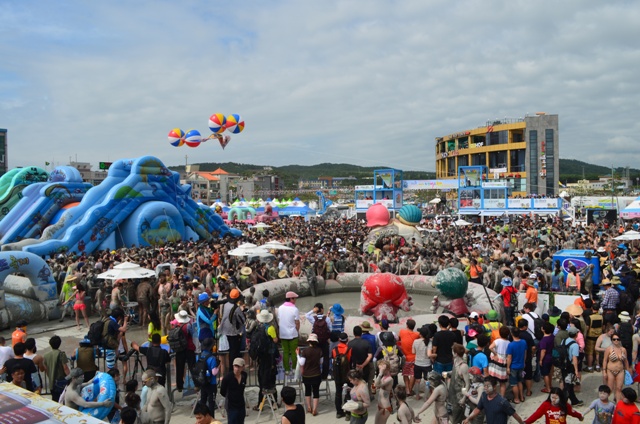
The Boryeong Mud Festival is held in South Korea every year for roughly the last two weeks of July. It’s supposed to be one of the biggest festivals South Korea offers, and in particular it is very popular with foreigners. Based on my experience, I say both of those statements are absolutely true. The mud festival is held on Daecheon Beach which is about a two and a half hour train ride (or drive if you are bold enough to drive in South Korea-I’m not) south of Seoul. It is extremely convenient to reach, because there are numerous trains leaving daily from Yongsan Station for Daecheon. During the festival, there is a bus from the train station to the beach approximately every 10 minutes, and it is roughly a 20 minute bus ride to the beach and festival site. The centerpiece of the festival is the Mud Play Zone at Mud Plaza. Surrounding the plaza are a variety of different experience booths, and all of this is set right next to a very large, popular sandy beach. The mud play zone is actually divided into two areas: the paid zone and the family zone. Both of them charge admission to enter. However the family zone is for families with kids the age of 13 and younger, and the paid zone is for those over the age of 13. The play times are divided into two blocks of time: the morning session of of 9:30-13:20 and the afternoon session from 14:10-18:00. I bought an all day, adult ticket and that cost me only 10,000 won (less than $10 USD). It’s a lot of fun, but just be prepared for crowds, long lines, and most of all, to get EXTREMELY muddy if you so desire (trust me, you do).

Boryeong Mud Festival morning session

Boryeong Mud Festival morning session 2

me clean before all the dirty fun began

me clean before all the dirty fun began

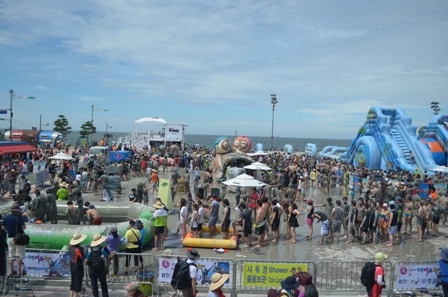
If you would rather play with fewer people, I highly recommend the morning session. The pictures above are from the morning, and as you can see in my later pictures, there aren’t QUITE as many people in the morning as there are in the afternoon.

Boryeong Mud Festival huge slide

The mud play zone consists of large, inflatable, bouncy mud slides, a small mud pit, a large mud pit, a mud prison to trap clean people inside and throw mud at them, and a few pair-oriented mud obstacle courses. All of this is set up in the adult equivalent of a bouncy castle. The family zone has roughly the same setup, only it is scaled down for children. This is definitely a time it is easier or better to go with a pair or a group of people, just because it probably does enhance the fun to play with someone else, plus the fact that some of the fun is targeted toward pairs. I went by myself, but it was still a lot of fun.

Boryeong Mud Festival crazy mud pit

Let the muddy games begin at the afternoon session

Boryeong Mud Festival me muddy

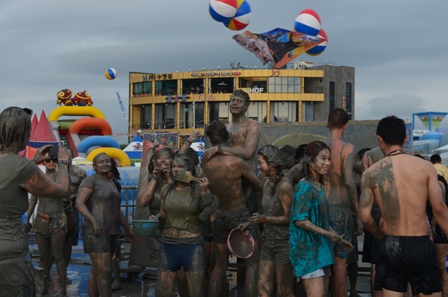
You can get as muddy as you want, and as you can tell from the above photos, I got pretty freaking muddy. I was covered in mud from head to toe. It’s like playing in one big mud puddle. The afternoon session was a bit crazier than the morning session. It was so much more crowded, to the point where the groups of people were pushing their way in past security. The lines were longer, and the people definitely were drunker. While food, drink or alcohol aren’t allowed in the play zone, there was plenty of booze to be had in the surrounding stores beforehand (plus whatever individuals brought with them), and the groups of young people definitely were partaking (often in very large bottles of booze).

Boryeong Mud Festival muddy festival goers

Boryeong Mud Festival crowd dancing

Boryeong Mud Festival crowd dancing spray

While the Boryeong Mud Festival is geared toward all ages, at times, it definitely felt like Spring Break: Daecheon Beach. Like I mentioned, this is a very popular festival with groups of twentysomethings. They are there to strip down (to tiny swimsuits, not naked-this is Korea after all), booze up, get muddy and dance on the beach. The only thing missing were the MTV cameras, though there was plenty of local press on hand capturing all the insanity. However, if that part is just not your thing, there is still plenty of fun to be had at the festival. In addition to the mud play zone, there were some experience booths like I’ve seen in other culture festivals. You can play with colored mud (in a much more controlled setting than the mud play zone). You can buy beauty products made from local Boryeong mud (in fact this festival’s origins trace to trying to promote the health and beauty benefits of the local mud and its products). You can make your own mud soap, get your face painted and just enjoy some relaxing time on the (very crowded) beach.

Boryeong Mud Festival Dacheon Beach crowd

Boryeong Mud Festival Dacheon Beach crowded

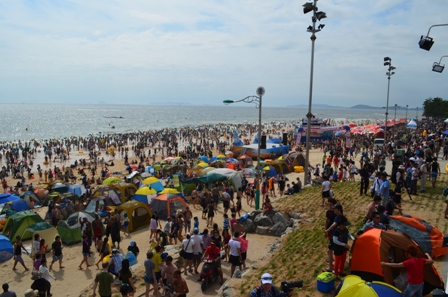
As you can see, groups of friends and families set up pup tents on the beach (for day use) to relax and frolic along the beach. The sandy beach extends for a distance in either direction. You can venture into the water, and the water temperature was pleasantly cool on the hot, sunny day I went, and it was a great place to rinse off all the mud. You can’t swim out a long distance from the shore, because the waves can be pretty powerful, and it is blocked off for jet skiers and patrolled by lifeguards. Still, it was fun to ride in the waves and relax on the beach, taking everything in around you.

In addition to the all day long mud play, the festival also hosts a number of concerts and other cultural experiences. The afternoon I was there, there as an air show performed by the Black Eagles, a South Korean Air Force unit. There are also different concerts and parties on different nights, and even though I didn’t stay since I had to catch my evening train back to Seoul, there were also fireworks on opening night.

Everything you want for the festival is all within a very small walking area. There are showers for a fee, though I warn you these are open bay showers crowded with many, many people and not private shower stalls. If you don’t mind showering, toweling off and dressing pressed up against a group of strangers, dive right in. At least the showers are segregated by gender.  There is a place to store your bags during the day for a small fee. I highly recommend you store almost everything, but carry around your wallet and phone in a waterproof case. The bathrooms on site are what you would expect from such a widely attended festival (i.e. a bit scary as the day progresses). Food and beverages are available on site, and if you choose to stay overnight, there are many hotels in Daecheon Beach. Though I recommend you book well in advance and not assume you’ll be able to walk up the day of and get a room, particularly for a beachside hotel.

This is a very enjoyable festival, and I definitely want to go back next year. I’m just thankful that the weather held out the day I was there, though you wouldn’t know it by looking at the ominous clouds gathering at the festival site in the picture below.

Boryeong Mud Festival afternoon clouds gathering

“The Interestings” Response

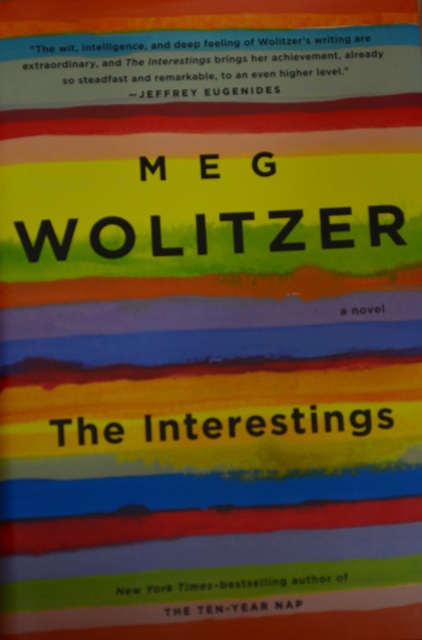
The Interestings book cover

I enjoy reading and have always enjoyed reading since I was a kid. Nowadays I go in cycles of reading a lot of books and not reading a lot of books. Sometimes I like to read books that are supposed to be “good for you”, and books that are just enjoyable for me, like crime thrillers and art world conspiracy thrillers (think “The Da Vinci Code”, but better written).

On occasion though, I read a book that touches something deep inside me, and I had that reaction when I read “The Interestings” this past weekend. Much of the book and what happens to the characters over the space of 35+ years struck a chord and I recognized some of the thoughts and experiences as similar to my own.

The author, Meg Wolitzer, just sucked me into her world through the talent of her writing and skill at weaving a non linear time throughout the book. It’s not just a matter of starting at Point A (which would have been when the characters all meet at art camp in 1974) and finishing at Point B (their lives set around present day). To me, the quality of story was like a bunch of memories. You start thinking of an experience at one time and then just start connecting that experience to other memories and how they are related. I’m probably not explaining that properly, but the storytelling felt natural to me and easy to follow. At no time did I feel that I didn’t understand what was going on or what the author was trying to convey. This story appealed to me on a deeper level, because it tells you what happens to these characters, even the fates of minor characters. I always want to know what happens to a character outside the timeline of the book. Where do they end up? What becomes of them? I have these thoughts about real people as well, even ones I don’t keep up contact. I still want to know what they did with their lives, even if it is a quick synopsis. This curiosity probably underpins most persons’ Facebook stalking and Google searches of people they used to know in real life.

The story is centered around a core group of four characters: Jules Jacobson (later Jacobson-Boyd), Ash Wolf, Ethan Figman and Jonah Bay. Also playing strong supporting roles are the characters of Goodman Wolf (Ash’s older brother) and Cathy Kiplinger. Ostensibly the book is centered around the life and experience of Jules, though at times, it cuts away to show the life and experiences of the other four characters at key moments in their lives and how they became who they are, and what happened to them over the course of their lives. These six characters meet at an art camp, Spirit-In-The-Woods, in 1974 and become friends, and the four main characters becoming lifelong friends. These kids bond over a shared love of creativity and a belief that they are inherently interesting, and deem themselves (somewhat self-deprecatingly) The Interestings.

The book follows these characters through key, formative moments in their lives, cutting back and forth from the 1970s to the 1980s, 1990s and present day. The story proceeds in a more or less timeline fashion, but it’s not purely linear, but I think that just deepens the storytelling.

While these characters share a love of art and creativity and have high hopes for their futures, that is not how it turned out for most of them. The life trajectories of Goodman and Cathy take a sharp turn on New Years Eve 1976 when Goodman is accused of raping Cathy. The courses of their lives are forever changed, and even though their experiences are not central to the group after that night (though the repercussions of that night echo through the rest of the lives of all the characters), you still check in with them periodically and see what happened to them during their lives, how it affected them, and how they managed to go on with life.

Jules dreamed of becoming a comedic actress and creating a career for herself as a character actress in theater. She studied theater in college and moved to New York City afterwards to try and build her career. Ash went to Yale and while she enjoyed acting, she yearned to be a theater director. Jonah, who was the son of a folk singer and was a gifted musician himself, gave that all up and pursued a career in mechanical engineering and robotics at MIT.

Ethan was the breakout talent from this group. At a young age, he showed a tremendous gift for drawing and animation and that gift was nurtured every summer at Spirit-In-The-Woods by his animation instructor, who was among the group of original animators for Walt Disney. He was the one who was destined to have the most commercial success in the field he most loved. Shortly after college, he did a brief stint as an animator on an adult cartoon show, before finding his own success in his own animated show inspired by his drawings and his creative inner world from when he was a child. He goes on to make millions and millions of dollars and become rather powerful in his industry. Because of the combination of his talent and his material success, he was allowed the freedom to pursue his life’s passion. He loved his work. It energized him. It made him feel alive. In many ways throughout most of the story, Ethan had the life that everyone would dream of. He fell in love with Ash and that love was returned. They enjoyed a mostly happy marriage (until the end). He got to do what he loved most in the world and he made millions of dollars doing it. But ironically (though probably not really ironically, because I imagine that the author chose this story ending for him, just to show that everybody suffers in life), his trajectory was the most tragic.

Ash is the second half of that power duo. She was beautiful, intelligent, talented and privileged throughout most of her life (though, like everybody, she too suffered her share of tragedies). After a fashion, Ash also built herself a nice career and reputation as a theater director, though she was conscious that she was able to do that, because she had her parents’ money and later, Ethan’s money to allow her the space to create her career. She never had to compromise and take a career in a field she wasn’t interested in. She was talented enough to be a director and she had the financial cushion to pursue that passion without worrying about the day to day, mundane concerns of life, like how to pay the rent, the bills or put food on the table.

Jules’ and Jonah’s stories were the most compelling to me (even though Jonah’s story isn’t the main focus of this book), just because I could relate to them so much on a personal level. Jules dreamed of being a comedic actress, but came to the realization that she was just not talented enough to build a lasting career as an actress. She worked as hard as she could. She went to acting classes. She went to open casting calls. But in the end, that wasn’t enough. There is a difference between a dream and a talent (a line from one of my favorite TV shows that stuck with me), and just because you want something so much, that doesn’t mean that you are good enough or lucky enough to ever achieve it. Sometimes, it is just the hand that life deals you. In the case of Cathy, she was a supremely talented dancer, and she loved to do it so much. But she simply did not have a dancer’s body that would allow her to dance professionally. In the case of Jules, she just simply wasn’t talented enough to build a career as an actress. So she had to figure out where her skills actually laid, and pursue  that career. In her case, she became a therapist. She may not have been the best therapist out there, but she parlayed her “funny” nature into building a rapport with her clients (patients).

Jonah was a different story. He possessed raw, natural talent for music and he loved to create music when he was a child. However, he shut that part of his life down after an unfortunate encounter with an unscrupulous folk musician who drugged him as a child and stole his musical creations and made money from them. Jonah pursued a career in robotics and technology instead. It was a career he was good at, and a career that had meaning (he built devices that allowed disabled persons to lead more independent and fulfilling lives), but he still wasn’t purely satisfied. In the end, he had to come to terms with the fact that he really did want to create music. He might never have a career pursuing music, but he could make music for himself on his own terms, and that could be enough to satisfy him.

So much of what happened to the characters hit home for me. When I was a kid, like many others, I dreamed of being an actress. I took drama throughout high school and dreamed of doing it in college or professionally. I ultimately veered away from that career track by my choice early on. On a personal level, I knew I was just not talented enough to make any sort of lasting career, and I wasn’t willing to put up with years of waiting tables or working odd jobs in the hope that one day I could build a sustainable career. I made compromises early on in life, since I chose not to pursue acting in college. My fear of being poor outweighed my love of acting. You have to really, really want it to pursue acting as a career field, and I wasn’t good enough, or hungry enough to do that.

But like Jonah, I work in a career field that I am reasonably good at, and it does have meaning, but I don’t always feel fulfilled. I feel I SHOULD be fulfilled, and maybe if I worked in a different job within my career field I would. Unlike Jules, I don’t have to worry about money in the sense of living paycheck to paycheck. I certainly don’t make Ethan money, but my career field allows me to enjoy the lifestyle I want for the most part in my off time. I live in a good apartment. I am able to live in foreign countries and travel around the world. I make enough to pursue my hobbies of painting and glass art in my personal time. So yeah, I feel like I don’t have the right to complain or not like my job, when so many other people struggle out there. But like Jonah, there is a yearning inside me to create art or do work I am truly passionate about, a job that makes me eager to get up in the morning and go to work. I doubt I could ever make a comfortable living making art, because I don’t know if I am talented enough for that, so I make art for myself.

What got me about this book is that life rarely turns out the way you hoped. Even for people who are materially successful, that doesn’t mean they necessarily have easy lives. They still experience career frustration. They might have special needs children. They may die an untimely death of cancer. Nobody gets through life unscathed, no matter what we may think of those in positions of privilege. And likewise, just because you dream of something in life, it doesn’t mean it will work out for you. You might have to make compromises when it comes to careers. You might have to make compromises when it comes to love, or you might not find love at all. Not everybody is special. Not everybody is talented, or not everybody is talented enough to pursue their life’s passion. You might not love your job, even if you should. We all wish that we are special, but the sad reality, is that so many of us aren’t special ENOUGH. Or at least not as special as we want to be.

This book had so many quotes and key passages that stuck with me enough to highlight them so I could go back to them later.

The opening quote (not from the author herself):

“…to own only a little talent…was an awful, plaguing thing…being only a little special meant you expected too much, most of the time.” -Mary Robison, “Yours”

This quote was from one of Jules’ therapy clients (page 42)

“Janice said that she had no idea how people went on year after year, not being touched or spoken to intimately. “How do they do it, Jules?” she asked. “How do I do it?”

This passage was from Ethan’s thoughts when his father in law gives him some of his own personal drawings and wants Ethan’s feedback. (page 214)

“So what’s the verdict?” Gil asked, his voice husky with vulnerability. “Should I keep giving it a whirl?”

“The moment extended into infinity. If the point of drawing was to bring your work into the world so that other people could see it and sense what you’d meant to convey, then, no, Gil should not keep giving it a whirl: he should never draw again. No whirls. It should be illegal for Gil Wolf to possess charcoal sticks. But if the point was something else, expression or release, or a way to give private meaning to the loss of your son, your child, your boy, then yes, he should draw and draw.”

Jonah expresses this thought about his own work. (page 259)

“I’d just like to enjoy what I do for a living more. To actually look forward to going in each day. I keep waiting for that to happen, but it doesn’t.”

Jonah explaining why he ran off and joined a cult (though I have ZERO desire to do that). (page 288)

“I needed something, okay?” he said. “I didn’t even know I did, but I did. Ash, you and Ethan have each other. Me, I”m totally on my own.” He was almost in tears as he spoke, confessing his isolation to his oldest friends. “Maybe I needed a deep love  that was more powerful than any other kind. Didn’t any of you ever feel you needed that?”

(page 324)

“Jules’s clients apparently loved her; they were always bringing her gifts, and they wrote her moving letter after they no longer came to see her. But still Jules was disappointed in how she had ended up. Even now, Ethan wanted another outcome for her, and maybe it could still happen. Talent could go in so many directions, depending on the forces that were applied to it, and depending on economics and disposition, and on the most daunting and most determining force of all, luck.”

Now this particular passage is my fear of what I’ll be thinking some decades down the road about myself and my personal life. (page 401).

“Jules thought of her mother, alone in the bed in the house in Underhill. Spending her forties alone, and her fifties, and her sixties, and then her seventies! All of those decades, alone and aching, just like the teenagers across the road, but without the reassurance that all of it would probably end in a blissful sexual fusillade. Why hadn’t her mother ever gone out on a date? How had she lived without sex or love? Sex could be love, or else, like now, it could be a very good distraction.”

And finally, realization and acceptance in the end. (page 455)

“But, she knew, you didn’t have to marry your soulmate, and you didn’t even have to marry an Interesting. You didn’t always need to be the dazzler, the firecracker, the one who cracked everyone up, or made everyone want to sleep with you, or be the one who wrote and starred in the play that got the standing ovation. You could cease to be obsessed with the idea of being interesting. Anyway, she knew, the definition could change; it had changed, for her.”

This book struck such a personal chord with me that at times it felt like it was tapping into my psyche. I’m not married or in a relationship like Jules is. I don’t have to make any compromises to have another person in my life at the moment. But I can’t help but feel a restlessness about my path in life. I wonder if I had chosen- not a different career field, because I really do like my overall career field-but rather different courses within my career field. I look back and wonder if I had chosen something different, or at least tried for something different, if I wouldn’t feel differently now. The endless thoughts of the path not taken. When I first entered my career field, I had a dream of where I wanted to go, and the first several years were geared toward achieving that dream. I was fairly confident I would achieve it, because I had always achieved what I wanted to in the past and it wasn’t all THAT difficult for me. So I didn’t pursue other avenues when they opened to me at the time. But then, I didn’t get my dream job, because for whatever reason, in the end, I wasn’t good enough or what they were looking for. So I’ve spent the last several years doing different jobs in my career field, and enjoying the opportunities presented to me, but I lacked the drive and the passion that I used to have, because I didn’t have a firm goal in mind. There are still some options, but it feels like the doors are closing on me, because I’ve been in this career field so long. So I struggle with continuing in this line of work. I mean, I enjoy the overall career field, but not necessarily my particular path in this career field. Should I go out and pursue something else, something that does fill me with passion? Am I good enough to pursue what I really love? Are there opportunities out there in this rough job market? Is it too late for me, and has life passed me by (which is a weird and sad thing to think when you are still young and only in your late 30s, but the thoughts are still there)? All of these thoughts and experiences in my head meshed so well with “The Interestings” and why this book resonated so deeply into my psyche and my soul.

Iceland Thingvellir River and Church Painting

my painting of Thingvellir river and church

I spent two weeks in Iceland in March 2011. I made the conscious decision to visit Iceland in the winter, because I wanted to see the Icelandic winter landscape, and especially wanted to see the Northern Lights.

Thingvellir is a day trip from Reykjavik and is the site where the Icelandic parliament was founded around 930 CE. Thingvellir is the place of a beautiful rift valley and the largest natural lake in Iceland, Thingvallavtn. I went out to area twice during my visit. One of the visits was to snorkel and the other time just a bus trip as part of the Golden Circle day trip.

There is a lot I like about this painting and a few things that give me pause. I laid down a watercolor underpainting and overlaid hard pastels and watercolor pencil on top for the detail. I especially like the depth created on the ice formations with the blue pastel water, overlaid with indigo blue watercolor pencil to give depth to the scene. After some thought, I decided to create the shadows in the snow with a lavender watercolor underpainting and light blue and violet hard pastel for texture and shadow. The ice formations was created with blue, gray and white watercolor pencil and burnished to give the appearance of a smooth ice surface finish.

The parts of the painting that I felt I could improve the most is the background and distance. I could improve the water reflections in the distance. I also realized after the fact that I drew the church way out of perspective. The church looks way bigger in the painting than it was in reality. I feel I need to improve creating a background with depth and texture to make it look more realistic.

This was one of those paintings that I wasn’t sure about when I first decided that I couldn’t make it better, but it did grow on me over time.

Thingvellir river and church

Above is the reference photo I used for this painting. I really loved Thingvellir, though truthfully I loved all of Iceland. It was a remarkably beautiful country. This day was very cold, sunny and bright and it just accentuated the fabulous natural of this special country.

Seoul Grand Park Rose Festival 2013

Rose Festival Seoul Grand Park sign

The month of June produces many different rose festivals across Korea. The one I visited this past weekend is hosted at Seoul Grand Park Rose Garden. It’s only a 2o minute subway ride on Line 4 from central Seoul, and about a 10 minute walk from the subway stop.

Since the month of June is winding down, peak rose blossoming had already hit, and the roses were slowly dying. However, there were still plenty of beautiful roses to be enjoyed in their bright, delicate, fragrant beauty.

Rose Festival flower tunnels

Rose Festival tunnel flower closeup

Rose Festival rows of red roses

I was at the garden right when it opened, so there was plenty of peace and quiet to enjoy the utter beauty of all the roses. Plus a soft rain had fallen earlier in the morning, so all the roses were sprinkled with delicate water droplets. All of the roses were very fragrant, but it was interesting to notice all the different fragrances. Many of them were the traditional rose scent, but I was very fascinated by the roses that had a sweet, lemon scent to it, because I had never encountered roses like that. I couldn’t stop taking pictures of flower closeups. I kept imagining turning these pictures into beautiful, closeup flower paintings. Let’s see how well they turn out when I finally get my art supplies into these projects.

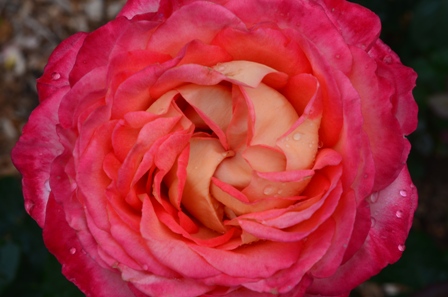
Rose Festival pink and orange rose closeup

Rose Festival bunches of red roses

Rose Festival orange and pink rose closeup

Rose Festival perfect red rose

Rose Festival fluffy pink and orange rose closeup

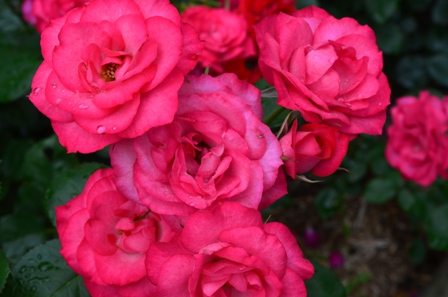
Rose Festival bunches of pretty pink roses

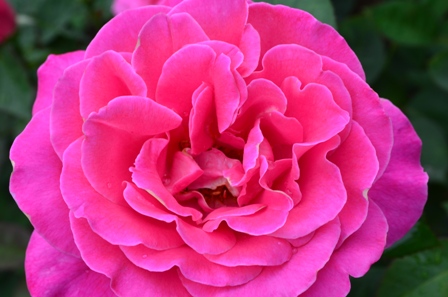
Rose Festival closeup of perfect pink rose

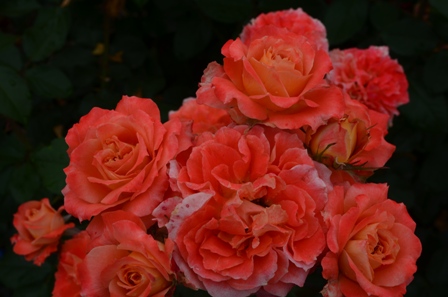
Rose Festival bunches of orange roses

Rose Festival bunches of light pink roses

Rose Festival bunches of bright pink roses

Rose Festival bright orange roses

Japanese Teppanyaki

Japanese Teppanyaki dinner

Like most Americans, I’ve been to more than one Japanese steakhouse in my time. You know the ones- with the chef/entertainer grilling up a storm in front of a crowd of hungry diners surrounding the grill. For my final night in Kyoto, I decided to splurge on dinner at a real Japanese steakhouse for teppanyaki. And “splurge” is an accurate description in this case, since dinner cost me about $118 USD. I knew this in advance, but couldn’t pass up the opportunity for the experience to indulge. I went to a restaurant called Mikaku, which is located in eastern Kyoto. The restaurant is pretty easy to find since it is a five minute walk from the Shiijo train  stop on the Keihan Main Line. Take exit to Shijo Dori and take a left on Nawate Dori. Take the first left and the restaurant is located on the second floor.

The setup is the same as Japanese steakhouses in America. There is a long countertop in the room with three grills for customers to view their dinner made in front of them. While there are other options for dinner, the main reason to come here is for the teppanyaki. The smallest cut of meat is 100g (3.5oz) and the price goes up from there.

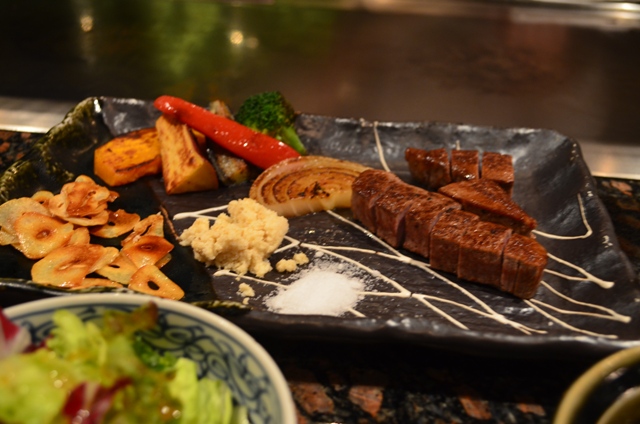
Kobe beef Japanese Teppanyaki

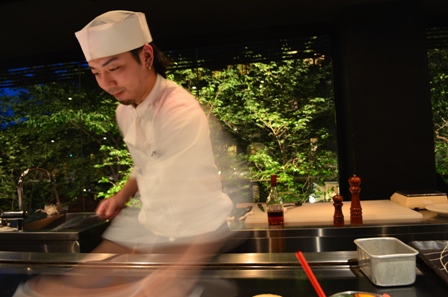
The full meal will get you your choice of size and cut of Kobe beef grilled to your specifications. You are given a bib like you find at lobster restaurants. You start the meal with a soup, which for my meal was Vichyssoise. You get an assortment of grilled vegetables, along with your meat. Japanese Teppanyaki chefs don’t have the same sort of entertainment stage presence like the ones you see in America, but they are no less skilled and professional in grilling your meal to perfection.

Japanese Teppanyaki chef

This was the first time I ever eaten Kobe beef, and it was delicious. The meat was super tender and practically melted in my mouth. My teppanyaki steak cooked to medium.

Kobe beef Teppanyaki 100g

After the meat course, you finish off the main meal with a super tasty garlic fried rice.

Teppanyaki fried rice

Teppanyaki fried garlic rice

This meal was a really memorable way to end my trip to Kyoto. This is absolutely not a restaurant you go expecting a discount. Go there knowing you will be spending over $100 USD PER PERSON. But if you can swing it, know it is worth it.

Nara Day Trip from Kyoto

me in front of Todaiji Temple

When possible, I always love to add a day trip out of the city I’m visiting on long weekends. It often means sacrificing seeing everything I can in a particular city, but it broadens the scope of my trip. During my Kyoto long weekend, I decided to take a day trip out to Nara. Nara was actually the first permanent Japanese capital when it was established in 710 CE. Its reign as Japan’s capital only lasted 74 years before the capital was moved to Kyoto. However in that short period of time, Nara laid the groundwork for Japanese arts, crafts and literature, as Nara imported everything it could from China. Today Nara is a modern city, but it still is home to some ancient temples and Japan’s largest bronze Buddha. Nara is easily reached from Kyoto on the JR Nara Express train which departs approximately every 15 minutes from Kyoto Station, and it takes approximately 45-60 minutes to reach Nara.

Todaiji Temple entrance

To maximize my travel experience, I went to the Horyuji Temple complex first, which is about a 20 minute train ride from Nara station and an additional easy, 20 minute walk from the train station. The temple complex was originally founded in 670 CE as a center for Buddhism in Japan. This temple complex was also Japan’s first UNESCO World Cultural Heritage Site in 1993.

Horyuji Temple complex

The temple complex consists of many different halls, plus Japan’s oldest five-story pagoda, as well as a gallery of temple treasures to display the important works of art, dating from the 7th and 8th centuries.

Horyuji Temple pagoda

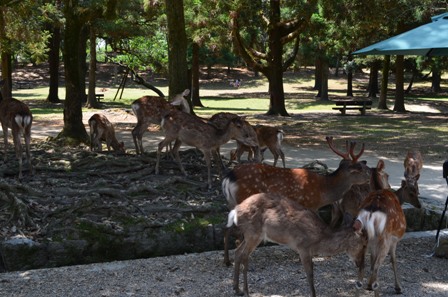
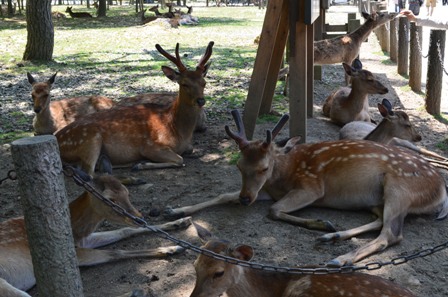
After enjoying the Horyuji Temple complex, I made my way back to the Nara city center. From the train station, it is about a 20 minute walk to Nara Park. Nara Park is a huge park where the rest of the historical sites are located. Nara Park is also home to packs of “wild” deer. Though these animals are ostensibly wild (with many signs warning patrons of such), you can buy packets of deer cookies to handfeed the deer. Trust me, these deer get hungry and will swarm you (gently) when they sense you have food for them.

Nara Park deer congregating

Hungry deer congregating around a deer cookie stand, hoping for some customers to feed them.

Nara Park deer napping

Tired deer napping in the shade. It was rather sunny, hot and humid that day.

me selfie with deer, Nara Park

Trying to take a selfie with a deer proved to be an interesting attempt at photo taking.

Deep into Nara Park is the Todaiji Temple.

Todaiji Temple entrance

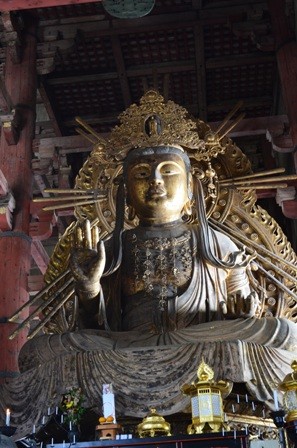
This temple is home to the Great Buddha (Daibutusu). While the initial Buddha began construction in the mid 700s, the present Buddha (or at least its head) dates from 1692 due to a couple fires melting the Buddha’s head, and an ancient earthquake in 855 CE that destroyed the head as well. Daibutusu stands approximately 15m (50 ft) tall, and is made with 437 tons of bronze, 286 pounds of pure gold, 165 pounds of mercury, and 7 tons of vegetable wax. Unlike other Kyoto temples, patrons can actually take pictures of the Buddha and all its surrounding statues inside the building.

Great Buddha, Todaiji Temple

Great Buddha flanking statue, Todaiji Temple

Todaiji Temple guardian statue

Also in Nara Park is Kasuga Shrine, which is a Shinto shrine nestled among the trees, pillars and approximately 3,000 stone and bronze lanterns that are specially lit a couple times a year.

Kasuga Shrine lanterns

Nara is definitely a worthwhile day trip from Kyoto. It is easy to reach with fast, reliable transportation, and there is enough to see and do to easily occupy visitors for a day or more, depending on their preferences.

Kyoto Nightlife

Kyoto canal night view

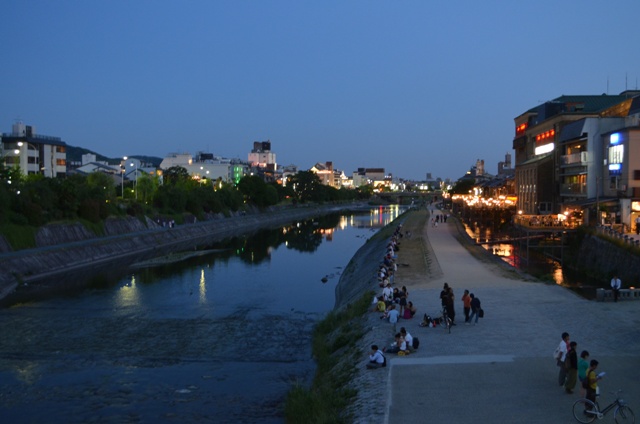
I’m not big on nightlife in most of my travels. It’s not that I don’t like to go out at night. It’s just that I’m usually alone, and bars and clubs aren’t my thing when I’m on my own. But that doesn’t mean I don’t like walking around my city of choice just to see the city at night. Kyoto is no different. It doesn’t have a hip, happening nightlife like you would find in Tokyo. There are plenty of restaurants and there are bars, but it’s much more low key.

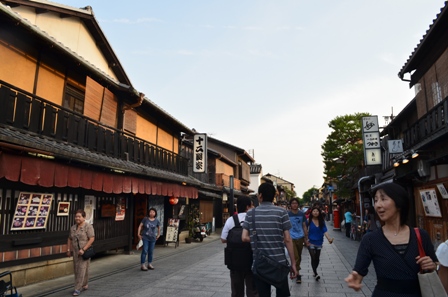
The two more traditional nightlife areas are often identified as Gion and Pontocho. Gion in particular is the the more traditional nightlife area that was the center of geisha culture. I walked around there briefly late at night, and it was remarkably dark, because there wasn’t a lot of streetlights. For obvious reasons, it’s much easier to see the district during the daylight.

Gion Street Kyoto

Gion Street, Kyoto

Gion is easily reached by the train. The closest train stop is Shijo on the Keihan Main Line. Walk east on Shijo Dori and then take a right on Hanamikoji Dori. The district is small and filled with narrow streets that are filled with people during the day, but are relatively quiet at night.

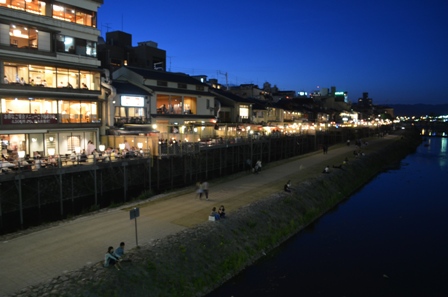
Another nightlife district is Pontocho, which is also nearby. Pontocho is a narrow alley that parallels the Kamo River and stretches from Shijo Dori north to Sanjo Dori. There are numerous train stops on either side of this district. Pontocho is filled with bars and restaurants of all varieties for enjoyment.

Pontocho, Kyoto

Ponotoco street lanterns

Many of these restaurants have terraces set up overlooking the river, and customers can pay a surcharge to enjoy the view in the cool night.

Kyoto canal-side night restaurants

Kyoto is a not a city to go for super modern, insane nightlife like you find in large cities. Though it does have plenty of bars and restaurants, it’s much more laid back with hints of Kyoto’s traditional past.

Kyoto Gardens

Nijo Castle beautiful garden view

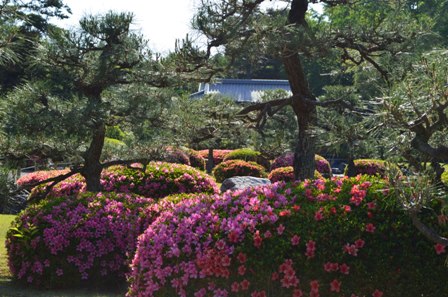
Kyoto is an extraordinarily beautiful city with many, many beautiful gardens. I visited Kyoto in May, so while it was beautiful with lush, green foliage everywhere, it was sort of like the lull time between the full blooming of cherry blossoms and azaleas in the spring, and the explosion of color that happens every fall. I couldn’t quite figure out if I was there at the tail end of the azalea blooming season or right at the beginning of the season. Based on the azalea blooming season in Seoul, I was there to see the season off for another year, not welcome a new one. Like the photo above, I saw enough azaleas to see how extraordinarily beautiful it would be to be there for the full bloom season. That photo, and the photo below, is from the garden at Nijo Castle and it was so peaceful and beautiful on that bright, sunny afternoon.

Nijo Castle garden azaelas

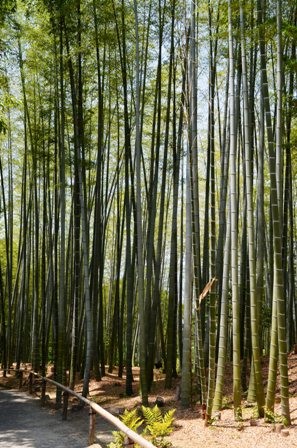
All the Kyoto temples, castles and shrines have at least a small garden to enjoy. Kodaiji Temple has some beautiful foliage while walking through the temple grounds, including a small bamboo forest.

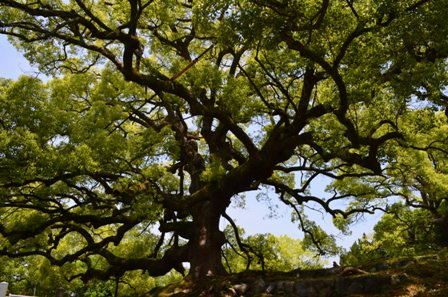
Kyoto interesting tree

I kept imagining what this tree will look like in the fall. I’ve seen pictures of amazing Japanese trees during autumn, and the rainbow of colors is awe inspiring to behold. I want to see Japanese foliage in the full thrust of autumn at some point in my life.

Kodaiji Temple complex

Kodaiji Temple garden window view

This view looks almost like a  painting, but rather it is framed by a door.

Kodaiji Temple bamboo forest

Ryonanji Temple also has a garden, but it is not the typical garden you expect. Sure, the temple is located on a woodsy grounds, but the centerpiece garden of this temple is a famous Zen rock garden. It was created in the 15th century during the Muromachi Period, and consists of 15 rocks set in waves of neatly organized white temples, surrounded by clay walls. Visitors aren’t able to walk in the garden obviously, but there is a wooden veranda visitors can contemplate the garden.

Ryoanji Temple Zen rock garden

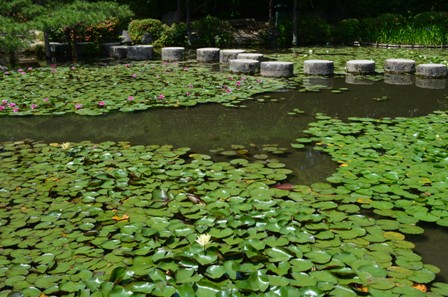
Another beautiful garden is the Shinen Gardens located at the Heian Shrine. This was another place replete with azaleas in partial bloom, and I kept imagining what it looks like during the height of blooming season when it would be a riot of color. It was also full of fledgling iris flowers and waterlilies, which just started their blooming season.


Shinen Gardens irises pond

me at Shinen Gardens waterlily pond

Shinen Garden waterlily pond overhead view

The waterlilies were starting their summer blooming season. At times, it almost felt I was in a hidden world somewhere in Narnia.

Shinen Garden waterlily pond stepping stones

water snake at Shinen Gardens waterlily pond

A water snake slithering through a waterlily pond.

Shinen Gardens waterlily pond closeup

Shinen Gardens waterlily pond overhead wide view

I only saw a few gardens, and what I did see made me want to come back to the city during the fall. Sure I’d also love to see the city during cherry blossom season, but that blooming season only lasts seven to 10 days. So it is hard to coordinate a vacation during cherry blossom season, and it’s easier to catch if you actually live in Japan. But autumn is my favorite time of the year, and I’m always on the lookout for beautiful, colorful nature. Kyoto would probably be the ideal place in Japan to experience the height of all. I’m seriously considering coming back on one of my fall long weekends.

Kyoto Temples- May 2013

Kinkakuji- Temple of Golden Pavilion

Memorial Day weekend I visited Kyoto. It had been on my travel list for a while since it is the cultural capital of Japan, and is one of the few Japanese cities to escape Allied bombing during World War II. So there are more historical structures and neighborhoods still in existence, even though they reside right along and among modern day Japanese architecture. If you love temples and shrines, this is definitely the city for you. I didn’t even see all of them, but focused on some of the larger, more famous and more beautiful temples.

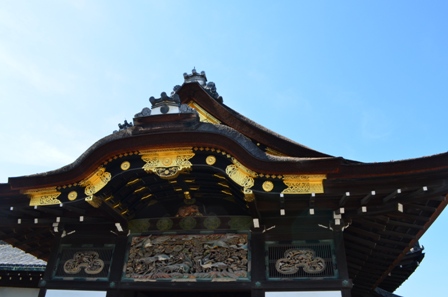
The first one I visited was Nijo Castle which is pretty centrally located in the city. The external building of the main castle,, Ninomaru Palace, is very beautiful.

Nijo Castle entry

The one thing about many (though thankfully not all) Japanese castles/temples is that photographs are not allowed inside of most of these structures. So you just relax and enjoy the view and you don’t worry about jockeying for position to take photographs. Asian castles, palaces and temples are set up very differently than their counterparts in the West, which is no surprise. The most interesting feature of this castle is the nightingale floors. Every time someone steps on these floorboards, you hear a squeaking sound like a nightingale bird. They were installed to protect the shogun from enemies, and the sound can be rather loud when tour groups are shuffling through.

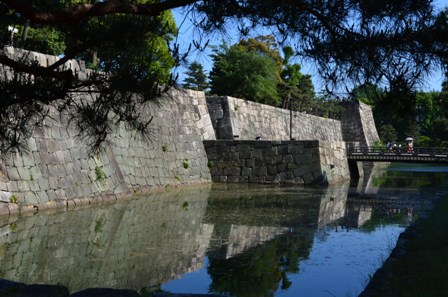
The entire castle complex is encircled by thick stone walls. There are other buildings located throughout the castle grounds, along with a very peaceful garden.

Nijo Castle walls

The next main temple I visited was the Sanjusangendo Hall. This is another temple that prohibits photography of its interior.

Sanjusangendo Hall

The interior of the temple is rather spectacular. The entire hall stretches nearly 120m  and is filled with 1,001 wooden statues of the thousand-handed Kannon surrounding a huge seated Kannon status in the center of the hall. It’s rather awe inspiring to realize that these wooden statues date from the 12th and 13th centuries and still exist. It’s rather hard to describe and should be something that is taken in to appreciate the artistry of the statuary.

After that temple, I continued my day long walk of eastern Kyoto with Kiyomizu Temple. This temple was initially built in 798 CE and rebuilt in 1633.  It too is a temple complex filled with other entry buildings and pagodas to enjoy.

Kiyomizu Temple entry

Kiyomizu Temple Pagoda

One of the most popular buildings in the temple complex is Jishu Shrine. This shrine is considered to be the home of the god of love and matchmaking. One can purchase charms for all sorts of desires, and even leave your own wishes.

Jishu Shrine

The main hall of the temple complex is constructed over a cliff and has a large wooden veranda supported by 139 pillars.

Kiyomizu Temple complex

The temple grounds were rich in green, because it was the height of spring. I can only imagine how beautiful the grounds look in the fall when the leaves turn into explosions of reds, oranges, and yellows. As you can see in the picture, this is a very popular place to visit, not only for foreign tourists but also school groups. I visited on a Saturday, and there were literally busloads of schoolkids running through the grounds.

Probably one of the most aesthetically beautiful temples in Kyoto is Kinkakuji Shrine (Temple of the Golden Pavilion). The original temple was constructed in the 1390s and was covered in gold leaf. The original structure was burned to the ground in 1950, and the temple was rebuilt in 1955.

me at Golden Pavilion

Golden Pavilion pond

I visited this temple on Monday, and not surprisingly, there were hordes of school groups visiting the site (seriously is that all school kids do every day-visit beautiful sites?) But still, the pavilion itself is very beautiful to look at (you can’t go inside the structure), and the surrounding green parklands was very beautiful.

It would be easy to overdose on temples and shrines and palaces in Kyoto, just because there are so many in the city, many of them original. But if you like beauty, they are certainly not to be missed in Kyoto.