Iceland Thingvellir River and Church Painting

my painting of Thingvellir river and church

I spent two weeks in Iceland in March 2011. I made the conscious decision to visit Iceland in the winter, because I wanted to see the Icelandic winter landscape, and especially wanted to see the Northern Lights.

Thingvellir is a day trip from Reykjavik and is the site where the Icelandic parliament was founded around 930 CE. Thingvellir is the place of a beautiful rift valley and the largest natural lake in Iceland, Thingvallavtn. I went out to area twice during my visit. One of the visits was to snorkel and the other time just a bus trip as part of the Golden Circle day trip.

There is a lot I like about this painting and a few things that give me pause. I laid down a watercolor underpainting and overlaid hard pastels and watercolor pencil on top for the detail. I especially like the depth created on the ice formations with the blue pastel water, overlaid with indigo blue watercolor pencil to give depth to the scene. After some thought, I decided to create the shadows in the snow with a lavender watercolor underpainting and light blue and violet hard pastel for texture and shadow. The ice formations was created with blue, gray and white watercolor pencil and burnished to give the appearance of a smooth ice surface finish.

The parts of the painting that I felt I could improve the most is the background and distance. I could improve the water reflections in the distance. I also realized after the fact that I drew the church way out of perspective. The church looks way bigger in the painting than it was in reality. I feel I need to improve creating a background with depth and texture to make it look more realistic.

This was one of those paintings that I wasn’t sure about when I first decided that I couldn’t make it better, but it did grow on me over time.

Thingvellir river and church

Above is the reference photo I used for this painting. I really loved Thingvellir, though truthfully I loved all of Iceland. It was a remarkably beautiful country. This day was very cold, sunny and bright and it just accentuated the fabulous natural of this special country.

Seoul Grand Park Rose Festival 2013

Rose Festival Seoul Grand Park sign

The month of June produces many different rose festivals across Korea. The one I visited this past weekend is hosted at Seoul Grand Park Rose Garden. It’s only a 2o minute subway ride on Line 4 from central Seoul, and about a 10 minute walk from the subway stop.

Since the month of June is winding down, peak rose blossoming had already hit, and the roses were slowly dying. However, there were still plenty of beautiful roses to be enjoyed in their bright, delicate, fragrant beauty.

Rose Festival flower tunnels

Rose Festival tunnel flower closeup

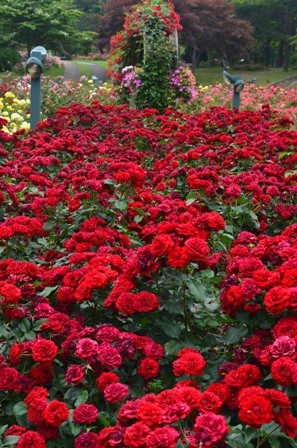
Rose Festival rows of red roses

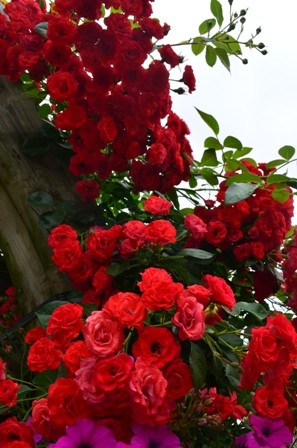
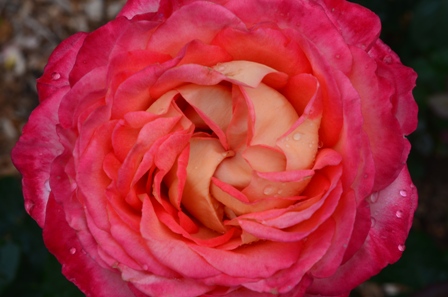
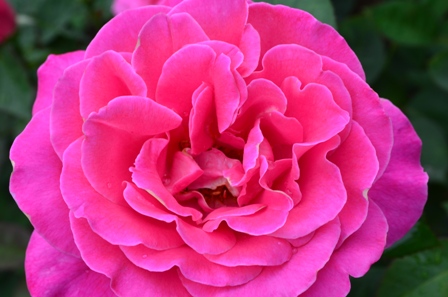
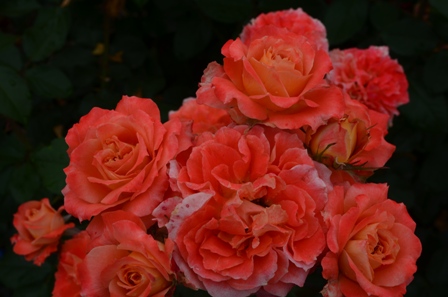
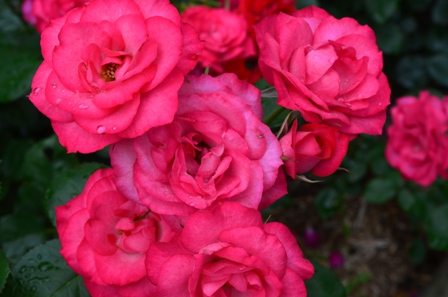
I was at the garden right when it opened, so there was plenty of peace and quiet to enjoy the utter beauty of all the roses. Plus a soft rain had fallen earlier in the morning, so all the roses were sprinkled with delicate water droplets. All of the roses were very fragrant, but it was interesting to notice all the different fragrances. Many of them were the traditional rose scent, but I was very fascinated by the roses that had a sweet, lemon scent to it, because I had never encountered roses like that. I couldn’t stop taking pictures of flower closeups. I kept imagining turning these pictures into beautiful, closeup flower paintings. Let’s see how well they turn out when I finally get my art supplies into these projects.

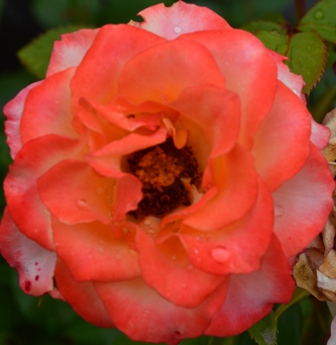
Rose Festival pink and orange rose closeup

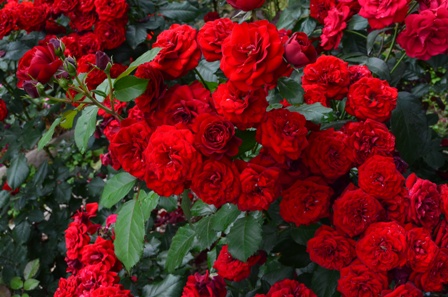
Rose Festival bunches of red roses

Rose Festival orange and pink rose closeup

Rose Festival perfect red rose

Rose Festival fluffy pink and orange rose closeup

Rose Festival bunches of pretty pink roses

Rose Festival closeup of perfect pink rose

Rose Festival bunches of orange roses

Rose Festival bunches of light pink roses

Rose Festival bunches of bright pink roses

Rose Festival bright orange roses

Japanese Teppanyaki

Japanese Teppanyaki dinner

Like most Americans, I’ve been to more than one Japanese steakhouse in my time. You know the ones- with the chef/entertainer grilling up a storm in front of a crowd of hungry diners surrounding the grill. For my final night in Kyoto, I decided to splurge on dinner at a real Japanese steakhouse for teppanyaki. And “splurge” is an accurate description in this case, since dinner cost me about $118 USD. I knew this in advance, but couldn’t pass up the opportunity for the experience to indulge. I went to a restaurant called Mikaku, which is located in eastern Kyoto. The restaurant is pretty easy to find since it is a five minute walk from the Shiijo train  stop on the Keihan Main Line. Take exit to Shijo Dori and take a left on Nawate Dori. Take the first left and the restaurant is located on the second floor.

The setup is the same as Japanese steakhouses in America. There is a long countertop in the room with three grills for customers to view their dinner made in front of them. While there are other options for dinner, the main reason to come here is for the teppanyaki. The smallest cut of meat is 100g (3.5oz) and the price goes up from there.

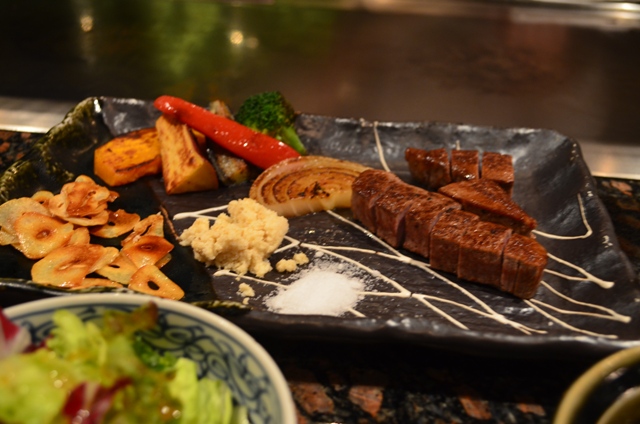
Kobe beef Japanese Teppanyaki

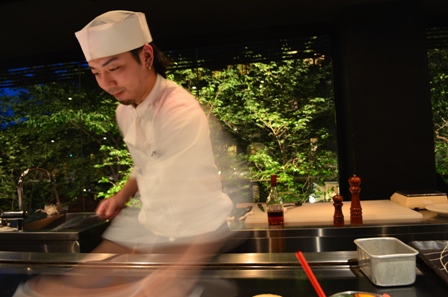
The full meal will get you your choice of size and cut of Kobe beef grilled to your specifications. You are given a bib like you find at lobster restaurants. You start the meal with a soup, which for my meal was Vichyssoise. You get an assortment of grilled vegetables, along with your meat. Japanese Teppanyaki chefs don’t have the same sort of entertainment stage presence like the ones you see in America, but they are no less skilled and professional in grilling your meal to perfection.

Japanese Teppanyaki chef

This was the first time I ever eaten Kobe beef, and it was delicious. The meat was super tender and practically melted in my mouth. My teppanyaki steak cooked to medium.

Kobe beef Teppanyaki 100g

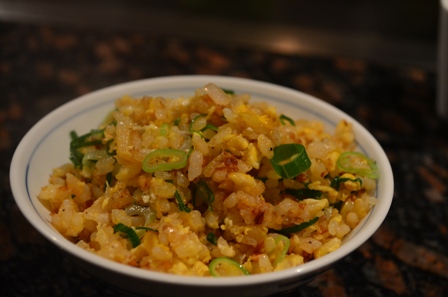
After the meat course, you finish off the main meal with a super tasty garlic fried rice.

Teppanyaki fried rice

Teppanyaki fried garlic rice

This meal was a really memorable way to end my trip to Kyoto. This is absolutely not a restaurant you go expecting a discount. Go there knowing you will be spending over $100 USD PER PERSON. But if you can swing it, know it is worth it.

Nara Day Trip from Kyoto

me in front of Todaiji Temple

When possible, I always love to add a day trip out of the city I’m visiting on long weekends. It often means sacrificing seeing everything I can in a particular city, but it broadens the scope of my trip. During my Kyoto long weekend, I decided to take a day trip out to Nara. Nara was actually the first permanent Japanese capital when it was established in 710 CE. Its reign as Japan’s capital only lasted 74 years before the capital was moved to Kyoto. However in that short period of time, Nara laid the groundwork for Japanese arts, crafts and literature, as Nara imported everything it could from China. Today Nara is a modern city, but it still is home to some ancient temples and Japan’s largest bronze Buddha. Nara is easily reached from Kyoto on the JR Nara Express train which departs approximately every 15 minutes from Kyoto Station, and it takes approximately 45-60 minutes to reach Nara.

Todaiji Temple entrance

To maximize my travel experience, I went to the Horyuji Temple complex first, which is about a 20 minute train ride from Nara station and an additional easy, 20 minute walk from the train station. The temple complex was originally founded in 670 CE as a center for Buddhism in Japan. This temple complex was also Japan’s first UNESCO World Cultural Heritage Site in 1993.

Horyuji Temple complex

The temple complex consists of many different halls, plus Japan’s oldest five-story pagoda, as well as a gallery of temple treasures to display the important works of art, dating from the 7th and 8th centuries.

Horyuji Temple pagoda

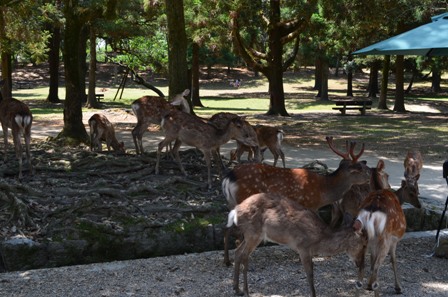
After enjoying the Horyuji Temple complex, I made my way back to the Nara city center. From the train station, it is about a 20 minute walk to Nara Park. Nara Park is a huge park where the rest of the historical sites are located. Nara Park is also home to packs of “wild” deer. Though these animals are ostensibly wild (with many signs warning patrons of such), you can buy packets of deer cookies to handfeed the deer. Trust me, these deer get hungry and will swarm you (gently) when they sense you have food for them.

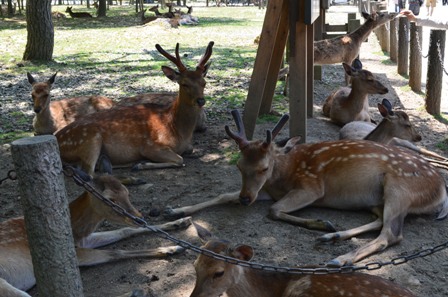
Nara Park deer congregating

Hungry deer congregating around a deer cookie stand, hoping for some customers to feed them.

Nara Park deer napping

Tired deer napping in the shade. It was rather sunny, hot and humid that day.

me selfie with deer, Nara Park

Trying to take a selfie with a deer proved to be an interesting attempt at photo taking.

Deep into Nara Park is the Todaiji Temple.

Todaiji Temple entrance

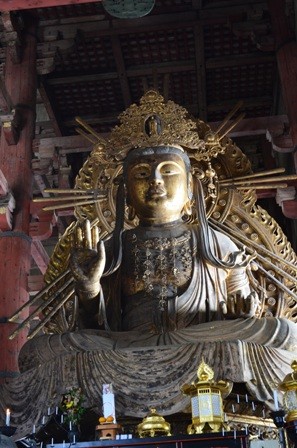
This temple is home to the Great Buddha (Daibutusu). While the initial Buddha began construction in the mid 700s, the present Buddha (or at least its head) dates from 1692 due to a couple fires melting the Buddha’s head, and an ancient earthquake in 855 CE that destroyed the head as well. Daibutusu stands approximately 15m (50 ft) tall, and is made with 437 tons of bronze, 286 pounds of pure gold, 165 pounds of mercury, and 7 tons of vegetable wax. Unlike other Kyoto temples, patrons can actually take pictures of the Buddha and all its surrounding statues inside the building.

Great Buddha, Todaiji Temple

Great Buddha flanking statue, Todaiji Temple

Todaiji Temple guardian statue

Also in Nara Park is Kasuga Shrine, which is a Shinto shrine nestled among the trees, pillars and approximately 3,000 stone and bronze lanterns that are specially lit a couple times a year.

Kasuga Shrine lanterns

Nara is definitely a worthwhile day trip from Kyoto. It is easy to reach with fast, reliable transportation, and there is enough to see and do to easily occupy visitors for a day or more, depending on their preferences.

Kyoto Nightlife

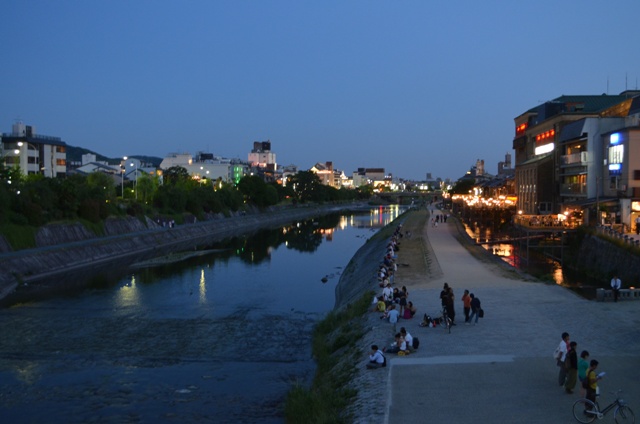
Kyoto canal night view

I’m not big on nightlife in most of my travels. It’s not that I don’t like to go out at night. It’s just that I’m usually alone, and bars and clubs aren’t my thing when I’m on my own. But that doesn’t mean I don’t like walking around my city of choice just to see the city at night. Kyoto is no different. It doesn’t have a hip, happening nightlife like you would find in Tokyo. There are plenty of restaurants and there are bars, but it’s much more low key.

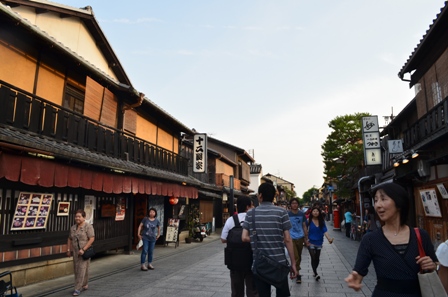
The two more traditional nightlife areas are often identified as Gion and Pontocho. Gion in particular is the the more traditional nightlife area that was the center of geisha culture. I walked around there briefly late at night, and it was remarkably dark, because there wasn’t a lot of streetlights. For obvious reasons, it’s much easier to see the district during the daylight.

Gion Street Kyoto

Gion Street, Kyoto

Gion is easily reached by the train. The closest train stop is Shijo on the Keihan Main Line. Walk east on Shijo Dori and then take a right on Hanamikoji Dori. The district is small and filled with narrow streets that are filled with people during the day, but are relatively quiet at night.

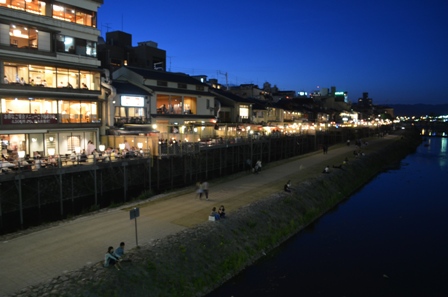
Another nightlife district is Pontocho, which is also nearby. Pontocho is a narrow alley that parallels the Kamo River and stretches from Shijo Dori north to Sanjo Dori. There are numerous train stops on either side of this district. Pontocho is filled with bars and restaurants of all varieties for enjoyment.

Pontocho, Kyoto

Ponotoco street lanterns

Many of these restaurants have terraces set up overlooking the river, and customers can pay a surcharge to enjoy the view in the cool night.

Kyoto canal-side night restaurants

Kyoto is a not a city to go for super modern, insane nightlife like you find in large cities. Though it does have plenty of bars and restaurants, it’s much more laid back with hints of Kyoto’s traditional past.

Kyoto Gardens

Nijo Castle beautiful garden view

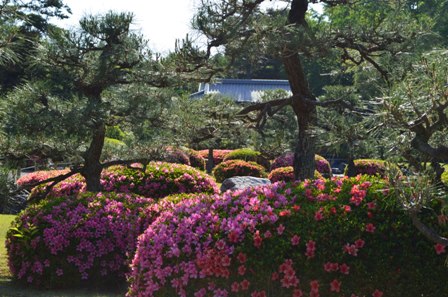
Kyoto is an extraordinarily beautiful city with many, many beautiful gardens. I visited Kyoto in May, so while it was beautiful with lush, green foliage everywhere, it was sort of like the lull time between the full blooming of cherry blossoms and azaleas in the spring, and the explosion of color that happens every fall. I couldn’t quite figure out if I was there at the tail end of the azalea blooming season or right at the beginning of the season. Based on the azalea blooming season in Seoul, I was there to see the season off for another year, not welcome a new one. Like the photo above, I saw enough azaleas to see how extraordinarily beautiful it would be to be there for the full bloom season. That photo, and the photo below, is from the garden at Nijo Castle and it was so peaceful and beautiful on that bright, sunny afternoon.

Nijo Castle garden azaelas

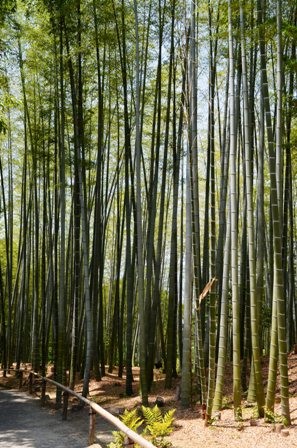
All the Kyoto temples, castles and shrines have at least a small garden to enjoy. Kodaiji Temple has some beautiful foliage while walking through the temple grounds, including a small bamboo forest.

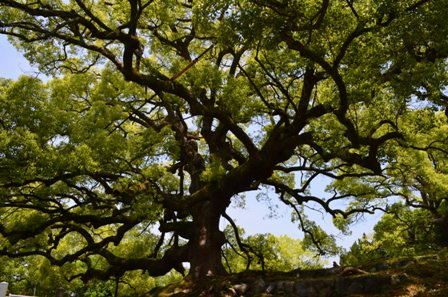
Kyoto interesting tree

I kept imagining what this tree will look like in the fall. I’ve seen pictures of amazing Japanese trees during autumn, and the rainbow of colors is awe inspiring to behold. I want to see Japanese foliage in the full thrust of autumn at some point in my life.

Kodaiji Temple complex

Kodaiji Temple garden window view

This view looks almost like a  painting, but rather it is framed by a door.

Kodaiji Temple bamboo forest

Ryonanji Temple also has a garden, but it is not the typical garden you expect. Sure, the temple is located on a woodsy grounds, but the centerpiece garden of this temple is a famous Zen rock garden. It was created in the 15th century during the Muromachi Period, and consists of 15 rocks set in waves of neatly organized white temples, surrounded by clay walls. Visitors aren’t able to walk in the garden obviously, but there is a wooden veranda visitors can contemplate the garden.

Ryoanji Temple Zen rock garden

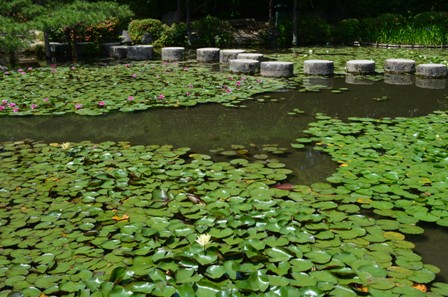
Another beautiful garden is the Shinen Gardens located at the Heian Shrine. This was another place replete with azaleas in partial bloom, and I kept imagining what it looks like during the height of blooming season when it would be a riot of color. It was also full of fledgling iris flowers and waterlilies, which just started their blooming season.


Shinen Gardens irises pond

me at Shinen Gardens waterlily pond

Shinen Garden waterlily pond overhead view

The waterlilies were starting their summer blooming season. At times, it almost felt I was in a hidden world somewhere in Narnia.

Shinen Garden waterlily pond stepping stones

water snake at Shinen Gardens waterlily pond

A water snake slithering through a waterlily pond.

Shinen Gardens waterlily pond closeup

Shinen Gardens waterlily pond overhead wide view

I only saw a few gardens, and what I did see made me want to come back to the city during the fall. Sure I’d also love to see the city during cherry blossom season, but that blooming season only lasts seven to 10 days. So it is hard to coordinate a vacation during cherry blossom season, and it’s easier to catch if you actually live in Japan. But autumn is my favorite time of the year, and I’m always on the lookout for beautiful, colorful nature. Kyoto would probably be the ideal place in Japan to experience the height of all. I’m seriously considering coming back on one of my fall long weekends.

Kyoto Temples- May 2013

Kinkakuji- Temple of Golden Pavilion

Memorial Day weekend I visited Kyoto. It had been on my travel list for a while since it is the cultural capital of Japan, and is one of the few Japanese cities to escape Allied bombing during World War II. So there are more historical structures and neighborhoods still in existence, even though they reside right along and among modern day Japanese architecture. If you love temples and shrines, this is definitely the city for you. I didn’t even see all of them, but focused on some of the larger, more famous and more beautiful temples.

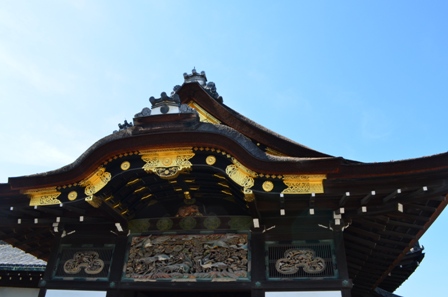
The first one I visited was Nijo Castle which is pretty centrally located in the city. The external building of the main castle,, Ninomaru Palace, is very beautiful.

Nijo Castle entry

The one thing about many (though thankfully not all) Japanese castles/temples is that photographs are not allowed inside of most of these structures. So you just relax and enjoy the view and you don’t worry about jockeying for position to take photographs. Asian castles, palaces and temples are set up very differently than their counterparts in the West, which is no surprise. The most interesting feature of this castle is the nightingale floors. Every time someone steps on these floorboards, you hear a squeaking sound like a nightingale bird. They were installed to protect the shogun from enemies, and the sound can be rather loud when tour groups are shuffling through.

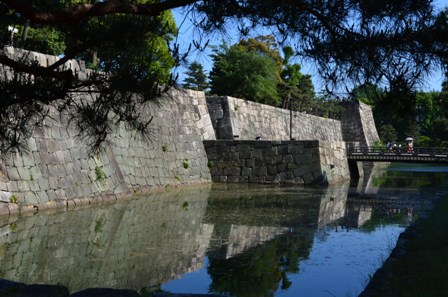
The entire castle complex is encircled by thick stone walls. There are other buildings located throughout the castle grounds, along with a very peaceful garden.

Nijo Castle walls

The next main temple I visited was the Sanjusangendo Hall. This is another temple that prohibits photography of its interior.

Sanjusangendo Hall

The interior of the temple is rather spectacular. The entire hall stretches nearly 120m  and is filled with 1,001 wooden statues of the thousand-handed Kannon surrounding a huge seated Kannon status in the center of the hall. It’s rather awe inspiring to realize that these wooden statues date from the 12th and 13th centuries and still exist. It’s rather hard to describe and should be something that is taken in to appreciate the artistry of the statuary.

After that temple, I continued my day long walk of eastern Kyoto with Kiyomizu Temple. This temple was initially built in 798 CE and rebuilt in 1633.  It too is a temple complex filled with other entry buildings and pagodas to enjoy.

Kiyomizu Temple entry

Kiyomizu Temple Pagoda

One of the most popular buildings in the temple complex is Jishu Shrine. This shrine is considered to be the home of the god of love and matchmaking. One can purchase charms for all sorts of desires, and even leave your own wishes.
Jishu Shrine

The main hall of the temple complex is constructed over a cliff and has a large wooden veranda supported by 139 pillars.

Kiyomizu Temple complex

The temple grounds were rich in green, because it was the height of spring. I can only imagine how beautiful the grounds look in the fall when the leaves turn into explosions of reds, oranges, and yellows. As you can see in the picture, this is a very popular place to visit, not only for foreign tourists but also school groups. I visited on a Saturday, and there were literally busloads of schoolkids running through the grounds.

Probably one of the most aesthetically beautiful temples in Kyoto is Kinkakuji Shrine (Temple of the Golden Pavilion). The original temple was constructed in the 1390s and was covered in gold leaf. The original structure was burned to the ground in 1950, and the temple was rebuilt in 1955.

me at Golden Pavilion

Golden Pavilion pond

I visited this temple on Monday, and not surprisingly, there were hordes of school groups visiting the site (seriously is that all school kids do every day-visit beautiful sites?) But still, the pavilion itself is very beautiful to look at (you can’t go inside the structure), and the surrounding green parklands was very beautiful.

It would be easy to overdose on temples and shrines and palaces in Kyoto, just because there are so many in the city, many of them original. But if you like beauty, they are certainly not to be missed in Kyoto.

Seoul Lotus Lantern Festival 2013 Cultural Experiences

me at Lotus Lantern Festival


Sunday was the third day of the Lotus Lantern Festival, and that day is all about cultural experiences. The street in front of Jogyesa Temple is turned into a street fair dedicated to all things Buddhism. Over 100 different booths are set up enabling participants to learn many different things.

Lotus Lantern Festival crowd


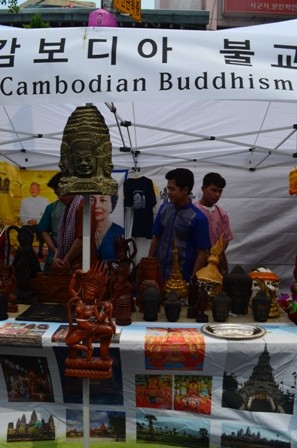
Examples: different forms of Buddhism in different countries.

Lotus Lantern Festival Cambodian Buddhism


Lotus Lantern Festival Thai Buddhism


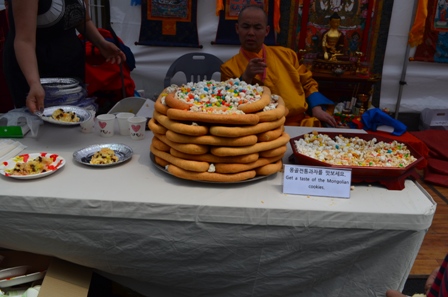
Try different tasty Buddhist foods, like Mongolian cookies and rice dishes:

Lotus Lantern Festival Mongolian Buddhism


There are also many opportunities to try a wide variety of crafts. There are more crafts than one can do in one day. Participants can make paper lotus flowers. They can craft a bracelet of Buddhist prayer beads. You can make Korean paper or lotus shaped candles. You can decorate masks or make clay objects.

Lotus Lantern Festival candle making

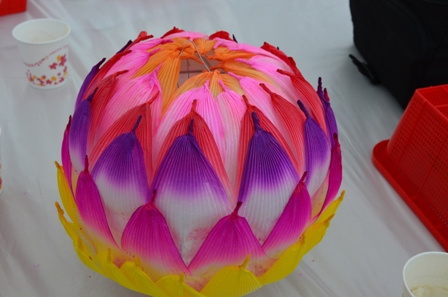
But my absolutely favorite activity at this festival was making a full size paper lotus lantern. The festival as an area marked off for foreigners to make lotus lanterns.

Lotus Lantern Festival lantern making


The activity is completely free and you are given all the materials you need to make a lotus lantern in a variety of colors. Some people made unicolor lanterns that resembled a real life lotus flower. And other lanterns were a rainbow of bright colors. Making a lantern is rather time consuming, but pleasantly contemplative.

Lotus Lantern Festival lantern instructions

It’s actually a bit more involved than you might think having to twist and glue every sheet of paper onto the lantern.

Lotus Lantern Festival lantern in progress


But it’s all worth it at the end when you have your very own colorful lotus lantern to take home with you.

Lotus Lantern Festival lantern complete


Overall the Seoul Lotus Lantern Festival is one of the best festivals I’ve ever been to. The setting in Jogyesa Temple, decked out with thousands of colorful lotus lanterns is beautiful. The parade is quite a sight to behold. And the cultural experiences day is an enjoyable learning experience.

Seoul Lotus Lantern Festival Parade 2013 part 2

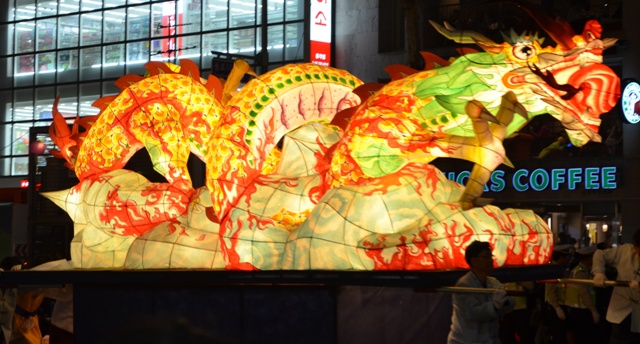
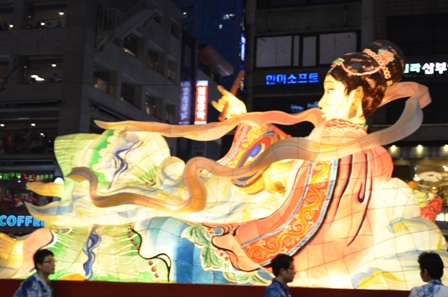
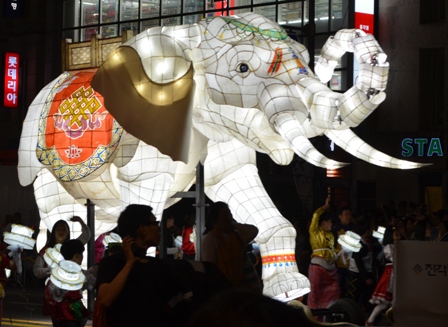
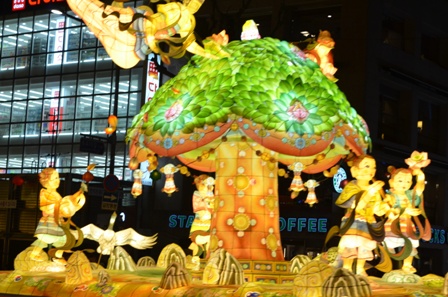
Lotus Lantern float (3)My favorite part of the Lotus Lantern Festival was the abundance of lantern floats that look absolutely amazing at night.  These floats ranged from traditional images like dragons and tigers to more contemporary images of children’s cartoons. These floats are just a select few that I particularly loved.

Lotus Lantern float (2)

Lotus Lantern float

Lotus Lantern float (7)What was interesting about so many of these floats is that they were pushed by hand for the entire parade route. There were some outsize floats that were driven by a vehicle, but more often than not, you would see a group of individuals pushing the float.

Lotus Lantern float (5)

Lotus Lantern float (6)My favorite floats were the abundance of dragons. I’ve always had a soft spot in my heart for dragons. Partly because they are just so exotic and beautiful looking (especially Asian dragons), but also because I am a Dragon in Chinese astrology

Lotus Lantern floats

Lotus Lantern float (9)Capturing these floats at night was an interesting challenge. I have a pretty good camera with an excellent night landscape setting. What it doesn’t do as well (or should I say I haven’t found the right settings) is capturing images at night in motion. More than once, my camera would take too long to focus and either the float passed me by, or the image was blurry. The amount of ambient light from surrounding businesses didn’t help either.

Lotus Lantern float (4)

Lotus Lantern float (8)I would highly recommend the Seoul Lotus Lantern Festival Parade (well, the entire festival, but more on that in a follow on post). As I mentioned before, this is probably the longest parade I have witnessed, and there are so many beautiful floats to marvel and enjoy.

Seoul Lotus Lantern Festival Parade 2013 part 1

Parade marchers (6)

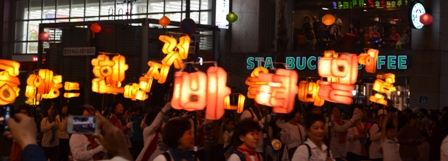
Saturday, May 11th 2013 was the annual Lotus Lantern Festival Parade held in conjunction with the Lotus Lantern Festival. The festival is to honor Buddha’s Birthday and this year the main festival was held May 10-12. The weekend is packed with a variety of religious and cultural experiences that are a lot of fun and informative. The highlight of the festival is the parade held on Saturday night. This parade is one of the best and the longest I have seen. The parade starts at Dongdaemun, the old east gate of Seoul and current home to a large market. It continues west down Jongno Street to the final destination of Jogyesa Temple, the center of the Lotus Lantern Festival. The parade lasts about two hours and consists of a wide variety of lighted lantern floats and marching groups carrying many different types of lanterns.

Parade marchers (4)

I decided to view the parade closer to the ending point about a 10 minute walk from Jogyesa Temple. When you’re short like I am, it is highly critical to get a good vantage spot to view a parade. The city actually sets up a couple rows of seats for people to sit in and watch the parade along parts of the parade route. I initially assumed that they were reserved for tour groups who paid for them, only to discover (a bit too late) that anyone can sit in them. Even when I get higher up, it seems to happen that someone much taller than me stands right in front of me, so I spend the entire parade jockeying my camera for a good position.

Parade marchers (5)

It was interesting to contrast the traditional beauty, meaning and celebration of the parade with the neon signs for modern businesses like Starbucks Coffee and Dunkin Donuts right in the background. Seoul is a very modern city with pockets of traditionalism tucked within it.

Parade marchers (3)

Parade marchers (2)

Tourists even have the opportunity to participate in the Lotus Lantern Parade through a special program that consists of lantern making, dinner, walking the actual parade, and the after parade festivities. The catch is that you have to register for it in advance. I didn’t do it this time, but next year I want to experience the Lotus Lantern Parade as fully as I can.

Parade marchers