Seoraksan National Park Day 1- Searching for Autumn Colors

Seoraksan day 1 beautiful view from Ulsan Bawi

Last weekend I kicked off my autumn hiking season with a long weekend at Seoraksan National Park. My favorite time of the year has arrived in Korea and I intended to enjoy the beautiful nature to the fullest. I have a whole season full of hiking planned at national parks throughout Korea. I have been to Seoraksan National Park the last time I lived in Korea, but that was actually only one day of hiking, so I wanted to enjoy it more and hike many different trails in the park.  Seoraksan National Park is one of the most popular national parks in Korea, for good reason. The hiking is amazing and the scenery is so beautiful. It’s nice any time of the year, but its true charm comes out when the fall colors ablaze everywhere. It’s also when the crowds come out, but that is just something you just deal with to enjoy yourself.

It’s very easy to reach Seoraksan National Park. The nearest large city is Sokcho and there are numerous busses departing from  the Dong Seoul bus station and Seoul Express Bus Terminal (about every 30 minutes during the day). The trip only takes about three hours, so I took an evening bus to Seoraksan Thursday night, so I could start hiking early Friday morning before the crowds hit. To make it easy for hiking, I chose to stay at a motel (The Seorak Morning Inn) in the village of Seorak-dong, which is about a 1.5 km easy, pleasant walk or short bus ride to the park entrance.

I picked Seoraksan as my first hiking weekend, both because I had a long weekend to do all the hikes I wanted in the time available, and it was also supposed to be the first national park to hit peak color for autumn foliage in the middle of October. I had visions of seeing the entire hills covered in red, orange and yellow. What I found was a bit different. Due to the warm weather this, the advent of fall seems to be delayed in Korea. It was the middle of October, and while there were leaves changing, it was not as much as I expected. But I valiantly set out in search of autumn colors.

My first day in the park was a Friday, so while there were people there, it certainly wasn’t as crowded as it is on weekends.  Of course it also helped that was I an early bird and arrived at the park shortly after it opened. The first thing I did when I got to the park (before the lines got too long) was take the cable car up to Gwongeumseong (Gwongeum Fortress) which is the ruin site of an old castle. The cable car ride is only about six minutes up, and it takes you to a hill with a beautiful view over the valley below and the mountains surrounding the hill.
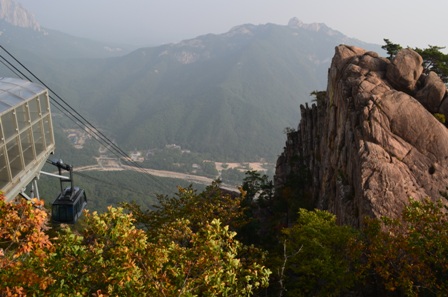
Seoraksan day 1 cable car to Gwongeumseong

The weather was a bit hazy at first, since it was early morning. But I could see patches of orange and yellow among the abundance of green trees.

Seoraksan day 1 Gwongeumseong view

It was SUPER windy at the top of the hill. See the picture below for just a hint at how windy it was. At times the gusts were so strong, I felt like I was going to be blown off the mountain if I lost my footing.
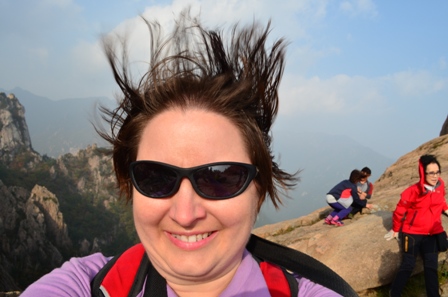
Seoraksan day 1 super windy me on top of Gwongeumseong

My ultimate goal was the top of Gwongeumseong, which was marked by the Korean national flag blowing in the wind. Getting up was interesting, because the path was a bit narrow in parts, and I had to pull myself along with a rope during parts of the ascent. And it was even windier on top of the mountain.  Like always, I personally found it easier to ascend and climb up rather than descend and climb down. Coming off the mountain was an interesting journey. When you see nimble, able Korean hikers descending on their butt, you KNOW it is a bit treacherous for someone like me who is clumsy and decidedly not sure-footed. But I made it in one piece, ready for more hiking.
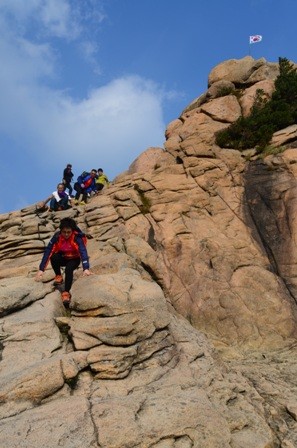
Seoraksan day 1 Gwongeumseong treacherous path

The second hike of the day was an easy hike to Biryong Falls. It was only 2.4 kilometers with no major uphills. Instead it was easy and pleasant to hike along the trail, enjoying the view around me. The hike starts a few hundred meters from the entrance to the cable car, and you can see the cable car ascend as you begin the hike.

Seoraksan day 1 cable view on trail to Biryong Falls

I was very charmed by the numerous, beautiful waterfalls and the colorful foliage during the course of the hike.

Seoraksan day 1 river view on Biryong Falls trail

I even saw more hints of autumn color on the trail. It was beginning to feel a lot more like autumn.

Seoraksan day 1 Biryong Falls autumn view

Seoraksan day 1 trail view on way to Biryong Falls

Even though the final destination was a waterfall, that doesn’t mean there was a shortage of waterfalls along the way, such as Youkdam Falls pictured below.

Seoraksan day 1 double falls view on way to Biryong Falls

Seoraksan day 1 overhead view of river

The sun kept peeking in and out from behind clouds and the trees during the walk. That highlighted the leaf colors, but it also produced interesting and beautiful effects on the rippling water.

Seoraksan day 1 shimmering waterfall pool of light

At the end of the hike is the 40m high Biryong Falls, which means “Flying Dragon”, because of the shape the water evokes. It’s a very pleasant place to sit by the water and silently take in the water and scenery or enjoy a picnic lunch with a group of other hikers, or at least partake in some of the food the very nice older women offered me.
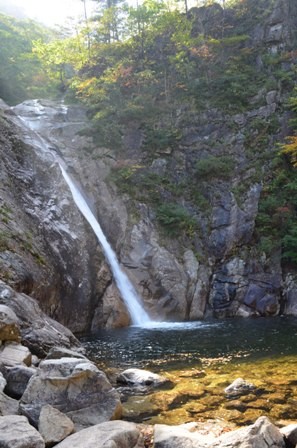
Seoraksan day 1 Biryong Falls

But as beautiful and peaceful Biryong Falls is, I didn’t relax, because I had one more hike planned for the day. And this hike is considered one of the most difficult hikes in Seoraksan National Park. It is also one of the popular ones, because of the beautiful, panoramic view from the top of the 876m high Ulsan Bawi. Because the first two hikes were pretty easy, I wasn’t really tired, which is good, because the Ulsan Bawi is an ass smoker, or more specifically, a thigh smoker. It starts out easy enough with beautiful scenery.

Seoraksan day 1 trail to Ulsan Bawi

But soon enough the hike reveals its true difficulty. The hike gets steeper as it proceeds to the midway point of Gyeojo Hermitage. It’s a nice place to rest, enjoy the scenery and gather your strength for the final ascent to Ulsan Bawi. From the hermitage to the top, it is only 1 kilometer, but it took me about an hour to ascend because of the difficulty and the steepness of the trail. I didn’t realize this until later when I saw a map of the trail, but the final 1 km of the trail is a 30.8% gradient, so at times it felt you needed to climb it and not just hike it. I’m in reasonably good shape, but I had to take numerous short breaks to catch my breath and allow my poor thighs to rest. But even though I was focused on getting to the top, I still was able to enjoy the colorful foliage. The higher I went, the more red leaves I could see.

Seoraksan day 1 autumn colors on Ulsan Bawi trail

I did this hike during my last visit to Seoraksan, and it was interesting to contrast the hikes. Both times the hikes were strenuous, but the trail was much more uneven several years ago. I had to spend a good chunk of my hike with my eyes glued to the ground so I didn’t trip and fall. But in the intervening years, the trail has been improved so it’s not QUITE so uneven. Wooden blocks have been placed among the stones, so it is easier to find steps.  The crowds were also much less this time around. During my last visit, it was on a Saturday afternoon, and there was literally a line waiting to reach the summit, since the summit is not that big and only so many people can fit up top. This time, there was no line, no wait. Maybe it was because it was Friday. Maybe it was because the leaves hadn’t fully changed colors. But either way, it made for a more pleasant journey. Plus a good chunk of the trail was steps, so it a BIT easier. However, when you are faced with a very long stairway UP, you just hope that your legs hold out.

Seoraksan day 1 steep trail to Ulsan Bawi

But then, I hit the top. I got to the summit of Ulsan Bawi. I could see for miles around, all the way to the town of Sokcho and the East Sea. Sure it is windy as all get out, but it’s worth it, because I MADE IT. No, it’s not like summiting Everest or anything difficult like that. But my thighs were certainly shaking enough on the way down.

Seoraksan day 1 Ulsan Bawi view summit

All told, I probably hiked over 10 km my first day at Seoraksan National Park. That doesn’t sound like a lot, and it’s really not since it’s only a little over six miles. But Korean hiking is no joke for the most part, particularly for someone short and clumsy like me. By the time I walked back to my hotel, I was ready for a hot bath and long snooze to get ready for day two of my Seoraksan hiking journey.
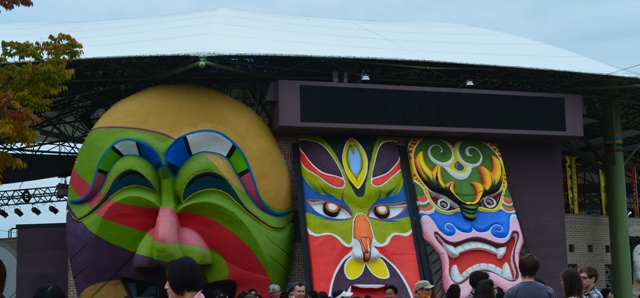
Andong Mask Festival 2013

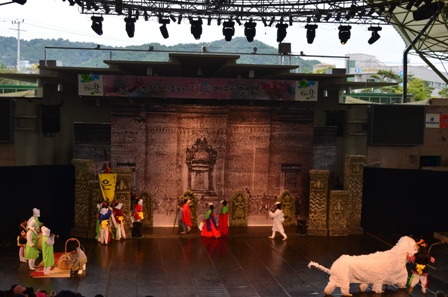
Andong Mask Festival mask dance theater

Last year I discovered the existence of the Andong Mask Festival, but was too lazy to go to it. Instead I spent my fall researching all the different sorts of fall activities I would do my second year in South Korea. I am very glad I did go to this festival, because it is large and interesting, as are most Korean festivals.

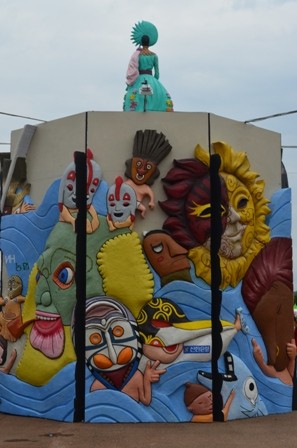
Andong Mask Festival signs

The main festival site was located in town a short bus ride (or taxi ride) away from the Andong train station or the Andong bus station. If you take the bus directly from the train or bus station, walk down the main street (left from the train station or right from the bus station) to the bus stop (don’t cross the street like you would if you were going to Hahoe Maeul Folk Village first). However during the festival, the same bus (#46) will connect the Hahoe Maeul Folk Village, the bus and train stations and the festival site on an hourly basis.

Andong Mask Festival site

There were multiple things to do on site. There was a theater to watch Korean mask dances or foreign mask dances throughout the day. There were stages for different musical concerts. There were different booths for foods and art products. There were plenty of toys and games for children to play, since most Korean festivals are very much family friendly and offer activities and experiences for the whole family or even just individuals like myself. There were even strange things like these robot rickshaws you can ride (I admit that when I first saw them, I thought they were children in costume pulling these rickshaws).
Andong Mask Festival robot  rickshaws

There were also exhibits of different masks around the world, since this was not just a Korean mask festival, but it incorporated mask traditions from different countries.

Andong Mask Festival mask exhibit

Andong Mask Festival masks of the world

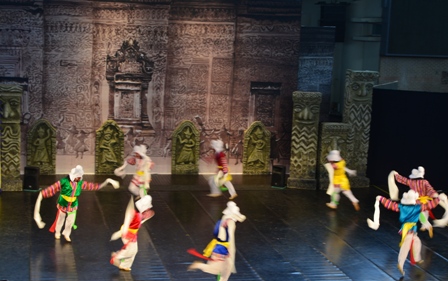
While I was there, I took in a mask dance performance. There were different performances of both Korean and foreign mask dances at regular intervals throughout the day, and I chose to watch the Eunyul MaskDance. Each performance was only 7,000 won (less than $7 USD) for an hour long show. All these different dances had different tableau performances, though I will admit I wasn’t exactly sure what the story was. I just enjoyed the traditional folk music and seeing different folk traditions play out before my eyes.

Andong Mask Festival mask dance group scene

Andong Mask Festival dragon dance

Andong Mask Festival group dance

Andong Mask Festival couples dance

Andong Mask Festival ribbon dance

And like most fun Korean festivals, there were experience booths to make your own mask.

Andong Mask Festival mask experience booth

You picked a booth that had the type of mask you are interested in making (there are multiple booths with different sorts of masks depending on your interests). Making your own mask only cost 5,000 won. You picked a mask and you were given a craft table and a mask decorating kit. The kit consisted of colored granular glue (white, black, red, yellow and blue). You can mix and match the colors to make whatever sort of color you want and you can decorate your mask in whatever design you want. I chose my particular mask, because it reminded me of a butterfly. I adore the color purple, so I used up all my red and blue to make the purple outline. I ultimately ended up using my university alma mater’s colors, the University of Washington  purple and gold (or yellow in this case). As I said, I was going for a beautiful butterfly, but in the end it looked more like a Mexican wrestling mask. But it’s my creation and I love it anyway.

Andong Mask Festival my artistic creation

If you are curious about masks, mask dances, the Andong Hahoe Maeul Folk Village, or just want to enjoy a pleasurable afternoon at a traditional Korean festival, I highly recommend the Andong Mask Festival. The festival lasts two weeks every year, usually the last weekend of September and the first weekend of October. Andong is an easy day trip from Seoul, and you can easily take the bus or the train to and from the festival.

Andong Hahoe Maeul Folk Village

Andong Hahoe Maeul cliffside view

The previous weekend, I made my way south to Andong for the Andong Mask Festival. The two-week annual festival is held in two main areas: the Mask Festival site in town (the subject of the next post) and the Hahoe Maeul Folk Village. If you’ve been to the Korean Folk Village in Suwon, the first thought could be that this village is another sort of museum. However, this is a real, living village for people to live and work.

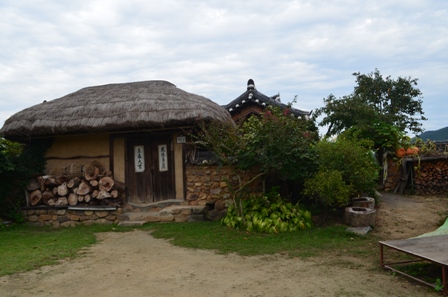
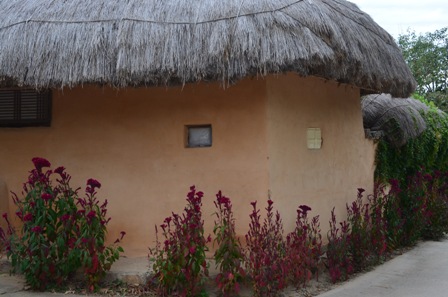
Andong Hahoe Maeul thatched huts

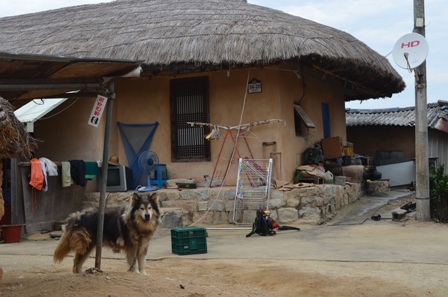
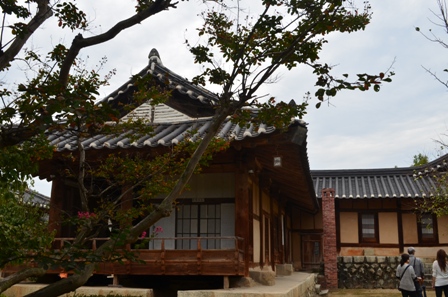
Hahoe is a village where the Ryu family originated and where its descendants have lived together for 600 years. The tile and thatched roofed homes have been preserved for hundreds of years (though undoubtedly reinforced with modern construction), even though the village dwellers have modern conveniences like cars, electricity, running water, indoor plumbing and satellite television.

Andong Hahoe Maeul Bukchon Residence

Andong Hahoe Maeul thatched hut with fluffy dog

The village is a pleasant place to spend a couple hours. Visitors can walk through the village peacefully among people living their lives. There are restaurants and stores for visitors, and there are just normal homes for individuals to live their lives.

Andong Hahoe Maeul stone walkways

Andong Hahoe Maeul flower lined street

The village is tucked among the surrounding mountains and is set along the Nakdong River, which flows are the river in a S shape and gives the village name. Ha means river and hoe means turning around.

Andong Hahoe Maeul thatched hut autumn scene

Andong Hahoe Maeul home with trees

Andong Hahoe Maeul hut with orange berry tree

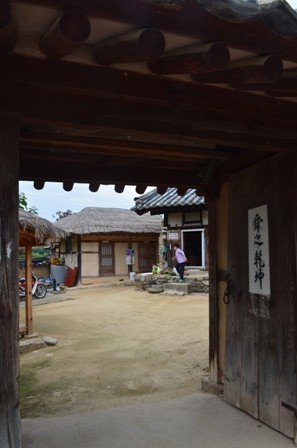
Visitors can walk around the village and peek into open doorways of walled homes to get a glimpse of normal village life.

Andong Hahoe Maeul doorway view

Andong Hahoe Maeul thatched roof  hut

In the center of the village resides the Samsindang, called the Samsin Goddess Tree. The zelkova tree is 600 years old. The tree is in the residence of the Samsin Goddess, who oversees pregnancy and child birth. Visitors can leave wishes around the tree.

Andong Hahoe Maeul Samsin Goddess tree

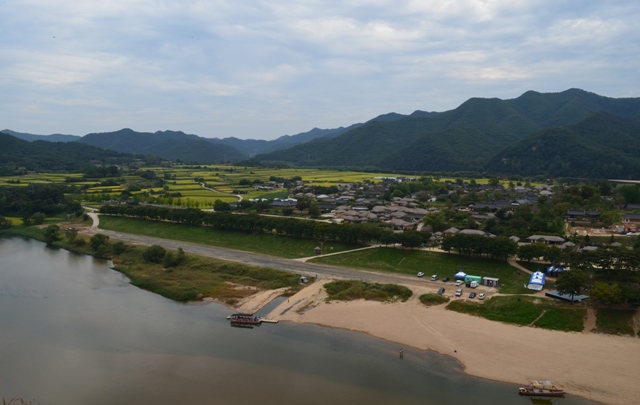
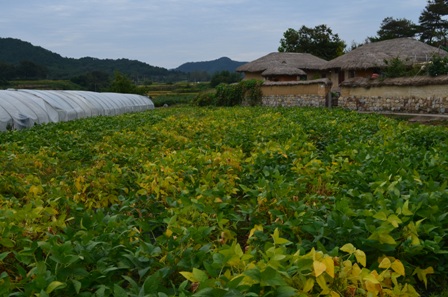
When you are done walking around Hahoe Maeul, you can cross the river on a small ferry for a small fee for a round trip (there is no bridge across the river anywhere near the village) and hike a short way up Buyongdae Cliff for a beautiful overlook of the village below (the lead picture on this post). You can also see the crop fields that surround the village and the river as it stretches around the village.

Andong Hahoe Maeul crop fields

Andong is very easy to reach from Seoul by public transportation. There are numerous daily buses from Dong Seoul Bus Terminal, but I prefer the train if there is that option. Most of the trains leave from Cheongnyangni Station (a stop off subway line 1). There are approximately seven trains daily and the direct train ride lasts approximately four hours.

From the Andong train station, Hahoe Maeul is pretty easy to reach, but don’t make the mistake I did. I got on the wrong numbered bus and it wasn’t just the wrong bus, but it was also heading in the wrong direction. I’m normally very good with directions, but sometimes I have to guess when it comes to vague directions. My guide book said I could take the #3 bus and it was supposed to go to Hahoe Maeul. That is not true. I ended up at the Andong Culture Complex (I saw that on the bus, and thought that was the right destination) and there was no one around and quickly figured out I was in the wrong place. Thankfully another bus came along shortly after that and I went back to the train station. If you take the bus to Hahoe Maeul, you need to take bus #46. Cross the street from the train station and head left to the bus stop. There are buses to the village approximately once an hour, and the trip takes approximately 30 minutes. However, if you don’t want to wait, you can easily take a taxi to the village, and the cost will be approximately 30,000 won (less than $30 USD depending on the exchange rate).

Hahoe Maeul is an interesting view into how villages used to look several hundred years ago, but it blends well into the modern world.

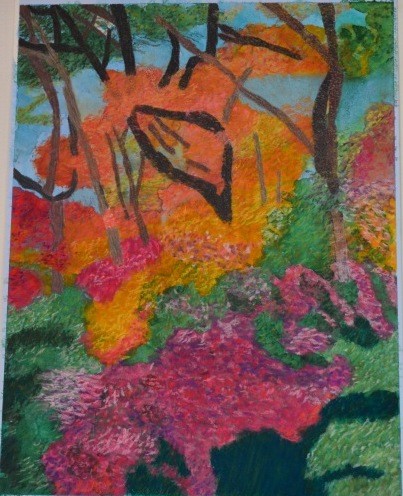
Palgonsan Provincial Park autumn foliage painting

my painting of Palgonsan Provincial Park fall foliage

Thus continuing my love of brightly colored landscapes and a desire to make brightly colored paintings. This painting was accomplished with a watercolor underpainting, watercolor pencils for the trees, and hard pastels for the foliage texture. I chose this particular picture to paint, because I really liked all the wild, natural colors.

my painting of Palgonsan colorful forest interim 1

I first applied masking fluid to all the trees to save the white. Then I laid down a multi-colored watercolor underpainting roughly corresponding to the colors of my desired endstate. I didn’t try to be very restrictive in the sense of coloring in exact lines, but rather a bit more free flowing and abstract.

my painting of Palgonsan colorful forest interim 2

After the underpainting dried, but before I applied the foliage texture with hard pastels, I used watercolor pencils for the trees. I pulled up all the masking fluid and laid in the trees with a variety of colors. I like watercolor pencils more than normal colored pencils, because I can layer all the colors and the detail like a normal colored pencil, but then I can make a rich, controlled wash with the watercolor. Then I finished up the painting by applying layers of differing colors of hard pastel to recreate the image of foliage.

Palgonsan Provincial Park red orange and yellow leaves

This was my reference photo. It was taken during a nice day hiking in Palgonsan Provincial Park one Saturday afternoon in October. I was completely taken by all the natural colors. Palgonsan Provincial Park was very easy to reach. I just took one of the numerous KTX trains from Seoul Station down to Dongdaegu, which was only about two and a half hours away by express train. The local bus number 1 out to Palgonsan Park and then just hike to your heart’s content and enjoy the beautiful Donghwa Temple and the beautiful nature. It made for an easy and pleasant full day trip.

My painting is certainly not photo realistic, and part of me wishes that it was. But another part of me likes the more impressionistic nature of the painting and thinks it captured the abstract colorful nature of that autumn foliage.  I still need to work on representing light sources accurately. I’ve been trying to branch out my technique and move away from attempting to recreate the reference photo as much as possible, to a more abstract capture of the scene.

Getting Filthy/Gorgeous at the Boryeong Mud Festival 2013

Boryeong Mud Festival title picture

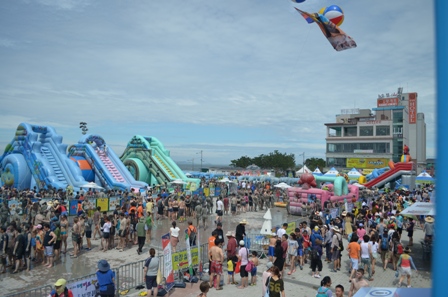
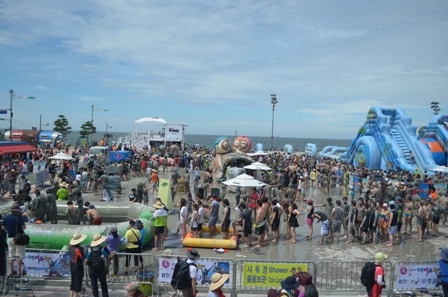
The Boryeong Mud Festival is held in South Korea every year for roughly the last two weeks of July. It’s supposed to be one of the biggest festivals South Korea offers, and in particular it is very popular with foreigners. Based on my experience, I say both of those statements are absolutely true. The mud festival is held on Daecheon Beach which is about a two and a half hour train ride (or drive if you are bold enough to drive in South Korea-I’m not) south of Seoul. It is extremely convenient to reach, because there are numerous trains leaving daily from Yongsan Station for Daecheon. During the festival, there is a bus from the train station to the beach approximately every 10 minutes, and it is roughly a 20 minute bus ride to the beach and festival site. The centerpiece of the festival is the Mud Play Zone at Mud Plaza. Surrounding the plaza are a variety of different experience booths, and all of this is set right next to a very large, popular sandy beach. The mud play zone is actually divided into two areas: the paid zone and the family zone. Both of them charge admission to enter. However the family zone is for families with kids the age of 13 and younger, and the paid zone is for those over the age of 13. The play times are divided into two blocks of time: the morning session of of 9:30-13:20 and the afternoon session from 14:10-18:00. I bought an all day, adult ticket and that cost me only 10,000 won (less than $10 USD). It’s a lot of fun, but just be prepared for crowds, long lines, and most of all, to get EXTREMELY muddy if you so desire (trust me, you do).

Boryeong Mud Festival morning session

Boryeong Mud Festival morning session 2

me clean before all the dirty fun began

me clean before all the dirty fun began

If you would rather play with fewer people, I highly recommend the morning session. The pictures above are from the morning, and as you can see in my later pictures, there aren’t QUITE as many people in the morning as there are in the afternoon.

Boryeong Mud Festival huge slide

The mud play zone consists of large, inflatable, bouncy mud slides, a small mud pit, a large mud pit, a mud prison to trap clean people inside and throw mud at them, and a few pair-oriented mud obstacle courses. All of this is set up in the adult equivalent of a bouncy castle. The family zone has roughly the same setup, only it is scaled down for children. This is definitely a time it is easier or better to go with a pair or a group of people, just because it probably does enhance the fun to play with someone else, plus the fact that some of the fun is targeted toward pairs. I went by myself, but it was still a lot of fun.

Boryeong Mud Festival crazy mud pit

Let the muddy games begin at the afternoon session

Boryeong Mud Festival me muddy

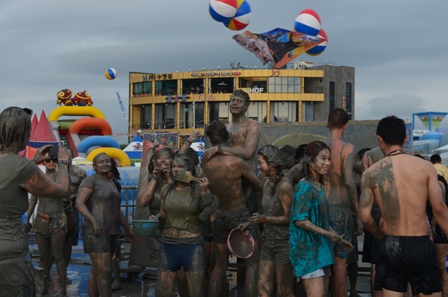
You can get as muddy as you want, and as you can tell from the above photos, I got pretty freaking muddy. I was covered in mud from head to toe. It’s like playing in one big mud puddle. The afternoon session was a bit crazier than the morning session. It was so much more crowded, to the point where the groups of people were pushing their way in past security. The lines were longer, and the people definitely were drunker. While food, drink or alcohol aren’t allowed in the play zone, there was plenty of booze to be had in the surrounding stores beforehand (plus whatever individuals brought with them), and the groups of young people definitely were partaking (often in very large bottles of booze).

Boryeong Mud Festival muddy festival goers

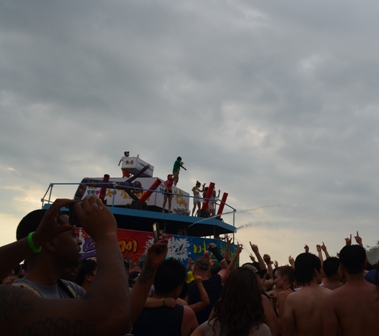
Boryeong Mud Festival crowd dancing

Boryeong Mud Festival crowd dancing spray

While the Boryeong Mud Festival is geared toward all ages, at times, it definitely felt like Spring Break: Daecheon Beach. Like I mentioned, this is a very popular festival with groups of twentysomethings. They are there to strip down (to tiny swimsuits, not naked-this is Korea after all), booze up, get muddy and dance on the beach. The only thing missing were the MTV cameras, though there was plenty of local press on hand capturing all the insanity. However, if that part is just not your thing, there is still plenty of fun to be had at the festival. In addition to the mud play zone, there were some experience booths like I’ve seen in other culture festivals. You can play with colored mud (in a much more controlled setting than the mud play zone). You can buy beauty products made from local Boryeong mud (in fact this festival’s origins trace to trying to promote the health and beauty benefits of the local mud and its products). You can make your own mud soap, get your face painted and just enjoy some relaxing time on the (very crowded) beach.

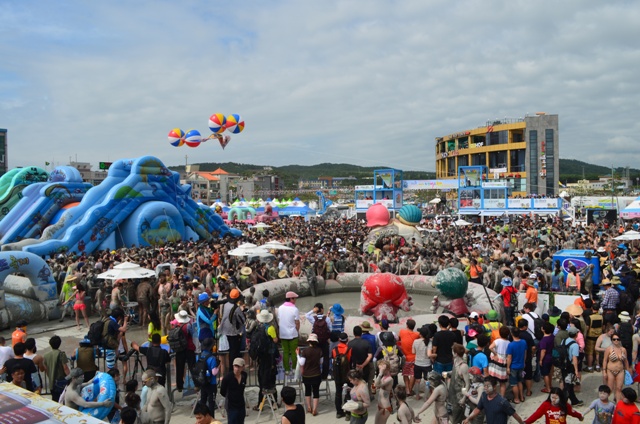
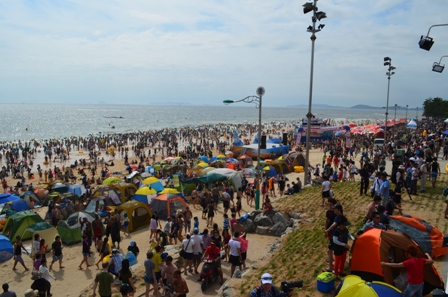
Boryeong Mud Festival Dacheon Beach crowd

Boryeong Mud Festival Dacheon Beach crowded

As you can see, groups of friends and families set up pup tents on the beach (for day use) to relax and frolic along the beach. The sandy beach extends for a distance in either direction. You can venture into the water, and the water temperature was pleasantly cool on the hot, sunny day I went, and it was a great place to rinse off all the mud. You can’t swim out a long distance from the shore, because the waves can be pretty powerful, and it is blocked off for jet skiers and patrolled by lifeguards. Still, it was fun to ride in the waves and relax on the beach, taking everything in around you.

In addition to the all day long mud play, the festival also hosts a number of concerts and other cultural experiences. The afternoon I was there, there as an air show performed by the Black Eagles, a South Korean Air Force unit. There are also different concerts and parties on different nights, and even though I didn’t stay since I had to catch my evening train back to Seoul, there were also fireworks on opening night.

Everything you want for the festival is all within a very small walking area. There are showers for a fee, though I warn you these are open bay showers crowded with many, many people and not private shower stalls. If you don’t mind showering, toweling off and dressing pressed up against a group of strangers, dive right in. At least the showers are segregated by gender.  There is a place to store your bags during the day for a small fee. I highly recommend you store almost everything, but carry around your wallet and phone in a waterproof case. The bathrooms on site are what you would expect from such a widely attended festival (i.e. a bit scary as the day progresses). Food and beverages are available on site, and if you choose to stay overnight, there are many hotels in Daecheon Beach. Though I recommend you book well in advance and not assume you’ll be able to walk up the day of and get a room, particularly for a beachside hotel.

This is a very enjoyable festival, and I definitely want to go back next year. I’m just thankful that the weather held out the day I was there, though you wouldn’t know it by looking at the ominous clouds gathering at the festival site in the picture below.

Boryeong Mud Festival afternoon clouds gathering