Jinju Namgang Lantern Festival 2013 at day

Jinju Lantern Festival day 12


The Jinju Namgang Lantern Festival is another festival I almost went to last year, but got lazy. But now that I only have one year left in Korea, I am compelled to do all the things I want to do before I don’t have that opportunity anymore. I absolutely love lantern festivals, and this festival is a bit different than the Seoul Lotus Lantern Festival in the spring to commemorate Buddha’s birthday.

The festival is held along the Namgang River and the Jinju Fortress (Jinjuseong) across the river. I got to the lantern festival right as it opened early in the morning. I wanted to maximize my time at the festival and not feel rushed. For the first few hours, crowds were very sparse. Which is understandable, since the lantern festival really comes to life after dark. It was very peaceful walking along the river or just sitting by the water admiring the floating lanterns.

Jinju Lantern Festival day 6


Jinju Lantern Festival 3


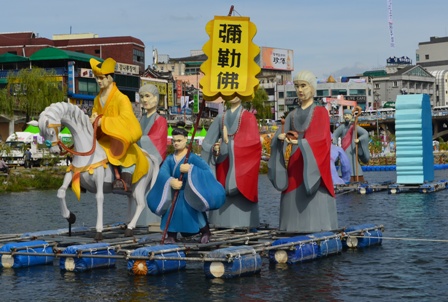
The lanterns are spread out on the water. The lanterns are a mixture of traditional Korean tableaus, Disney fairytale characters and international symbols, like the Statue of Liberty and the Sphinx. There are numerous floating bridges crossing the river (for a small fee of course) so you can easily get back and forth across the river for both parts of the festivals.
 

Jinju Lantern Festival day 11

Jinju Lantern Festival day 10

Jinju Lantern Festival day 9

Jinju Lantern Festival day 8

Jinju Lantern Festival day 7


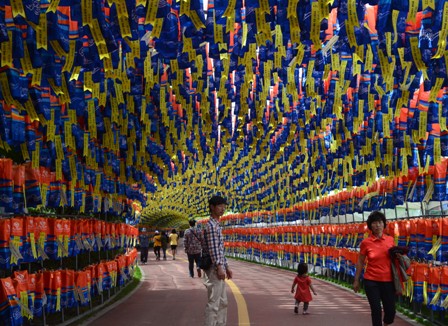
The lantern festival is also held in conjunction with the Gacheon Arts Festival and the Jinju Silk Festival. All the festival events and activities are on the river, so you can enjoy a wide variety of activities from all festivals, like enjoying local artists’ paintings. The lantern festival has a wide variety of Korean and international food booths to eat your way through the day. Like most Korean festivals I’ve been to, there were also experiential booths to make your own lanterns, some of which you could light with candles and float in the river at night or desire wish lanterns you can hang up in the lantern tunnels.
Jinju Lantern Festival day 4

Jinju Lantern Festival day 5


The other main section of the lantern festival is held across the river at the Jinju Fortress. The fortress was first used to defend the region during the Japanese invasion Imjin Waeran in 1592/1593. The fortress is now reconstructed, and within the walls, there are a couple of temples, shrines and the Jinju National Museum. A wide variety of lanterns are set up in Korean traditional tableaus such as traditional Korean fairy tales and the Korean military forces defending the fortress.

Jinju Lantern Festival day 16

Jinju Lantern Festival day 15

Jinju Lantern Festival day 14

Jinju Lantern Festival day 13


Throughout the day on the fortress premises there were a wide variety of Korean traditional folk performances like musical dance performances and examples of Korean martial arts.

Jinju Lantern Festival day 2

Jinju Lantern Festival day 1


Jinju is very easy to reach from Seoul. There are numerous buses from Seoul’s Gangnam Express Bus Terminal to the Jinju Express Bus Terminal. I chose to take the train, just because I prefer trains if they are available. The direct KTX train from Seoul leaves several times a day for the three and a half hour trip to Jinju. Know that if you take the KTX train, the train station is south of the city center, not within walking distance. I would recommend that unless you speak Korean, it might be best to take a taxi (approximately 15 minute drive) to the city center. I originally took the bus to the festival and ended about a 2 km walk from the festival site.  The Express Bus Terminal is located about a 20 minute walk down the river from the lantern festival.
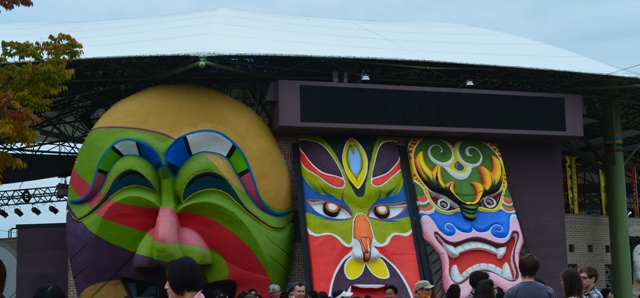
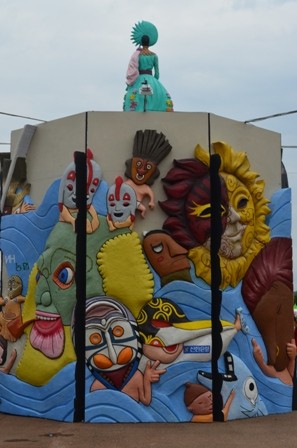
Andong Mask Festival 2013

Andong Mask Festival mask dance theater

Last year I discovered the existence of the Andong Mask Festival, but was too lazy to go to it. Instead I spent my fall researching all the different sorts of fall activities I would do my second year in South Korea. I am very glad I did go to this festival, because it is large and interesting, as are most Korean festivals.

Andong Mask Festival signs

The main festival site was located in town a short bus ride (or taxi ride) away from the Andong train station or the Andong bus station. If you take the bus directly from the train or bus station, walk down the main street (left from the train station or right from the bus station) to the bus stop (don’t cross the street like you would if you were going to Hahoe Maeul Folk Village first). However during the festival, the same bus (#46) will connect the Hahoe Maeul Folk Village, the bus and train stations and the festival site on an hourly basis.

Andong Mask Festival site

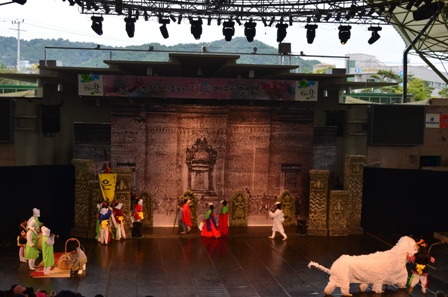
There were multiple things to do on site. There was a theater to watch Korean mask dances or foreign mask dances throughout the day. There were stages for different musical concerts. There were different booths for foods and art products. There were plenty of toys and games for children to play, since most Korean festivals are very much family friendly and offer activities and experiences for the whole family or even just individuals like myself. There were even strange things like these robot rickshaws you can ride (I admit that when I first saw them, I thought they were children in costume pulling these rickshaws).

Andong Mask Festival robot  rickshaws

There were also exhibits of different masks around the world, since this was not just a Korean mask festival, but it incorporated mask traditions from different countries.

Andong Mask Festival mask exhibit

Andong Mask Festival masks of the world

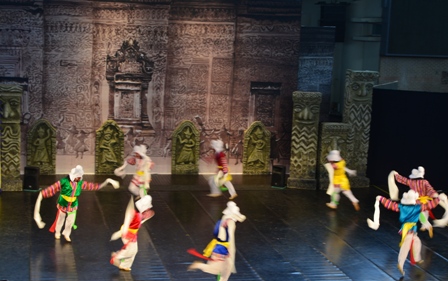
While I was there, I took in a mask dance performance. There were different performances of both Korean and foreign mask dances at regular intervals throughout the day, and I chose to watch the Eunyul MaskDance. Each performance was only 7,000 won (less than $7 USD) for an hour long show. All these different dances had different tableau performances, though I will admit I wasn’t exactly sure what the story was. I just enjoyed the traditional folk music and seeing different folk traditions play out before my eyes.

Andong Mask Festival mask dance group scene

Andong Mask Festival dragon dance

Andong Mask Festival group dance

Andong Mask Festival couples dance

Andong Mask Festival ribbon dance

And like most fun Korean festivals, there were experience booths to make your own mask.

Andong Mask Festival mask experience booth

You picked a booth that had the type of mask you are interested in making (there are multiple booths with different sorts of masks depending on your interests). Making your own mask only cost 5,000 won. You picked a mask and you were given a craft table and a mask decorating kit. The kit consisted of colored granular glue (white, black, red, yellow and blue). You can mix and match the colors to make whatever sort of color you want and you can decorate your mask in whatever design you want. I chose my particular mask, because it reminded me of a butterfly. I adore the color purple, so I used up all my red and blue to make the purple outline. I ultimately ended up using my university alma mater’s colors, the University of Washington  purple and gold (or yellow in this case). As I said, I was going for a beautiful butterfly, but in the end it looked more like a Mexican wrestling mask. But it’s my creation and I love it anyway.

Andong Mask Festival my artistic creation

If you are curious about masks, mask dances, the Andong Hahoe Maeul Folk Village, or just want to enjoy a pleasurable afternoon at a traditional Korean festival, I highly recommend the Andong Mask Festival. The festival lasts two weeks every year, usually the last weekend of September and the first weekend of October. Andong is an easy day trip from Seoul, and you can easily take the bus or the train to and from the festival.

Andong Hahoe Maeul Folk Village

Andong Hahoe Maeul cliffside view

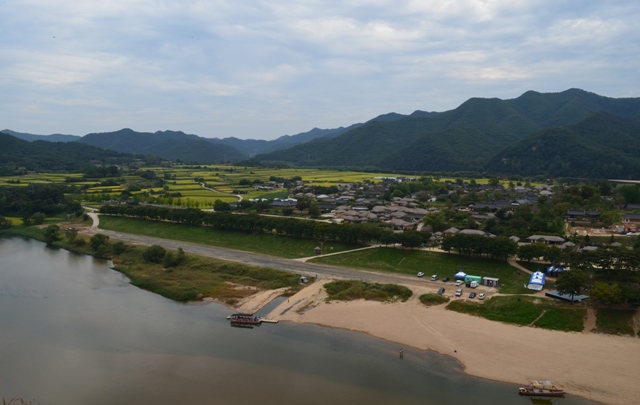
The previous weekend, I made my way south to Andong for the Andong Mask Festival. The two-week annual festival is held in two main areas: the Mask Festival site in town (the subject of the next post) and the Hahoe Maeul Folk Village. If you’ve been to the Korean Folk Village in Suwon, the first thought could be that this village is another sort of museum. However, this is a real, living village for people to live and work.
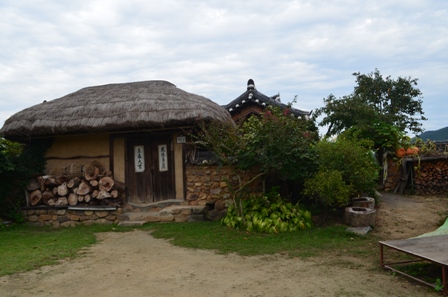
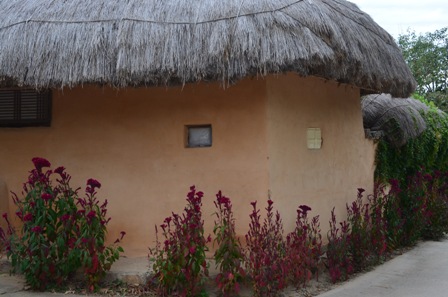
Andong Hahoe Maeul thatched huts

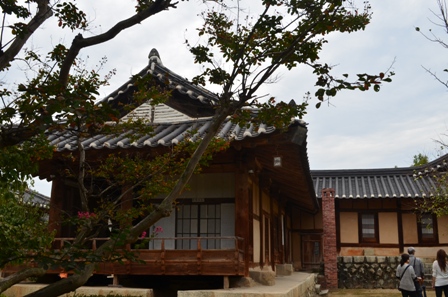
Hahoe is a village where the Ryu family originated and where its descendants have lived together for 600 years. The tile and thatched roofed homes have been preserved for hundreds of years (though undoubtedly reinforced with modern construction), even though the village dwellers have modern conveniences like cars, electricity, running water, indoor plumbing and satellite television.

Andong Hahoe Maeul Bukchon Residence

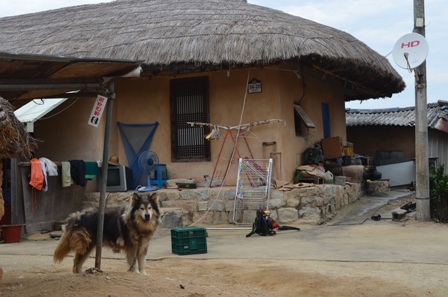
Andong Hahoe Maeul thatched hut with fluffy dog

The village is a pleasant place to spend a couple hours. Visitors can walk through the village peacefully among people living their lives. There are restaurants and stores for visitors, and there are just normal homes for individuals to live their lives.

Andong Hahoe Maeul stone walkways

Andong Hahoe Maeul flower lined street

The village is tucked among the surrounding mountains and is set along the Nakdong River, which flows are the river in a S shape and gives the village name. Ha means river and hoe means turning around.

Andong Hahoe Maeul thatched hut autumn scene

Andong Hahoe Maeul home with trees

Andong Hahoe Maeul hut with orange berry tree

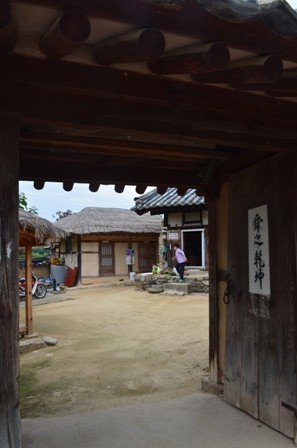
Visitors can walk around the village and peek into open doorways of walled homes to get a glimpse of normal village life.

Andong Hahoe Maeul doorway view

Andong Hahoe Maeul thatched roof  hut

In the center of the village resides the Samsindang, called the Samsin Goddess Tree. The zelkova tree is 600 years old. The tree is in the residence of the Samsin Goddess, who oversees pregnancy and child birth. Visitors can leave wishes around the tree.

Andong Hahoe Maeul Samsin Goddess tree

When you are done walking around Hahoe Maeul, you can cross the river on a small ferry for a small fee for a round trip (there is no bridge across the river anywhere near the village) and hike a short way up Buyongdae Cliff for a beautiful overlook of the village below (the lead picture on this post). You can also see the crop fields that surround the village and the river as it stretches around the village.

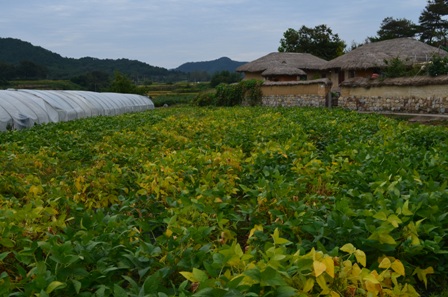
Andong Hahoe Maeul crop fields

Andong is very easy to reach from Seoul by public transportation. There are numerous daily buses from Dong Seoul Bus Terminal, but I prefer the train if there is that option. Most of the trains leave from Cheongnyangni Station (a stop off subway line 1). There are approximately seven trains daily and the direct train ride lasts approximately four hours.

From the Andong train station, Hahoe Maeul is pretty easy to reach, but don’t make the mistake I did. I got on the wrong numbered bus and it wasn’t just the wrong bus, but it was also heading in the wrong direction. I’m normally very good with directions, but sometimes I have to guess when it comes to vague directions. My guide book said I could take the #3 bus and it was supposed to go to Hahoe Maeul. That is not true. I ended up at the Andong Culture Complex (I saw that on the bus, and thought that was the right destination) and there was no one around and quickly figured out I was in the wrong place. Thankfully another bus came along shortly after that and I went back to the train station. If you take the bus to Hahoe Maeul, you need to take bus #46. Cross the street from the train station and head left to the bus stop. There are buses to the village approximately once an hour, and the trip takes approximately 30 minutes. However, if you don’t want to wait, you can easily take a taxi to the village, and the cost will be approximately 30,000 won (less than $30 USD depending on the exchange rate).

Hahoe Maeul is an interesting view into how villages used to look several hundred years ago, but it blends well into the modern world.

Hong Kong Disneyland

Hong Kong Disneyland selfie

The second half of my Lantau Island day trip was spent at Hong Kong Disneyland. I realize that some fellow travelers have a rather negative view of Americans who partake in American things overseas- like it means we are ugly Americans. I’ve encountered this view on more than one trip, and this one was no different. But hey, I get used to it and just enjoy what I want to do.

Hong Kong Disneyland train station

Hong Kong Disneyland Main Street and me

I enjoy almost all things Disney, and I’ve visited most of the Disney parks around the world. I went to California Disneyland way back in 1985 when I was just eight years old. I visited Disney World for a few days in 2009. I enjoyed Disneyland Paris back in 2008. And now Hong Kong Disneyland. The only one left on the list is Tokyo Disneyland, and I intend on checking that (or at least Tokyo’s unique addition to the Disney family-DisneySea) on my next trip to Tokyo next year.

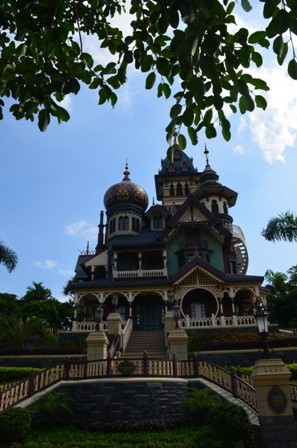
HongKong Disneyland is obviously a smaller version of American Disneyland. It is located on Lantau Island, which is where the Big Buddha is located, along with Hong Kong International Airport. Many of the icons of American Disneyland are represented in HongKong Disneyland, sometimes with a bit of a twist on them. There is a Main Street, a Sleeping Beauty Castle (though substantially smaller than Disneyland or DIsneyworld). There is Tarzan’s Tree house (as opposed to the Swiss Family Robinson Treehouse), a Jungle River cruise, a Hong Kong version of Big Thunder Mountain Railroad (called Big Grizzly Mountain Railway Mine Cars) and Haunted Mansion (called Mystic Manor here), Cinderella Carousel, Space Mountain, Orbitron, and most of Fantasyland.

Hong Kong Disneyland castle with flowers

Hong Kong Disneyland Mystic Mansion

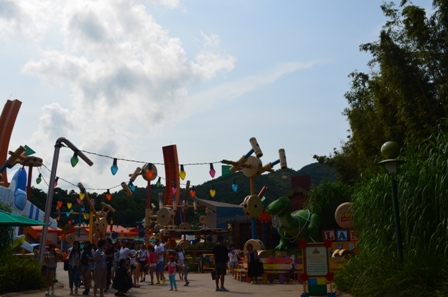
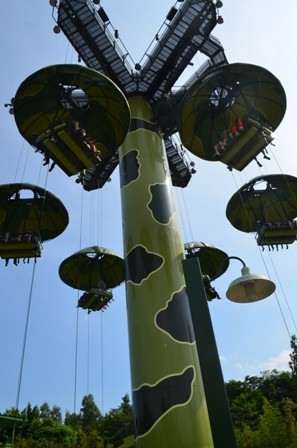
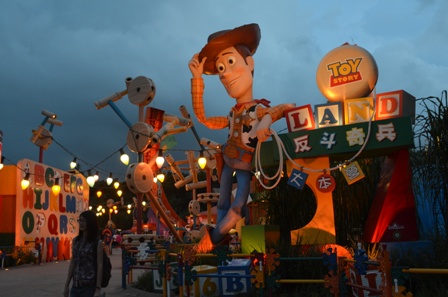
Now I haven’t been to American Disneyland in nearly 20 years, so I don’t know if these new places have been added, but they weren’t at DIsneyWorld or Disneyland Paris. Toy Story Land has  a couple fun rides, including Toy Soldier Parachute Drop and RC Racer. I have to say, for a Disney park, RC Racer was definitely a thrill ride as a roller coaster that rocks back and forth and achieves a nearly vertical drop.

Hong Kong Disneyland Toyland night

Hong Kong Disneyland Toyland

Hong Kong Disneyland parachute drop

Compared to Big Thunder Mountain Railroad, Hong Kong Disneyland’s version of Big Grizzly Mountain Railway Mine Car was way more thrilling than the American original. This roller coaster was faster, with sharper turns, and it incorporated elements of my favorite Disney roller coaster, Expedition Everest at Disneyworld’s Animal Kingdom. However, I felt their version of Space Mountain was a bit lacking in scary thrills that you come to expect from Space Mountain. Now granted I am not a Space Mountain connoisseur, though I wish I was. When I was at Disneyland all those years ago, the wait was two hours (this was in the days before FastPass), so I didn’t get to ride it. When I went to Disneyworld, it was down for maintenance. So the only other Space Mountain ride I’ve been on was Disneyland Paris, and that one was a terrifying thrilling ride (in all the best ways), so I was a bit let down at Hong Kong Disneyland. Maybe it was simply a space factor, so the ride couldn’t be as big as it is in other parks.
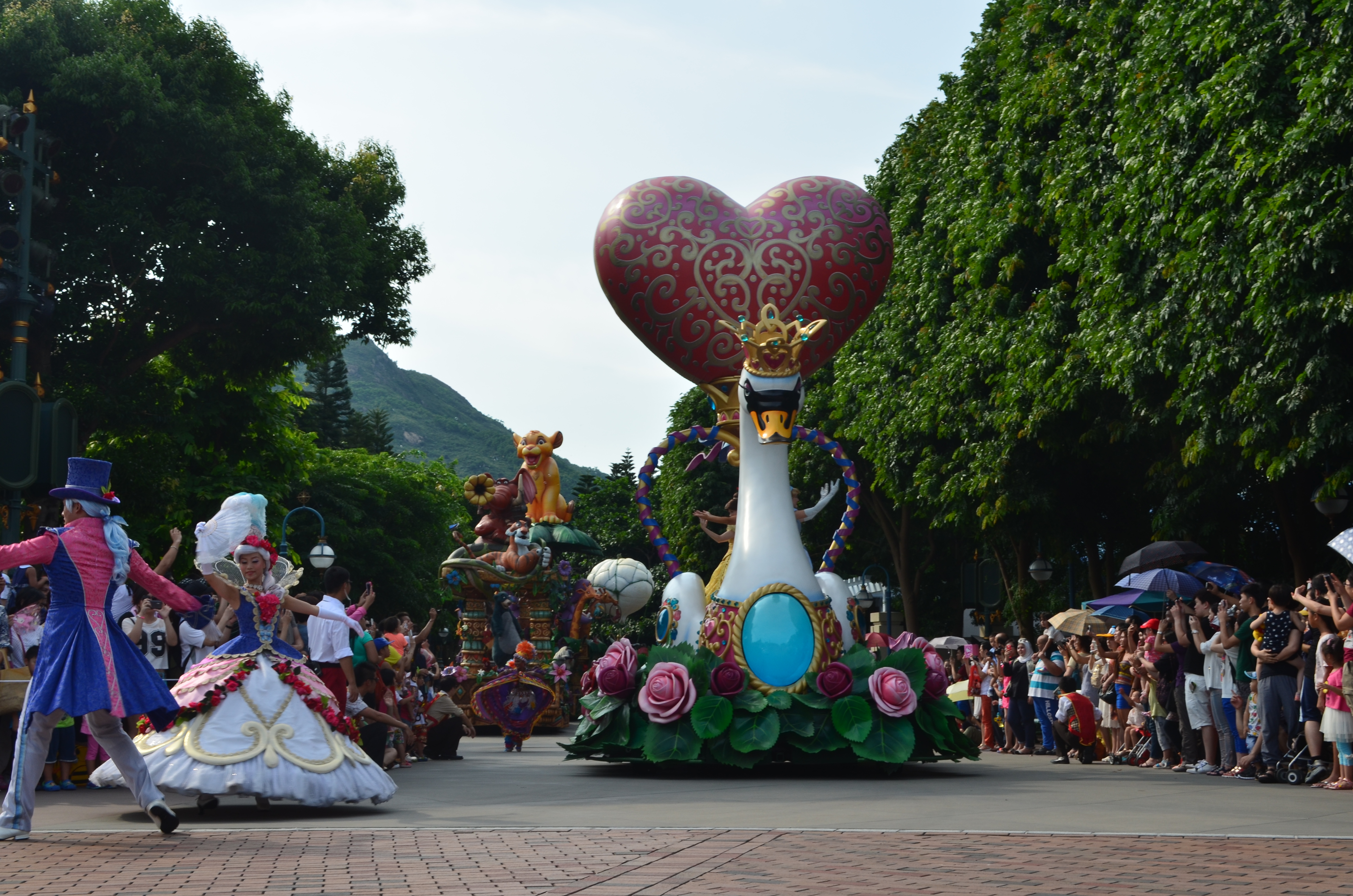
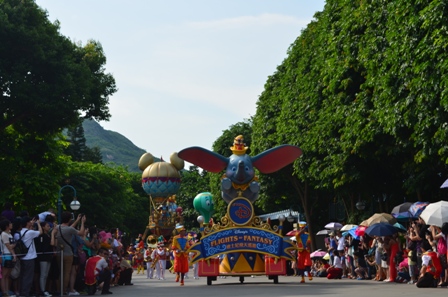
There is a nice afternoon parade to enjoy, and a fireworks show at closing time.

Hong Kong Disneyland parade 1

Hong Kong Disneyland parade 7

Hong Kong Disneyland parade 5

The weather held up the vast majority of the day, even though dark ominous clouds hung over the park all day. In fact it waited until roughly 30 minutes prior to closing before a true subtropical rain storm unleashed on everybody. This photograph doesn’t do justice to the absolute torrential rain that was pouring down.

Hong Kong Disneyland raining

Thankfully the rain stopped roughly 10 minutes prior to closing and the subsequent fireworks show (covered in the next post).

Hong Kong Disneyland Main Street and castle night view

Overall, Hong Kong Disneyland is an enjoyable way to spend an afternoon and a microcosm of American Disney parks. I deliberately chose to go on a Monday, figuring it would cut down on the crowds, and I was so correct. I never waited more than 10 minutes for any one ride, and on many of the rides, they have a separate line for single riders. The one ride that did have a 30 minute ride had the single rider line and I literally walked on to the ride with zero wait. I wish more theme parks would institute this option for single riders. In fact, the largest crowds were seen during the afternoon parade and the evening fireworks show. Getting to and from Hong Kong Disneyland is super easy. Catch a ride on the Tung Chung MTR line and transfer at Sunny Bay station (a roughly 40 minute train ride from Hong Kong station) for a special train to Hong Kong Disneyland resort.

Hong Kong Disneyland Tommorowland

Hong Kong Lantau Island day trip

Hong Kong Lantau Big Buddha statue

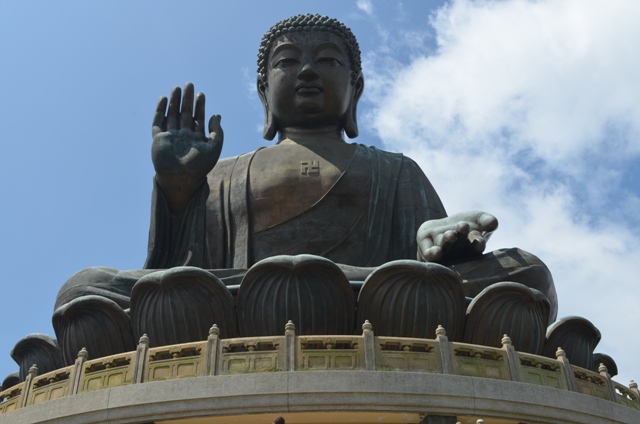
My day trip for my Hong Kong trip was a visit to Lantau Island. That island is the biggest in the Hong Kong archipelago, though it is sparsely populated. It is home to the international airport and Disneyland Hong Kong (subject of another post). But the rest of the island is filled with thick forests, small mountains and fishing villages. For the first half of my day trip, I decided to visit the Lantau Big Buddha (or its proper name, the Tian Tan Buddha) and the Po Lin Monastery. It is rather easy to visit both, since they are co-located in the same place. I had intended to ride the Ngong Ping Cable Car to get there. It starts right next to the Tung Chung MTR stop (the last stop on the orange Tung Chung Line. It takes about 45 minutes to reach from Hong Kong Station) and the 25 minute trip will take you straight to Ngong Ping village and provides unparalleled views of Lantau Island (I assume). However, the day I got there, I saw the sign that stated that the annual three weeks of maintenance on the cable car started that day. I was bummed, but there is always a bus (#23) that travels from the MTR stop to Ngong Ping village. It leaves approximately every 30 minutes, though in reality it will leave early if the bus is already filled to capacity with passengers. So while I didn’t get the aerial view of Lantau Island, I got a mini bus tour as the circuitous route wended its way through some fishing village before making the steep ascent to Ngong Ping village. The Big Buddha has only been there since 1993, and until 2007, it was the tallest outdoor seated bronze statue of Buddha. The Buddha is over 100 feet tall, and in fact can be easily viewed from below on the bus ride as you make your approach.

The Buddha itself is right next to the Po Lin Monastery.

Hong Kong Lantau Po Lin Monastery entrance gate

Hong Kong Lantau Po Lin Monastery plaza

As you are in the square, you can easily see the Big Buddha towering over the square.

Hong Kong Lantau Big Buddha wide view

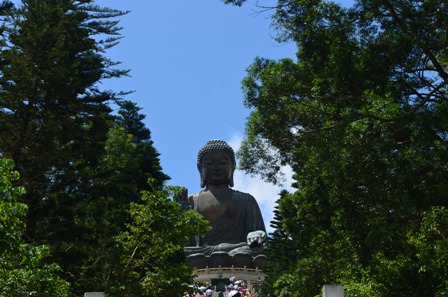
Then you get to the bottom of the stairs. It is 268 steps to the top and the view from the bottom looking up at the Big Buddha is beckoning you, or taunting you, depending on your views of things.

Hong Kong Lantau Big Buddha stairs

When I saw the stairs, I was reminded of the old Nike commercial from 1993 where a couple rapidly runs up the stairs of the Jaguar Temple in the Mayan ruins of Tikal. While I wish I can say I sprinted to the top, I did fairly well for the first 75% of the stairs before I started to feel the stairs, and more importantly, that wicked subtropical sun. This morning was the best weather of my trip, and the sun was high, bright and hot as it was pounding down on my head. And I stupidly forgot to bring my hat with me that day (at least I remembered the sunscreen and sunglasses).

Hong Kong Lantau Big Buddha tree frame

Hong Kong Lantau Big Buddha selfie

Once you are at the top, you can walk around the Buddha. There are numerous smaller statues surrounding the Big Buddha, and there are some very nice views of Lantau Island. Some of those views reminded me of forest views of Kauai with the hills and thick greenery.

Hong Kong Lantau Big Buddha statue view

Hong Kong Lantau island view

Hong Kong Lantau Big Buddha side view

The descent is not as strenuous as the ascent. I was hoping to see more of Po Lin Monastery, but the vast majority of it was under renovation. You can still walk through the gate and the open square, but the monastery itself was until piles of scaffolding.

While there wasn’t currently much to see at Po Lin Monastery, and there was no sign saying when the renovation would be complete, make sure you stop in the dining hall for lunch. Between 1130 and 1630 every day, you can purchase a vegetarian lunch on the premises. Tickets are available either right next to the dining hall, or at the bottom of the stairs to the Big Buddha. HK $80 will get you a standard lunch outside, but for a mere HK $118 (less than $15 USD) gets you the deluxe meal. That meal is inside in the dining room and you are given a fabulous, delicious vegetarian spread. When I was there, I had this thick, tasty mushroom soup, vegetarian spring rolls, sauteed greens and mushrooms, stir fried vegetables and rice. If you choose to bring your own lunch, you can sit outside and enjoy it, though heed the signs that say that no meat or alcohol is allowed on the premises (Buddhists are vegetarians).
Hong Kong Lantau Island Po Lin Monastery lunch

There are other things to see and do up there. There are some other Buddhist hermitages you can walk to. If you wanted, you could climb up to the top of Lantau Peak, a walk that supposedly takes around three hours round trip. You can explore the Ngong Ping village. But for the most part, you can see the main sights in half a day. I would have taken more time there, but I had other plans for my Lantau Island day trip (covered in the next couple of posts).

Hong Kong night view

Hong Kong night skyline colorful

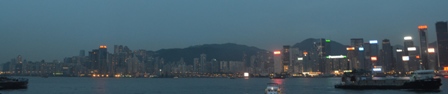
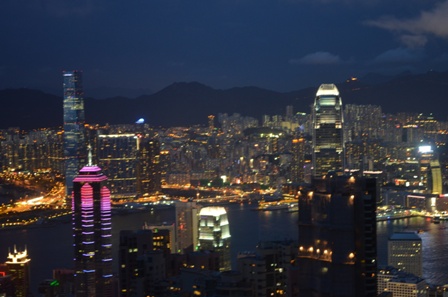
I adore night views of any sort. I love them in the country, because there is no light pollution. You can see all the stars and planets that you just can’t see in the city. But even though it is a very different view, I adore city night views. The lights and the activity is so invigorating. Plus a bonus in Hong Kong in the summertime, is that temperature drops into a more pleasant warmth. There are a wide variety of ways to see Hong Kong at night. As I mentioned in a previous post, I HIGHLY recommend you view Hong Kong from The Peak at night for the widest view of the city. But you can see the skyline view from sea level on both sides of Victoria Harbor or from The Star Ferry. My first night in Hong Kong, I walked around Kowloon, just calmly taking in the views from the pier.

Hong Kong night island skyline

Hong Kong night selfie skyline

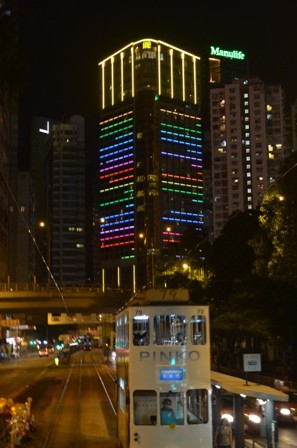
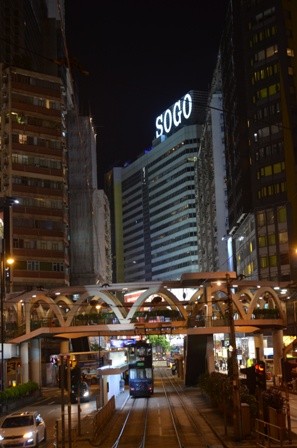
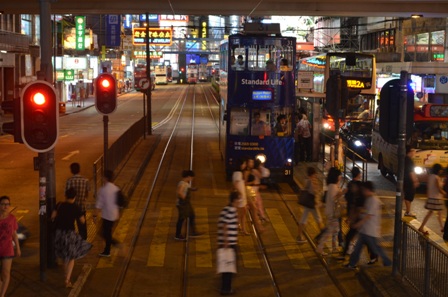
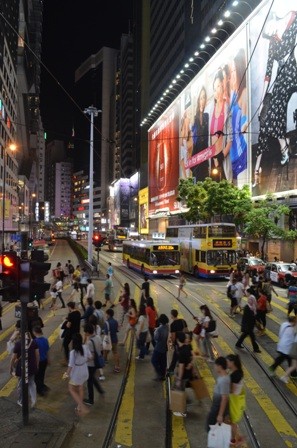
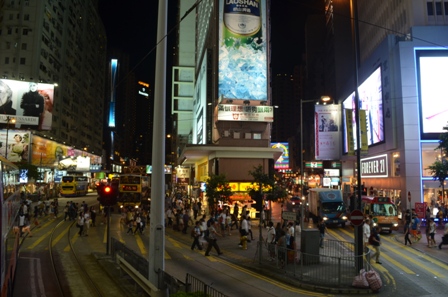
But another way to see Hong Kong at night, or at least part of Hong Kong Island, is to hop on a tram and ride it for as long as you want (or until it ends-whichever comes first). The tram is an old remnant of Hong Kong’s earlier public transportation. It still exists, though the same route is covered by busses and subways. But there is something very peaceful riding in the trams, at least at night. It is a historical throwback to older days in Hong Kong.

Plus it is also cheap. A ride is approximately HK $2.30, regardless of how long you ride. If you don’t like carrying around exact change (like me), this is another Hong Kong transportation system that takes the Octopus Card. Seriously, if you do go to Hong Kong and plan on doing much of any riding on public transportation (and I mean ANY, including all subways, most busses, all trams, including The Peak tram, the Star Ferry), I HIGHLY recommend you buy an Octopus Card. You can buy the card at any subway stop customer service center and top off the card with more revenue at any subway stop. It is just so much more convenient to swipe a card rather than juggle around for exact change.

Anyway, I chose to ride the tram at night. You can ride it during the day and get a good sightseeing tour for cheap, but there tends to be more people on the tram. When I rode, I was able to get a front view on the second level, so I had the best view of Hong Kong. Like I said, it is a very peaceful way to enjoy the lights and the beauty of the city around you while a warm summer breeze blows through your hair.

Hong Kong at night 3

Hong Kong at night 2

Hong Kong at night 5

Hong Kong at night 1

Hong Kong at night 6

Hong Kong at night 7

Hong Kong at night 4

There are plenty of people out walking around at night, going to restaurants, shopping and the like. You can choose to participate, or you can just sit back and enjoy the view.

Hong Kong parks

Hong Kong park title picture

Hong Kong is certainly not the only large city to have an abundance of green space and parks, since that is true of most of the very large cities I’ve visited. What I can say is that Hong Kong is the first metropolis I’ve visited in a sub-tropical climate. I was there in early September, which is the tail end of their summer and typhoon season. It was almost unbearably hot at times. It was a different sort of summer heat than I experience in Seoul. In Seoul, whether it’s the close confines of the buildings trapping the heat, or it is farther from the sea, I’m not sure, but during the height of summer, I could walk outside for a short period of time and literally have sweat pouring down my face and body (it doesn’t help that I sweat very easily). Hong Kong is definitely hotter and more humid, but in some strange way, it was more tolerable. Maybe it’s because, except for half a day, there were clouds in the sky that protected from the most brutal of the sunlight. Or maybe it’s because Hong Kong is on the water, so you can often get sea breezes to cool you down.
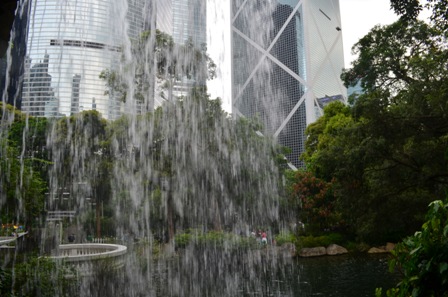
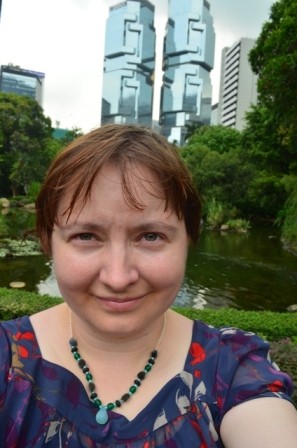
But in any case, there are plenty of parks to enjoy. Hong Kong Park fascinated me, because it is a small, green space right in the middle of the financial district. So you would be admiring trees and plants and fountains and look up and see a super modern building towering over you. But what always caught me was the sub tropical plants that you don’t see in Tokyo, Seoul, London or New York City parks.

Hong Kong park Lippo building

Hong Kong park waterfall architecture

Hong Kong park fountain and building

Hong Kong park architecture tree frame

Hong Kong park stairs

One of my favorite parks is actually in Kowloon, and it is the Kowloon Walled City Park. Nowadays the park is located in what is nearly the far north of Kowloon Peninsula. It’s most easily reached by taking the subway (called Mass Transit Railway or MTR) green line (Kwun Tong Line) to Lok Fu station and walking 15 minutes from there, or taking the number 1 bus from the Star Ferry stop to the park bus stop. But what is now deep into Kowloon Peninsula used to actually be right on the water. It really does help visualize just how much of Hong Kong is built on reclaimed land within the past 150 years.

Back in the day (meaning around 1847 after Britain took over Hong Kong Island), Kowloon was a lot smaller, and what is now the walled city park was actually Kowloon Walled City, which was a small garrison the Chinese used to defend Kowloon. The walled city fell into a governmental limbo in 1898 after Britain took over the New Territories, but the Chinese didn’t consider the walled city to be part of those territories. So for decades, the walled city sort of remained ungoverned and  just developed its own lifestyle and set of laws. Along with that, the walled city became a boon for the drug trade and unlicensed dental clinics. People built up and up within the walled city, but there didn’t seem to be much in the way of building regulations or health standards and the walled city was sort of an unregulated slum within the middle of Hong Kong, even though the Hong Kong government made attempts over the years to raze the walled city to the ground. It finally happened in 1993 and the walled city was converted to a park. Below is a diagram of what the park looked like when it was an actual walled city. The park has a permanent exhibit talking about the history of the park. It’s small, but it shouldn’t be missed, because the history is really fascinating and it’s amazing to see pictures of what life used to be like in the walled city and compare it to the green, tranquil park before your eyes.

Hong Kong Walled City Park old view

Now it is actually a very pleasant park filled with trees, walking pathways and small hints here and there of the structures that used to exist in the walled city. You can see remnants of the Old South Gate that was excavated after the demolition.

Hong Kong Walled City Park South Gate

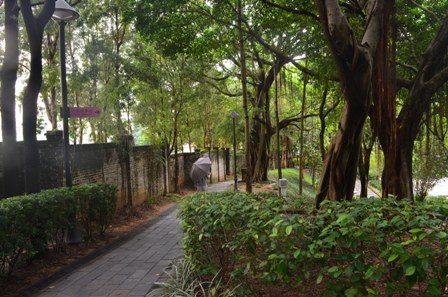
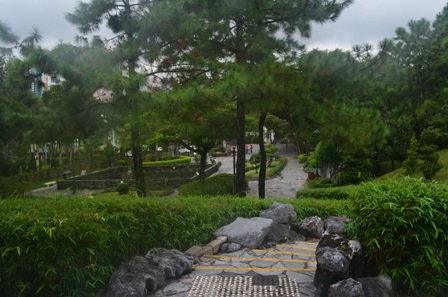
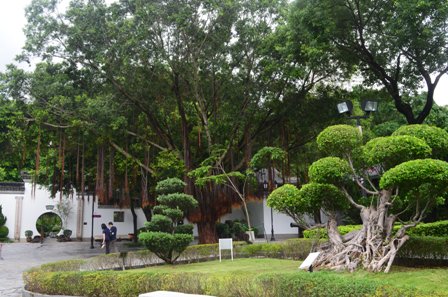
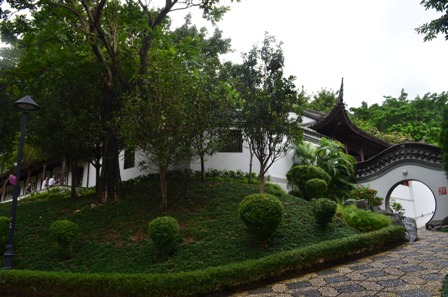
Even though very few historical sites remain in the Walled City Park, it is still calm, quiet and you see people walking or doing tai chi in peace. Even though as you can see, this park is not in some isolated corner of Kowloon, but rather right in the middle of a collection of high rises (like pretty much the rest of the city).

Hong Kong Walled City Park 1

Hong Kong Walled City Park 2

Hong Kong Walled City Park 3

Hong Kong Walled City Park 4

Hong Kong Walled City Park 5

Hong Kong Walled City Park 6

Hong Kong Walled City Park 7

Hong Kong architecture

Hong Kong architecture title picture

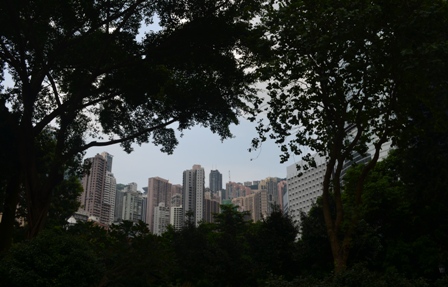
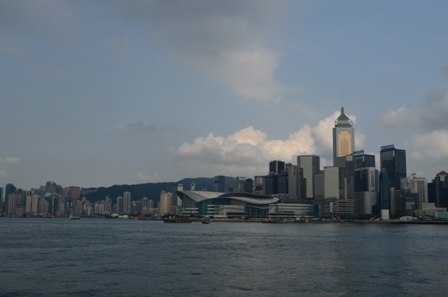
Hong Kong is in many ways like other large cities I’ve visited around the world, and yet like every city, it has its own personality and character. And there was an interesting dichotomy in the super fancy skyscrapers in the financial Central District, and the buildings spread throughout the rest of the city. Pretty much everywhere you go, it is a given that you will be surrounded by very tall buildings. I can only imagine what it would be like to live there all the time. I picture how dark some of the streets might get during very cloudy days. And of course there is the difference in the beauty of the skyline from a distance, and the different sort of beauty when you are smack in the middle of the maze of buildings and they rise up all around you. I got plenty of opportunity to see the skylines from a distance on both sides of Victoria Harbor. Kowloon and Hong Kong Island are only separated by a approximately five minute ferry ride on The Star Ferry (plus actual subway train lines), so you can easily take in the views from both sides.

Hong Kong architecture skyline Kowloon

Hong Kong architecture Kowloon skyline

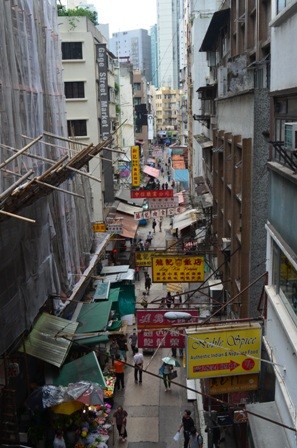
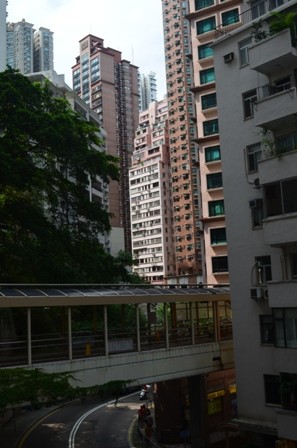
Then you get to the maze of buildings on Hong Kong Island. The streets rise up steeply in parts from Central District, to SoHo (south of Hollywood Road), all the way up to Mid-Levels, which is located about halfway up the hill from Central District and The Peak. You can walk easily and painlessly from Central to Mid-Levels, through a series of escalators. What’s interesting about these escalators, is that there is only one set. They come down from the Mid-Levels to Central from approximately 0600 am to 1020 am. This is presumably to support the large commute of individuals who live in the Mid-Levels but work in the Central District or beyond. After that, the escalators only ascend for the rest of the day. It’s very easy to take the escalators to Mid-Levels, but keep in mind that you will be descending the stairs on your own (it’s not tremendously difficult). What caught my eye when walking around looking at the architecture is just how colorful some of the buildings are,  and how densely packed they were in some areas.

Hong Kong architecture 10

Hong Kong architecture 8

Hong Kong architecture 7

Hong Kong architecture 9

The picture below was an interesting capture. I’m not exactly sure what is going on with the groups of people I saw camped out around town, mainly in places near Hong Kong Station and the like.

Hong Kong architecture 11

Hong Kong architecture 12

In both of these pictures you can see large groups of people congregating. Now Hong Kong is constantly filled with large groups of people, but what was interesting here was that these groups were just hanging out. I could never quite figure out what they were doing, but I also never asked either. None of them looked homeless, because they certainly weren’t begging for money, nor were they looking to sell anything. But on many of these walkways, you would see small areas segregated by cardboard and groups (families?) of women and girls (no men) just hanging out, sitting, talking, playing games and enjoying food. I wondered if maybe they were hanging out like this, because they didn’t have air conditioning at home and sitting out like this would get at least some cooling breezes at times. Whatever it was, it is very much part of the culture of the city, because nothing seemed overly amiss about it.

Hong Kong is a city with a LARGE population density. This is definitely not a place to go to get away from it all and be alone. But it is very interesting to compare and contrast the supermodern skyscrapers with the older parts of the city and see how it all meshes together into one community.

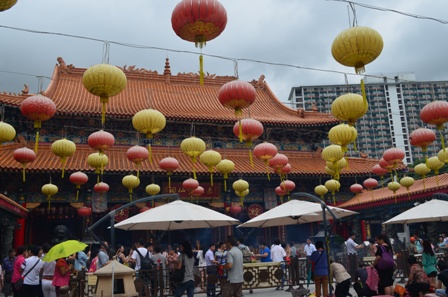
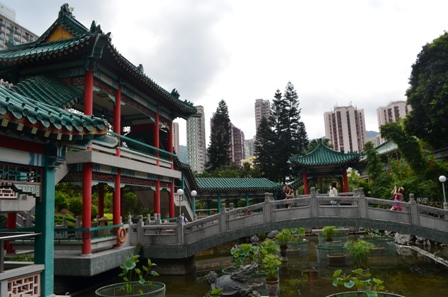
Another interesting trip was to see the Wong Tai Sin temple, a Taoist temple in the far north of Kowloon Peninsula. It is easily reached by taking the subway (MTR), green line Kwun Tong Line to the Wong Tai Sin stop. Take exit B2, and you will exit right in the plaza before the temple. The temple was only built in 1973, but it is very popular. It is very colorful and beautiful and it’s easy to walk around the temple grounds and see pictures of all the different gods represented at the temple. There are even some temple gardens to wander. Admission is free, with a requested donation of whatever you want to pay. Like everything about urban life, I find it interesting to look out from a religious temple grounds and see the skyscrapers around me. I know I write about it a lot, but I grew up in a TINY town with few people and lots and lots of trees. So these views are very different and very interesting to me.

Hong Kong Won Tai Shin temple entrance

Hong Kong Won Tai Shin temple plaza

Hong Kong Won Tai temple worship

Hong Kong Won Tai temple city view

Hong Kong Won Tai temple gardens

Hong Kong’s The Peak- a view from the top

Hong Kong The Peak skyline day

I spent Labor Day weekend 2013 in Hong Kong, and I really enjoyed it. Hong Kong was on my Asian travel list for years, and now I was finally able to go there. The city both seemed very familiar and interestingly exotic. I live in Seoul, so I’m not oblivious to the interesting dynamics of large Asian cities. And at times, parts of Hong Kong (particularly in Kowloon) reminded me of some of the narrow streets of different Chinatowns of large American cities. And other times (like in the Central district of Hong Kong Island), the city could be any large city with a financial district, like New York City. But even more than Seoul or Tokyo, I was struck by the sheer amount of population density in Hong Kong. Mind you, the Greater Seoul Metropolitan Area has around 25 million people (roughly 50% of the population of South Korea), but it didn’t feel as tightly confined as Hong Kong. Maybe it’s because the urban sprawl of Seoul seems greater and the clusters of high rises are more spread out, whereas everything in Hong Kong is closely packed together.

One of the best ways to get a bird’s eye view of Hong Kong is ascend to The Peak, which is the tallest hill in Hong Kong. It’s also one of hte most exclusive neighborhoods in Hong Kong, with mansion and apartments that cost an arm and a leg. There are a few ways to get to the top, but one of the quickest (in terms of ride length, and ignoring the wait in line) and most interesting is to take the tram.

Hong Kong The Peak tram

The Peak tram has been in operation for over 120 years, though the trams themselves have been upgraded over the years. It is HK $28 to ascend to the top, and HK $12 dollars to descend. If you don’t have an Octopus Card, or previously purchased tickets, you have to purchase them on site, but the ticket office is reached during the wait to actually get on the train. The tram can fit approximately 120 people on each trip, both standing and sitting, though I REALLY don’t recommend you choose to be one of the ones who stands for the trip. The trip may be only approximately eight minutes, but the ascent feels nearly vertical at times. Trust me, you are going to want to sit down and enjoy the view (sit on the right side of the tram on the ascent to see the best view in my opinion). I decided to get to the top of The Peak about 90 minutes before sunset to fully enjoy a day view and then be around to take advantage of a full night view. The wait for the tram really was only about 30 minutes, and that was when the line was pretty long.

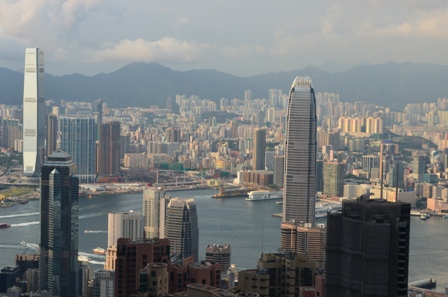
In any case, once you get to the top, you have a variety of options. You’ll disembark in the large, multi-floored Peak Tower. You can go to the top of the mall to the Sky Terrace, which costs HK $35 for the view. If the cost just doesn’t do it for you, there is a free observation desk next to the mall. It’s at a lower level, but the view is still nice (as you’ll see from my night pictures). It was really cool to just stand up there and take in the full view of the northern side of Hong Kong Island and Kowloon across Victoria Harbor. It really makes you appreciate just how dense the population is in Hong Kong.

Hong Kong The Peak Victoria Harbor day

Hong Kong The Peak skyline cloudy

Hong Kong The Peak selfie day

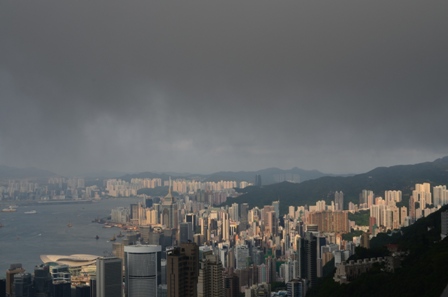
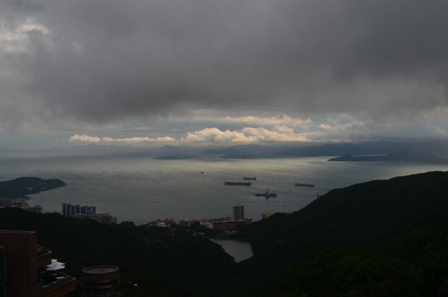
The observation deck is not quite on the exact top of The Peak, but the actual peak tends to attract clouds. Even while I was there, dark clouds were lurking about and threatening to pour out some rain (as you can see in the dark clouds in some of the pictures above), but the weather stayed clear while I was up there.

Hong Kong The Peak cloudy

After fully admiring the day view, I took a short walk around the top. There are pedestrian roads around the top that enables you to see the other side of Hong Kong Island, and also enjoy the thick foliage.

Hong Kong The Peak sunset view

There are plenty of stores and restaurants on top, along with such tourist “attractions” like Madame Toussard’s. But after enjoying some ice cream, I just patiently waited for it to get dark and was rewarded with a very beautiful night view. The lights of Hong Kong really do shine bright at night.

Hong Kong The Peak skyline wide

Hong Kong The Peak night skyline

Hong Kong The Peak nighttime skyline

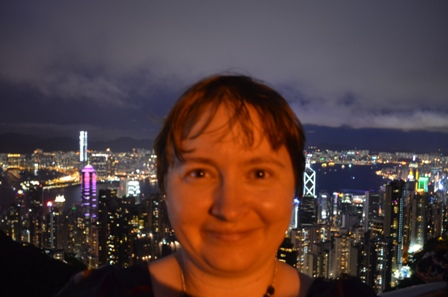
Hong Kong The Peak selfie night

You descend The Peak the same way you ascended and an eight minute tram ride later, you are back at sea level. The Peak tram is open from 7am to midnight, so there is ample opportunity to see it. Assuming the weather is clear, this is definitely a not-to-be-missed view. It really is the best way to take in the full view of Hong Kong below you.

Palgonsan Provincial Park autumn foliage painting

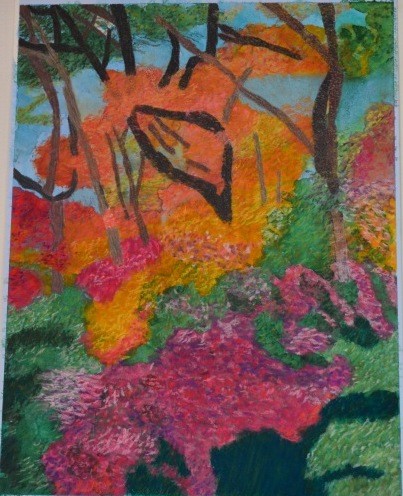
my painting of Palgonsan Provincial Park fall foliage

Thus continuing my love of brightly colored landscapes and a desire to make brightly colored paintings. This painting was accomplished with a watercolor underpainting, watercolor pencils for the trees, and hard pastels for the foliage texture. I chose this particular picture to paint, because I really liked all the wild, natural colors.

my painting of Palgonsan colorful forest interim 1

I first applied masking fluid to all the trees to save the white. Then I laid down a multi-colored watercolor underpainting roughly corresponding to the colors of my desired endstate. I didn’t try to be very restrictive in the sense of coloring in exact lines, but rather a bit more free flowing and abstract.

my painting of Palgonsan colorful forest interim 2

After the underpainting dried, but before I applied the foliage texture with hard pastels, I used watercolor pencils for the trees. I pulled up all the masking fluid and laid in the trees with a variety of colors. I like watercolor pencils more than normal colored pencils, because I can layer all the colors and the detail like a normal colored pencil, but then I can make a rich, controlled wash with the watercolor. Then I finished up the painting by applying layers of differing colors of hard pastel to recreate the image of foliage.

Palgonsan Provincial Park red orange and yellow leaves

This was my reference photo. It was taken during a nice day hiking in Palgonsan Provincial Park one Saturday afternoon in October. I was completely taken by all the natural colors. Palgonsan Provincial Park was very easy to reach. I just took one of the numerous KTX trains from Seoul Station down to Dongdaegu, which was only about two and a half hours away by express train. The local bus number 1 out to Palgonsan Park and then just hike to your heart’s content and enjoy the beautiful Donghwa Temple and the beautiful nature. It made for an easy and pleasant full day trip.

My painting is certainly not photo realistic, and part of me wishes that it was. But another part of me likes the more impressionistic nature of the painting and thinks it captured the abstract colorful nature of that autumn foliage.  I still need to work on representing light sources accurately. I’ve been trying to branch out my technique and move away from attempting to recreate the reference photo as much as possible, to a more abstract capture of the scene.