Seoul Lotus Lantern Festival 2013 Cultural Experiences

me at Lotus Lantern Festival


Sunday was the third day of the Lotus Lantern Festival, and that day is all about cultural experiences. The street in front of Jogyesa Temple is turned into a street fair dedicated to all things Buddhism. Over 100 different booths are set up enabling participants to learn many different things.

Lotus Lantern Festival crowd


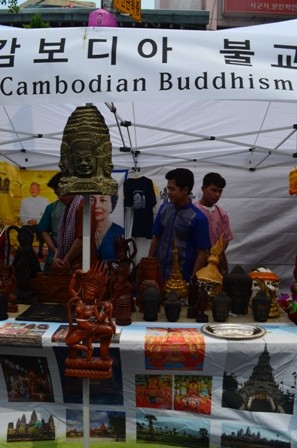
Examples: different forms of Buddhism in different countries.

Lotus Lantern Festival Cambodian Buddhism


Lotus Lantern Festival Thai Buddhism


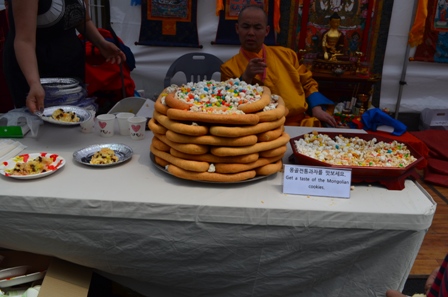
Try different tasty Buddhist foods, like Mongolian cookies and rice dishes:

Lotus Lantern Festival Mongolian Buddhism


There are also many opportunities to try a wide variety of crafts. There are more crafts than one can do in one day. Participants can make paper lotus flowers. They can craft a bracelet of Buddhist prayer beads. You can make Korean paper or lotus shaped candles. You can decorate masks or make clay objects.

Lotus Lantern Festival candle making

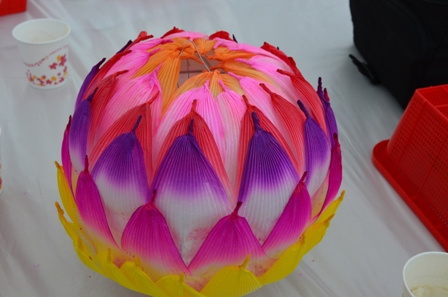
But my absolutely favorite activity at this festival was making a full size paper lotus lantern. The festival as an area marked off for foreigners to make lotus lanterns.

Lotus Lantern Festival lantern making


The activity is completely free and you are given all the materials you need to make a lotus lantern in a variety of colors. Some people made unicolor lanterns that resembled a real life lotus flower. And other lanterns were a rainbow of bright colors. Making a lantern is rather time consuming, but pleasantly contemplative.

Lotus Lantern Festival lantern instructions

It’s actually a bit more involved than you might think having to twist and glue every sheet of paper onto the lantern.

Lotus Lantern Festival lantern in progress


But it’s all worth it at the end when you have your very own colorful lotus lantern to take home with you.

Lotus Lantern Festival lantern complete


Overall the Seoul Lotus Lantern Festival is one of the best festivals I’ve ever been to. The setting in Jogyesa Temple, decked out with thousands of colorful lotus lanterns is beautiful. The parade is quite a sight to behold. And the cultural experiences day is an enjoyable learning experience.

Seoul Lotus Lantern Festival Parade 2013 part 2

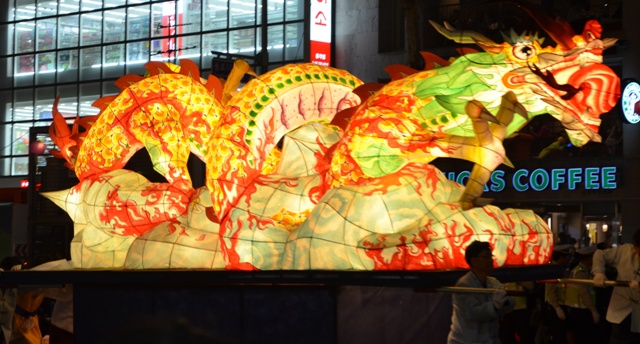
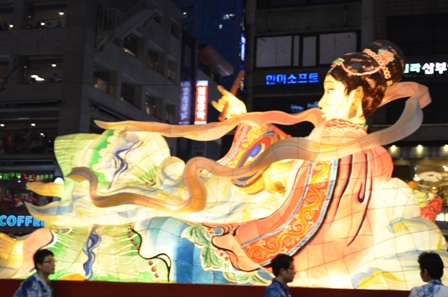
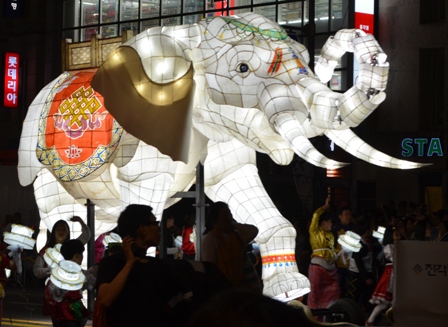
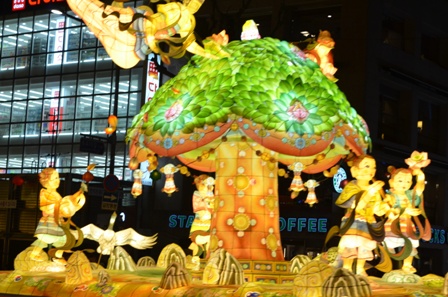
Lotus Lantern float (3)My favorite part of the Lotus Lantern Festival was the abundance of lantern floats that look absolutely amazing at night.  These floats ranged from traditional images like dragons and tigers to more contemporary images of children’s cartoons. These floats are just a select few that I particularly loved.

Lotus Lantern float (2)

Lotus Lantern float

Lotus Lantern float (7)What was interesting about so many of these floats is that they were pushed by hand for the entire parade route. There were some outsize floats that were driven by a vehicle, but more often than not, you would see a group of individuals pushing the float.

Lotus Lantern float (5)

Lotus Lantern float (6)My favorite floats were the abundance of dragons. I’ve always had a soft spot in my heart for dragons. Partly because they are just so exotic and beautiful looking (especially Asian dragons), but also because I am a Dragon in Chinese astrology

Lotus Lantern floats

Lotus Lantern float (9)Capturing these floats at night was an interesting challenge. I have a pretty good camera with an excellent night landscape setting. What it doesn’t do as well (or should I say I haven’t found the right settings) is capturing images at night in motion. More than once, my camera would take too long to focus and either the float passed me by, or the image was blurry. The amount of ambient light from surrounding businesses didn’t help either.

Lotus Lantern float (4)

Lotus Lantern float (8)I would highly recommend the Seoul Lotus Lantern Festival Parade (well, the entire festival, but more on that in a follow on post). As I mentioned before, this is probably the longest parade I have witnessed, and there are so many beautiful floats to marvel and enjoy.

Seoul Lotus Lantern Festival Parade 2013 part 1

Parade marchers (6)

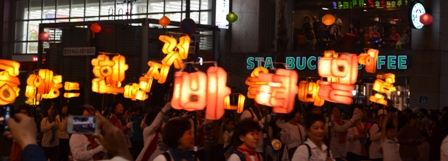
Saturday, May 11th 2013 was the annual Lotus Lantern Festival Parade held in conjunction with the Lotus Lantern Festival. The festival is to honor Buddha’s Birthday and this year the main festival was held May 10-12. The weekend is packed with a variety of religious and cultural experiences that are a lot of fun and informative. The highlight of the festival is the parade held on Saturday night. This parade is one of the best and the longest I have seen. The parade starts at Dongdaemun, the old east gate of Seoul and current home to a large market. It continues west down Jongno Street to the final destination of Jogyesa Temple, the center of the Lotus Lantern Festival. The parade lasts about two hours and consists of a wide variety of lighted lantern floats and marching groups carrying many different types of lanterns.

Parade marchers (4)

I decided to view the parade closer to the ending point about a 10 minute walk from Jogyesa Temple. When you’re short like I am, it is highly critical to get a good vantage spot to view a parade. The city actually sets up a couple rows of seats for people to sit in and watch the parade along parts of the parade route. I initially assumed that they were reserved for tour groups who paid for them, only to discover (a bit too late) that anyone can sit in them. Even when I get higher up, it seems to happen that someone much taller than me stands right in front of me, so I spend the entire parade jockeying my camera for a good position.

Parade marchers (5)

It was interesting to contrast the traditional beauty, meaning and celebration of the parade with the neon signs for modern businesses like Starbucks Coffee and Dunkin Donuts right in the background. Seoul is a very modern city with pockets of traditionalism tucked within it.

Parade marchers (3)

Parade marchers (2)

Tourists even have the opportunity to participate in the Lotus Lantern Parade through a special program that consists of lantern making, dinner, walking the actual parade, and the after parade festivities. The catch is that you have to register for it in advance. I didn’t do it this time, but next year I want to experience the Lotus Lantern Parade as fully as I can.

Parade marchers

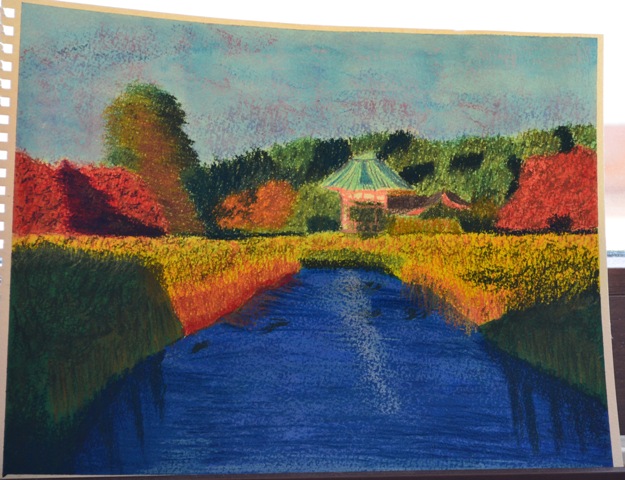
Tokyo Ueno Park Colorful Autumn Foliage painting

Ueno Park autumn foliage painting


This painting was the next in line for my autumn creations. I am deeply inspired by colorful nature, so for the most part, when I take pictures, I try and compose the pictures like I would a painting, because I know that I will probably want to paint it later. I selected this picture (see below), because it had the colorful foliage I like to paint, and it was a different setup than the previous painting from Bukhansan National Park. The composition for this painting reminded me of all the perspective drawings I did in art class as a kid. The majority of the medium for this painting was a watercolor underpainting  overlaid with hard pastels. The gazebo was drawn in watercolor pencil.

The most challenging part of this painting for me was to produce a sense of depth in the water to add to the perspective, and also to render the green foliage in the foreground with as much realism as possible. That required me to lay in multiple layers of pastel in different colors. Even then it still wasn’t completely realistic, but close enough.

Like most paintings, this one looks better from afar, and after I completed it, it took a bit to grow on me. Sometimes it takes a bit for me to finally say the painting is as complete as it is going to be. Frequently I am dissatisfied during the actual process of creating the painting, and I often feel that I am not producing the painting on the page that is in my head (and close to the reference photo). However, I eventually reach a point where I can’t think of any way to improve the painting and I call it done. Then, it takes a couple days for me to really develop an attachment to the the painting  and to like it.

Ueno Park colorful fall foliage


The reference photo was taken in Ueno Park in central Tokyo when I visited there Veteran’s Day weekend November 2012.  Ueno Park is one of Tokyo’s largest parks and right next to a major Metro stop  (Ueno). It’s a pleasant park to walk around and enjoy different museums, temples, shrines and gardens. This particular picture was taken late in the day and the sun was close to setting. I like the warm, late afternoon autumn light and how it makes most of the backdrop warm, though the cool blues of the water and green foliage in the foreground makes a nice contrast to the yellows and oranges in the background.

Bukhansan National Park Red Autumn painting

my painting of Bukhansan National park sunny red trees


Autumn in Korea is my favorite time in the country. The weather is cooler and less humid, which makes hiking so much more pleasant than during parts of the Korean summer when the humidity makes you feel like you just took a shower after stepping outside, and sometimes the monsoon rains gives you a real shower. But most of all, the reason I love Korean autumns is that the landscape come alive with bright, beautiful colors. Korea is a very mountainous country and there are numerous forests populated with trees that change color and foliage for the seasons. These bright colors of nature inspire me to create art.

The art my eye is drawn to, either as a viewer of art or as a creator of art, is bright and colorful paintings. I’ve never been a fan of dark, dreary realist paintings and preferred paintings that pop with color. Likewise the art I want to make is the colorful world around me. This makes autumns the perfect time to capture images to create paintings later.

The mediums I used for this painting were a watercolor under painting in greens and browns, watercolor pencil for the trees, and hard pastels for the foliage. I felt the combination of  mediums would be ideal to achieve the effects I wanted. This was the first time I used an under painting, and I was really pleased with the result for the most part, though next time I should fade out the colors of the under painting more to make the colorful leaves pop to a greater degree. In the past, one of the frustrating things about using white paper for paintings is that the teeth of the paper showed through  and marred the overall effect I was trying to achieve. Putting down the green/brown under painting enabled me to build the trees and leaves on top of the under painting and thus achieve a greater illusion of depth. The viewer can see the green poking through in parts of the painting to look like real nature. The big lesson I did learn for improvement with this painting, is that I should use an under painting for the leaves as well. This became readily apparent when I started to apply the pastels for the leaves. I prefer hard pastels, because I personally find soft pastels to be rather messy. Even though the pastels are hard, they have varying degrees of hardness and softness. The whites, yellows, and even the oranges to a certain degree were reasonably soft and therefore easy to build up layers of color to produce realistic-looking leaves. I ran into trouble with the red pastels though. That color was substantially harder and it was more difficult to apply the red color to the existing under painting. The reds didn’t pop the way I wanted them to, unlike the yellows and oranges, because they didn’t layer well. It was also more apparent for parts of the painting where the leaves overlaid branches. I initially used masking fluid to block out the tree branches before applying the under painting, so when the fluid was removed, the paper was white. Due to the hardness of the pastels, it didn’t build up layers of color easily and the whiteness of the paper can be seen behind parts of the painting. Overall though, I was rather pleased with this effort, since it was the first one like it that I painted. I think I mirrored the reference photo well enough (though it wasn’t a complete duplication), and captured the brilliant reds, oranges and yellows of this landscape.

Bukhansan National Park sunny red trees


This is the reference photo used for the painting. It was taken in Bukhansan National Park on a fine sunny October afternoon. The park is located within the Greater Seoul Metropolitan Area, which makes it readily accessible for urban hikers. Visitors can easily reach the park by taking subway Line 3 to Gupabal station, exit 1 and then Bus 704 or 34 to Bukhansan National Park. Just follow the hordes of people in hiking gear to the trailhead and follow the signs for the trails from there. The park’s location within Seoul means that this park is convenient not just to you, but to everyone (approximately 25 million people) in the Greater Seoul Metropolitan Area. While beautiful, particularly during autumn, this is not a place for solitary hiking, so know before you go. Crowds are numerous on the weekends, though if you want to beat them as much as possible, start very early. Yes, there will be early hikers, but they are the serious hikers and not the slow family walkers. You can walk as much as you want and turn around at any point, since the trail is well marked with signs and distances. The trail can be a bit uneven and steep in places, but for the most part, the trail is suitable to regular hikers. One word of advice though. Since this park is reached via a bus and not a direct subway stop, there is a high potential for running into long lines at the main bus stop for the park. When I went, I made it to the bus stop not long after sunset, and it took me an hour to get on a bus to go to back to the subway. The smart hikers in the know walked further up the road to catch an earlier bus stop and avoid the main bus stop with the very long lines. After all, once a bus was full of people from the early stops, it would just drive by the main stop. If you like hiking and love beautiful nature (particularly in autumn), Bukhansan National Park has much to offer for hikers, nature enthusiasts and landscape artists to be inspired.

Seoul Cherry Blossoms 2013

Image

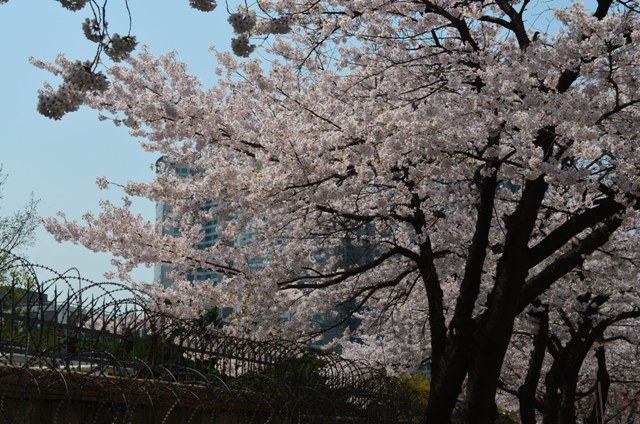
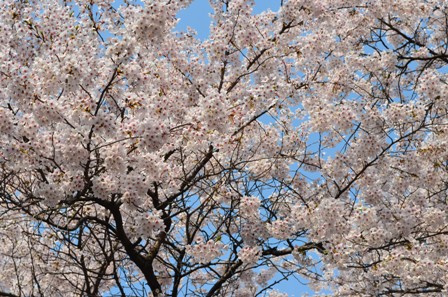
Springtime in Korea means many things. It means longer days, bright sunshine, an end to bitterly cold winters. And my favorite thing- the blossoming of Korean flowers. All throughout the countryside different flowers start to bloom beginning in March and continuing throughout spring. Among my favorite flowers are the numerous cherry blossoms that are spread throughout the city. This year I went to two different areas of Seoul to partake in the amazing beauty of the cherry blossom trees- Yongsan and Yeouido. What I love about Yongsan is the view of the urban landscape surrounding the area of the city broken up by bright, beautiful cherry trees lining the roadways.Image

I think this photos sums up the contradictions that is South Korea at the moment. It is a very beautiful country, with a rich history, fabulous temples and palaces and ancient ruins, gorgeous nature, mountain views and colorful trees and flowers. But it is also undeniable that just to the north lies their sister Korea, separated by the Demilitarized Zone since 1953 and technically still in a state of war, though there is an armistice in place (now whether or not North Korea REALLY abides by that now remains to be seen). The greater metropolitan area of Seoul is well within the range of North Korean long range artillery, and security is often in the back of your mind (particularly nowadays with North Korean rhetoric at a particular fever pitch). This picture juxtaposes the delicate, ephemeral beauty that is the Korean cherry blossoms against the cold, hard concertina wire designed to protect both military and civilian alike and provide security.

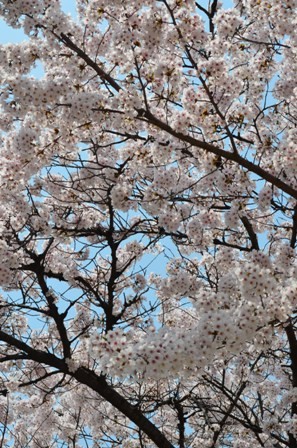
It’s hard not to delight in the innocent wonder of the massive amounts of cherry tree blossoms. I wanted to capture all the images to create paintings from them later.

Image

Cherry Blossoms Yongsan 2013

Image

Image

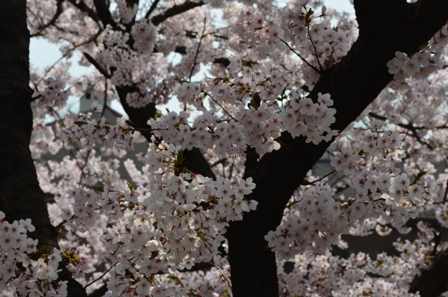
What I like about Yongsan is that it is comparatively empty. It’s easier to get up close and personal with the cherry trees in relative peace, quiet and solitude. For a different experience, I recommend attending the Yeouio Cherry Blossom Festival. Yeouido Island is another excellent location for cherry tree-lined streets in Seoul, just south of the Han River. In fact, part of the Hangang park runs along the northern area of Yeouido Island, and is an excellent area to enjoy a picnic, walk, run or bike along the Han River, and enjoy the gorgeous views of Seoul. Every year the Yeouido Cherry Blossom Festival is held-this year from 12-21 April 2013. The bulk of the festival is held around the road surrounding the National Assembly on Yeouido Island. It is easily reached by taking the Seoul subway, Line 9 to National Assembly stop. During the festival, the road is blocked off from traffic, which makes it easier for the thousands of visitors to enjoy the cherry trees, take pictures, enjoy musical performances and just relax with the sunny beauty of a Seoul springtime. This is a beautiful area, though it is definitely not for those who don’t particularly like crowds, since the festival is full of them.

me at Yeouido Cherry Blossom Festival 2013

ImageCherry Blossoms Yeouido sunny trees 2013

Image

You have to take advantage of the cherry blossom season, because it certainly isn’t long. Cherry trees blossoms last about 7-10 days and then they are gone. Already, the cherry trees are shedding, spreading their delicate petals in the wind like pink-white snowflakes along the sidewalks. Soon all the branches will be bare, and you must another year for spring.

Next year, I want to get farther afield to enjoy different cherry tree festivals, particularly the one held in Hwagae near Jirisan National Park. But if you live in Seoul and just want to see some cherry trees, it is very easy to do so without ever leaving the city.

The Artist’s Way- Week One

I’ve been wanting to expand upon my artistic creativity for a while. So I decided to purchase the book, “The Artist’s Way: A Spiritual Path to Higher Creativity.” The book has a 12 week program, and each week focuses on  a different aspect of your creativity. The book is targeted toward so-called “blocked artists”, where individuals want to be artistic and creative, but are blocked from pursuing their dreams due to some internal or external issues. Each work is supposed to be exercises targeting those blocks.

One exercise is morning pages. Each morning, the first thing you are supposed to is write down three pages of longhand. There are no guidelines on what you are supposed to write. It’s just supposed to be a sort of stream of consciousness of whatever comes to mind. There is no right way to do these, but the point of these writings are to get to these blocks, the ideas in your head that are holding you back from being artistic. In theory, these blocks emerge during the course of your writing, and you are supposed to counter those blocks with positive affirmations. These pages are also supposed to be a tool to unlock the creative parts of your brain.

The second aspect of the weekly exercises is artist dates. Again, there are no guidelines on what you want to do. It’s supposed to be a time for you to do whatever it is you want to do that inspires your creativity. It might be a long walk. It might be a visit to an art supply store. Maybe you go and create your own art. It’s supposed to be your time to just do something to inspire your artistic self.

The first week was focused on creating a sense of safety. The focus was supposed to be on bringing to light those negative viewpoints that are holding you back. It might be persons in your life that aren’t supportive of you pursuing your artistic dreams. Maybe people don’t believe in you. Maybe you don’t believe in you. The point was to list all of those blocks and affirmations to overcome them.

Overall, I found this week to not be overly taxing from an emotional standpoint. I personally don’t have unsupportive individuals in my life. My parents both believe I can do whatever I want, and I don’t have anybody else who has a negative opinion of my artistic ideas. My artistic block can be summed in one idea: I don’t know if I am good enough to make a living from art. My art IS getting better, though I could benefit from actual professional instruction. But who the hell knows if it is good enough to actually make any decent money from it? That’s why I’ve always viewed any potential art career as something more to do as a side project or something when I retire from my main career (assuming I make it that far in my career). Could I just go for an art career and give up my main career? My big block in that regard is I am not willing to be a starving artist. I don’t want to be poor, and I live in fear of being poor. Now granted, if I KNEW I would successful, I’d go for it, and work through any obstacles. But life and career don’t work that way. There are no guarantees in anything. I could be successful one day, or I could very easily not be. Am I willing to take the risk with no guarantee of reward? Right now, the answer is no.  So I’ve made a conscious decision to pursue a career field that pays pretty well, and the benefits are pretty good. Now let’s just see how long that can last. Until then, I can just continue to improve my artistic talent, so if I ever decide to pursue an artistic career, at least I’ll be ready for it.

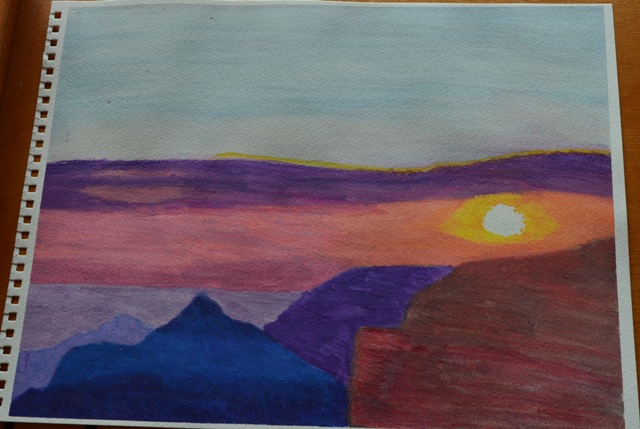
Grand Canyon North Cape Royal Sunset Painting

my painting of Grand Canyon Cape Royal sunset

I’ve been trying to get back into painting again. I’ve created art in fits and starts for most of my life. Like most kids, I enjoyed drawing and painting in art class just for fun. I dabbled a bit with watercolors in college, before getting frustrated with not making enough progress, and stopping. Then for a couple years, I discovered the beauty and portability of colored pencils. Colored pencils give me the control I like, but the artwork can be time consuming. And again I wasn’t making the progress I hoped, so I gave it up.

About a year and a half ago, I decided to take it up again. This time, I decided to go with a mixture of watercolor pencils and pastels. I like the combination both bring to create artwork. Watercolor pencils give you the control and precision of wax colored pencils, but they also can be used for the color diffusion of watercolor paints. I like to draw the painting out and then follow up with water to blend the colors. Pastels are a great way to render diffuse, bold color, particularly for landscape paintings.

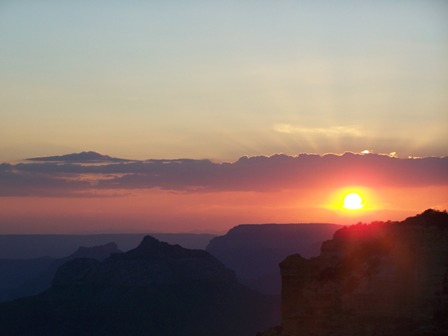
For this painting, I selected a reference photo of a sunset I took at Grand Canyon North at Cape Royal during my vacation there this past summer (see below). I felt it was a good picture to start with. I found it very beautiful, with bright colors- just like the paintings I want to create, and the paintings I appreciate as a collector. Plus, I felt it would be relatively easy to render, since sunsets seem to be easier.

What I will say about this painting is that- it’s not BAD for a first effort after months of not painting. It certainly could be worse. I’ve done better sunsets in the past, but something about this painting just didn’t work for me. Maybe it would have been better to render it in pastel, as watercolor sort of seemed to blend all the colors into one big patch, rather than the separate, distinct colorful clouds and sun from the reference photo. Or I should have been more disciplined in the drawing of the clouds. And the use of watercolor for the canyons just didn’t really come out like I hoped. The distant shadows were okay, but the closer canyons weren’t really distinct or detailed. Again, pastels might have been a better choice to render the shadows of the stones and the vegetation of the canyons.

When I first took the painting in after I decided I was finished, I was rather disappointed. I had this image in my head of how I would be able to correctly recreate the reference photo as a painting. While the painting captured the general use of color from the photo, the overall effect was flat. There was no dimensional shadowing or distinct clouds. There was no depth or real artistry.

But as what usually happens, the more time passed and the more I could take it in, I started to appreciate it more. Sure, it wasn’t what I envisioned in my head. But there is a colorful beauty there, and not all artwork must be 100% representational to be enjoyed. Think of it like a first draft of a writer’s novel. It may not be what I want it to be right now, but nobody starts out being a really good artist. It takes work, lots and lots of work to become a quality artist. Inevitably in that work journey, there will be efforts that don’t exactly thrill you, but still can teach you something, and you can still take away something from the creation to make future work better. I have to constantly fight against the internal voice that tells me if I am not instantly good at something, it isn’t worth working harder to become better at it. So while this painting is not what I hoped it would be, it’s representative of a first step toward becoming a better (maybe one day, professional) artist.

Below is the reference photo I took of the sunset. I visited Grand Canyon North in August 2011. This was my first night in the area, and I drove out to Cape Royal, because I knew the sunsets were supposed to be amazing. It was very peaceful to sit out at the viewpoint and watch the sun melt into a variety of blazing colors and paint itself across the canyons. It’s times like these on vacations when I am reminded again and again how much beauty there really is in this world, and it is this beauty that inspires me to be an artist.
Grand Canyon Cape Royal sunset

Seoul Museum of Art- Tim Burton Exhibit

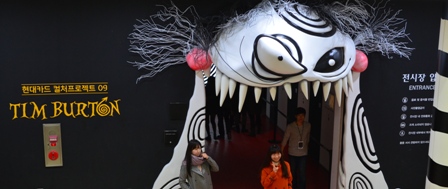
Tim Burton Exhibit entrance

Last weekend I visited the Tim Burton exhibit at the Seoul Museum of Art. The exhibit itself has been around for a few years, starting at the Museum of Modern Art in New York City. It’s now been on a traveling exhibition, and Seoul is the only stop in Asia. I always liked most of Tim Burton’s movies, so I figured it would be an interesting art exhibition, and was it ever. The exhibit covered artwork he created from his childhood all the way up to his current movies. Artifacts included in the exhibition were childhood paintings, drawings from his movies, models from his movies, and essentially anything that inspired him to create the art and movies he has over the years.

Tim Burton Romeo and Juliet sign

Tim Burton Exhibit 2nd floor

The exhibit was broken up into three areas covering his childhood artwork, his work as an animator for Burbank Studios, and his work as a director and producer of movies that are now deemed “Burtonesque”. It was interesting to see the evolution of his work and the maturation of his creative process. It was also interesting to see what sorts of things inspired him to paint on his own. When he was younger, he seemed to have a real love of freaky clowns, aliens and very large breasted women (but don’t most heterosexual men?)  It struck me just how many different sort of art styles exist out there among all the artists of the world for the past several hundred years. I like to frequent art museums of all genres and eras, but I can’t help but marvel at the more modern forms of expression, particularly the more expressionistic and surrealistic styles of artists like Tim Burton. Artists of the Renaissance, baroque and even Impressionism to a large degree, tried to recreate the world as they saw it, or at least a more representational view of their subjects. But 20th century painting styles and beyond have also incorporated very different styles where artists are not just looking to make art that looks realistic, but capture the strange images in their imagination.

I too like to create art in my spare time, and lately I’ve been getting back into pastel and watercolor pencils to improve my technique. I tend to favor more landscapes and pictures with bright colors. Most of the work I do are from reference photos I take on my travels. So I tend to try and be as reasonably representative as possible when I recreate these images as paintings. That’s the kind of art that comes natural for me to make. But I have to admit to a twinge of jealousy when I see artists like Tim Burton (and others) who create art from their sheer imagination. They aren’t looking to recreate reality exactly, but rather create their own version of reality or bring their imagination to life. I can only imagine what sorts of things go on in these artists’ heads and what drives them to see the world the way they do and create the art they do. I enjoy being being transported into the fantasy worlds they create, and it was very easy to get lost in the different worlds Tim Burton has created over the years through his art and his movies.

As you walk through the exhibit, you get a real feel for what something means when it is called “Burtonesque.”  Tim has several motifs and styles he likes to use in many of his artwork. Examples include stripes and swirls and the strange, almost grotesque shapes of his animated creatures. Particularly with his later, more mature work, it is easy to look at a piece of art and know immediately Tim Burton was the person who created it.

Tim Burton Nightmare Before Christmas paintings

Nightmare Before Christmas drawing

Nightmare Before Christmas series drawings

Tim Burton models

Now, no art museum exhibit would be complete without a visit to the merchandise store, and Tim Burton’s exhibit was no exception. Among the magnets, prints, postcards and the like available for purchase, was the comprehensive Tim Burton art book. And this book doesn’t screw around. I feel you absolutely get your money’s worth with this purchase. It is a huge book, both in size dimensions and number of pages. It includes over 400 pages filled with his artwork over the years. It’s makes a great doorstop :), but more than that, I bought it to sort of serve as inspiration to make future artwork. I can look through all the pages and see what Tim Burton has created over the years through the sheer force of his imagination, and appreciate it whenever I want. I can also use his work to inspire me to further my own artistic abilities. Maybe one day I’ll get to the point where I can create the art that goes through my head rather than just what I see in a photograph in front of me.

Tim Burton merchandise

Morning Calm Arboretum Lighting Festival

Morning Calm Arboretum Sunken Garden wide view


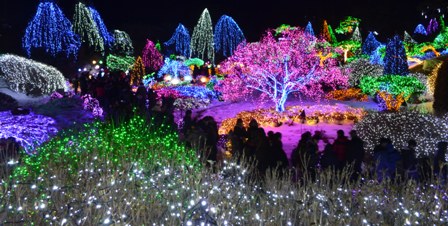
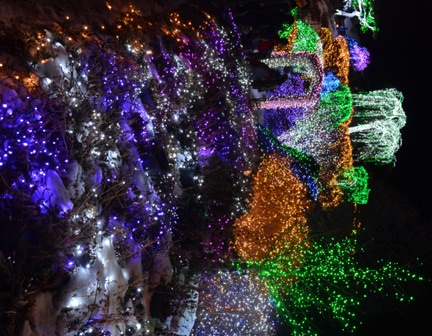
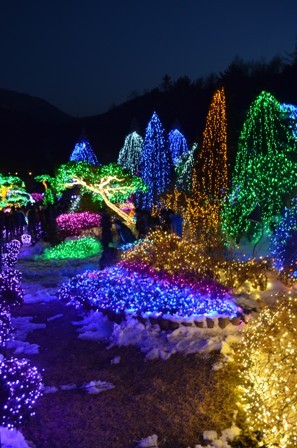
What’s a public garden in a cold climate supposed to do in the winter? Sure, you can stay open all year around, but for the most part, the beautiful flowers people like to see at gardens are hibernating for the winter. Of course gardens can also close, and some of them do, until spring when new flowers bloom. Or gardens can take the step that the Morning Calm Arboretum in Korea does and host a lighting festival. Sure the garden is open during the day and you can walk around the gardens and take in the snow-covered views. But the real action starts when the sun sets, and the garden comes alive with all the lights. Shrubs and trees are covered in all shades of colored lights imaginable.

Morning Calm Arboretum beautiful lights of Sunken Garden

Morning Calm Arboretum Hometown Garden beautiful lights

All of a sudden, you are transported into a fantasy world, albeit a crowded fantasy world filled with many, many people jockeying for position to take the best photos. While beautiful, this is definitely not the place to come if you want peaceful solitude, where you can just sit back and take in the view. Or I should say, you can’t really contemplate the view from any viewpoint that attracts a lot of people. Everyone is impatient for their turn to take pictures ( I know I was), so you take the pictures you can, take in the view from the viewpoints for a couple minutes and then just walk around and enjoy the lights and block out the people (if that is your thing like it is mine). When I was focused on just seeing the lights and not worried about taking pictures, time just sort of slowed down and it was more about enjoying the moment and experience for what it was.  The Sunken Garden is the main attraction, where most of the lights are located. But there are also three other lighted areas: the Hometown Garden, the Bonsai Garden, and the Road to Heaven pathway.

Morning Calm Arboretum night lights in snow

The Morning Calm Arboretum Lighting Festival takes place every year from approximately early December to early March. During the lighting festival weekends, the garden is open until 2100. The earliest sun will set is around 1730 near winter solstice and gets progressively later as time goes on. When I was there this past Saturday, sun set around 1815 and the lights came on right around that time.

me with Morning Calm Arboretum Sunken Garden view

Getting to the Morning Calm Arboretum is a bit time consuming, but still pretty straightforward. Since I don’t want to drive in Korea, I elected to take public transportation. I took the Metro and a bus all the way there. In Seoul, take a train to Sangbong station, which is a stop on the Metro Line#7 or the Jugang Line. Transfer to the Gyunchen Line subway headed toward Chuncheon. An alternate means is to take an ITX train from Yongsan, Cheongnyangi, or Sangbong (among other stations) headed toward Chuncheon. The ITX train is undoubtedly quicker, and just slightly more expensive. It however doesn’t run quite as frequently as the Metro. Either way, you will exit the train at the Cheongpyeong Station. From there, go around the back of the train station to catch a bus. There is a shuttle bus that runs from Gapyeong Terminal to the Morning Calm Arboretum on regular intervals throughout the day. The shuttle bus will stop at key tourist sites, such as Nami Island, Petit France and Morning Calm Arboretum. An all day bus ticket with cost 5,000 won per person. The ride from Cheongpyeong Station to Morning Calm Arboretum is approximately 30 minutes. Ticket prices for the Lighting Festival is 8,000 won per adult. A note if you take the shuttle bus there. The last bus is scheduled to leave from the arboretum at 2000, and keep in mind there will be a line of people headed back to the train station.  So keep that in mind if you want to sit down for the 30 minute ride back to the train station. Taxis will also be available, though there is also a  line for them as well. Travel time from central Seoul to Cheongpyeong Station is approximately two hours each way.

More information for the Morning Calm Arboretum can be found at their website: http://morningcalm.co.kr/

The website is in both English and Korean. The Morning Calm Arboretum is open year round, the views change throughout the year thanks to the changing seasons.