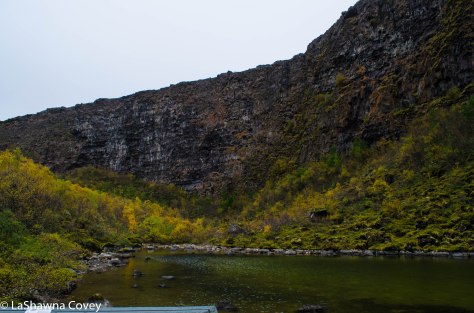
As I’ve written in many other blog posts, there is so much beautiful nature in Iceland. It’s like an embarrassment of riches if you love nature, and the sheer diversity packed on that small island, means you get major bang for your buck during a visit to Iceland.
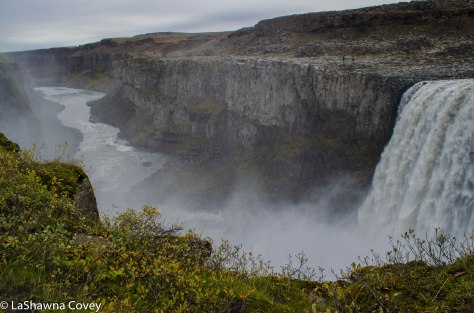
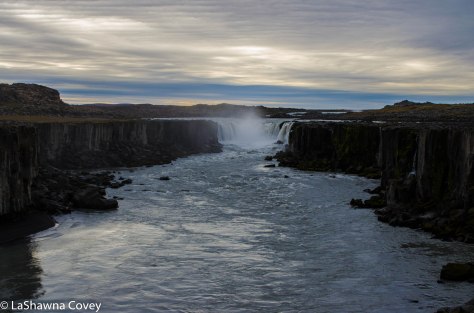
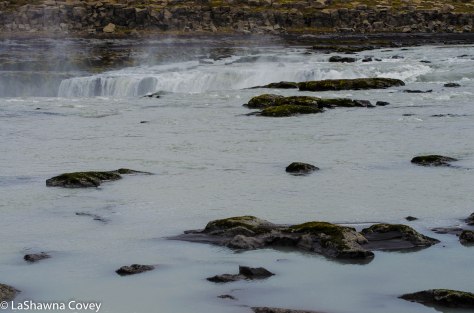
I’ve talked about other major waterfalls previously, such as Dynjandi and Dettifoss, but there are so, so many other waterfalls. Many of them are super famous for visitors in the first place, and many of them are easily accessible, just off a major road (so they are catnip for tour groups). Of course there are some other beautiful waterfalls I wanted to see, but either didn’t have the time to hike to them, or the type of car I needed to get to them. But there are enough diversity of waterfalls and ease of access, that you can satiate any thirst for waterfalls. I know I got my fill while I was there, and I can never visit too many waterfalls.
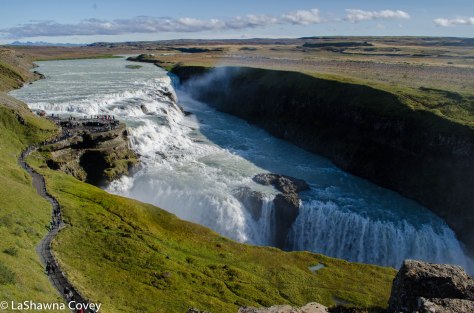
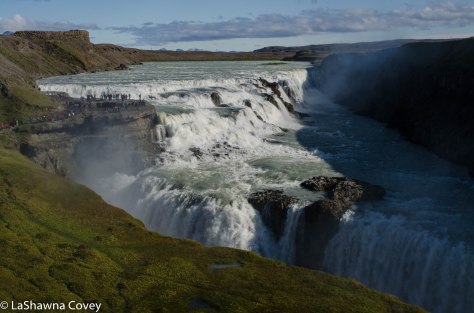
On our very first day in Iceland, literally just a few hours off an overnight flight to Iceland, we were standing at the edge of probably one of the most famous waterfalls in Iceland, which is Gulfoss. It’s not necessarily the best waterfall in Iceland (though I don’t know how you would determine which waterfall is “best”), and it’s not the biggest, but it is the most famous. Gulfoss is one stop on the super popular “Golden Circle” day tour of different sites around West Iceland (the other stops being Geysir, Pingvellir and usually a geothermal power plant). I daresay that the vast, vast majority of tourists to Iceland will see Gulfoss, either on an organized tour bus group or on an independent tour.
Most visitors probably don’t venture very far outside of the Reykjavik daytripper radius, so it is easy for tourists to take bus tours to see sites outside of Reykjavik, but not that far outside of Reykjavik. On my first trip to Iceland, I did the Golden Circle day trip, because it was just easier, and I hadn’t decided to rent a car to travel around Iceland at that point.
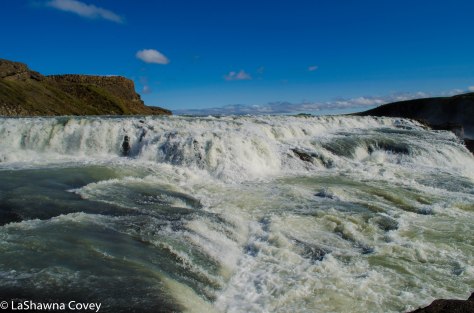
But planning this tour, I knew we would rent a car for a couple weeks, and would avoid Reykjavik altogether, simply to maximize time in the outer sites. But even though both my mother and I had been to Gulfoss, I wanted to see it again. Since both of our visits to Iceland were in the winter, we wanted to see the waterfall in warmer weather. A winter visit was really nice, because the surrounding area was covered in snow and ice, but the ice also meant that the trail to get closer to the waterfall was closed, but this time, we would be able to get up close and personal with the waterfall.
If you want to do your own self drive Golden Circle, it is super easy to do, since all the sites are located within a reasonable drive of each other, and all sites are well marked. That is one of the many nice things about driving in Iceland. Once you get outside of the Reykjavik metro area, there are usually only a few roads, and everything is well marked, so it is so easy to drive and not get lost.
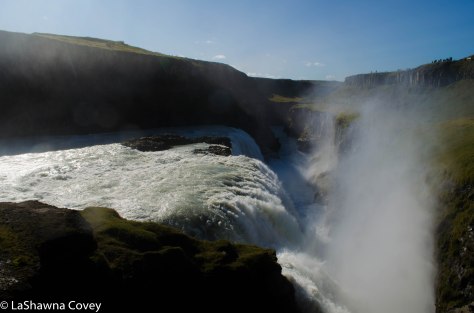
Since Gulfoss is super popular, you are guaranteed plenty of crowds when you visit (unless you visit really early or really late in the day). The waterfall is an odd and interesting setup, which only adds to the beauty of the site before you. You can view the waterfall from an overlook to get a wide expanse view of the falls and the canyon. The falls aren’t just one single falls, but rather multiple level falls. You can also hike down some stairs and a path down to stand right on the edge of some of the falls. The amount of water pouring through the canyon throws up a lot of mist that can obscure the canyon view, only to be exposed when the wind picks up.
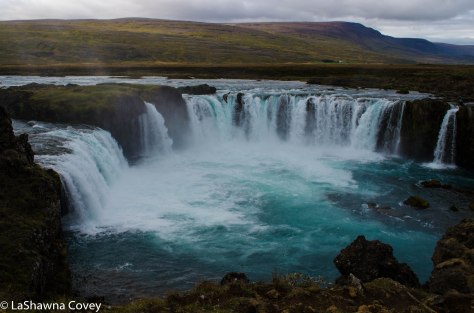
Another beautiful falls that is easily accessible is Godafoss, which is a nice, horseshoe-shaped falls that is located just off the Ring Road east of Akureyri on the way to Myvatn. This falls can be seen from the road, and there are two viewpoints on either side of the falls. Both sides provides a bit different view of the falls and the river, so it is worth it to stop at both viewpoints if you have the time. You can either drive the short distance between each waterfall side, or walk the easy path and bridge over the river.

Both viewpoints require a tiny bit of scrambling over rocks, but it’s not that difficult if you are careful. Like all of the waterfalls in Iceland, there aren’t any guardrails. So it is incumbent upon visitors to be careful and not do stupid stuff that might result in them falling off high cliffs.
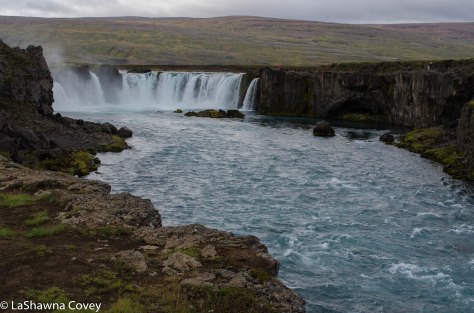
The view of Godafoss from up close and personal and from farther down the river are really nice, and provide many picture worthy settings. Godafoss is also worth your time. You are liable to see some tour buses at this site, but since you see far fewer tour buses outside of Reykjavik, it doesn’t overwhelm visitors trying to push their way through crowds for a good view.
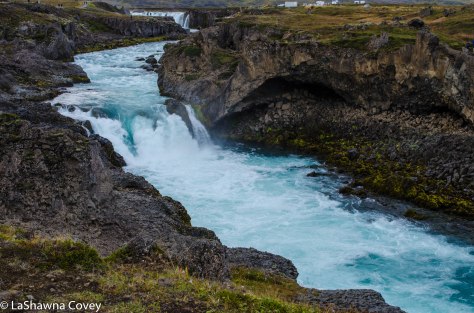
The next set of waterfalls I want to talk about don’t have any individual names (that I know of), but if you have time, they are absolutely worth your time. And I don’t think this site is really popular, so you have to know about it in advance (though it is known enough, that you won’t be on your own when you visit).
If you happen to be in South Iceland (and chances are, you will spend some time in South Iceland, either on your own or as a tour group), I would recommend making the time to visit Fjardargljufur, which is a picturesque, twisty, somewhat narrow canyon that houses some nice waterfalls.
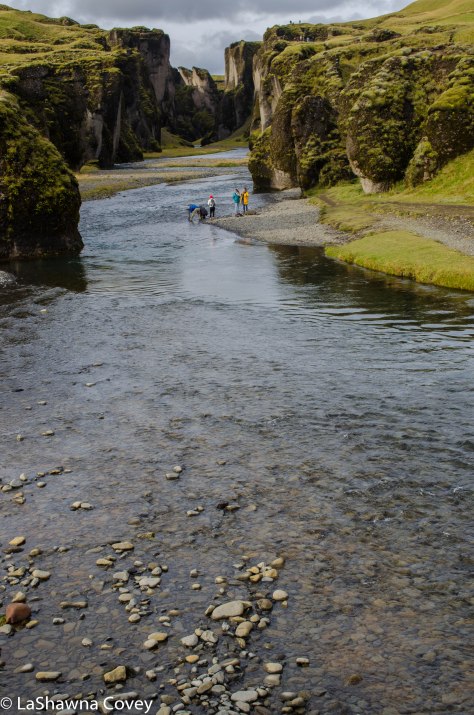
Reaching the car park for the canyon is rather easy. It is on Route 206, off the Ring Road, east of the town of Kirkjubaejarklaustur. Like all routes in Iceland, it is well marked with a sign. The road to the car park is about 3.5 kilometers down a rutted, bumpy road. But by this point in our Iceland vacation, I was wearily used to bumpy gravel roads, so I just slowed down and knew I would get there.
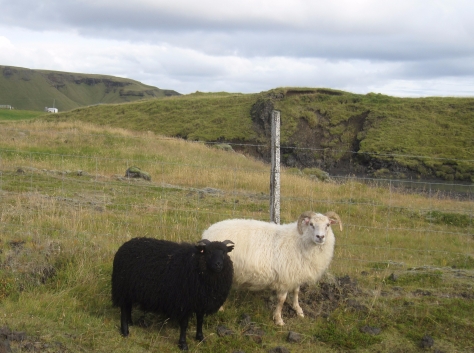
On the road, we finally got to see one of the things we had been hoping to see up close in Iceland, and that was a black sheep. Even though most of the sheep in Iceland are white, there are occasional sights of black sheep and mixed black and white sheep, but most of them were always off in the distance. The few times we had tried to approach a group with black sheep, they always ran away, because they seem so shy. But finally, we saw a white and black sheep just hanging out together just off by the side of the road. Here was our chance to photograph a black sheep. I was hoping to get a good photo, but by the time I got out of the car and got my camera out, they were running away like little sheep teases. However, my mother just had to roll down the car window and was able to snap a nice picture of the cute little sheep couple.
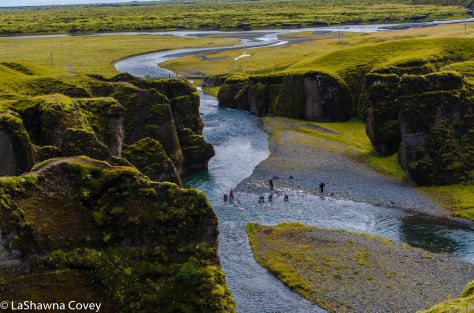
We knew we were at the car park, because we saw the long line of cars down the side of the road. Amazingly since this is not a hugely popular site, there is a nice bathroom right at the trailhead. The canyon is only about two kilometers out, the walk is very nice. The path is very well maintained, though there are some hills since it follows the topography of the surrounding canyon.
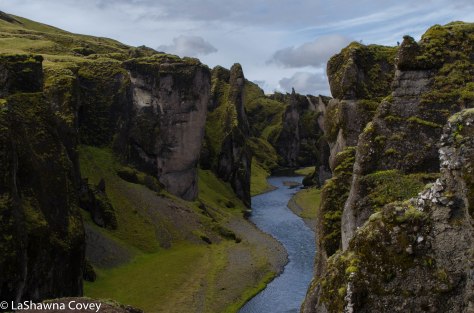
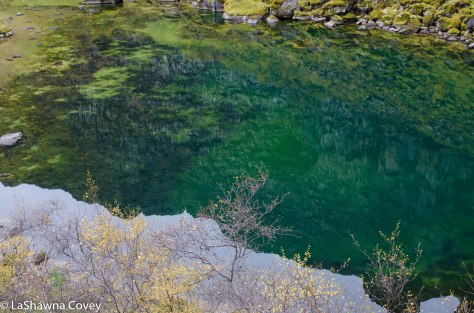
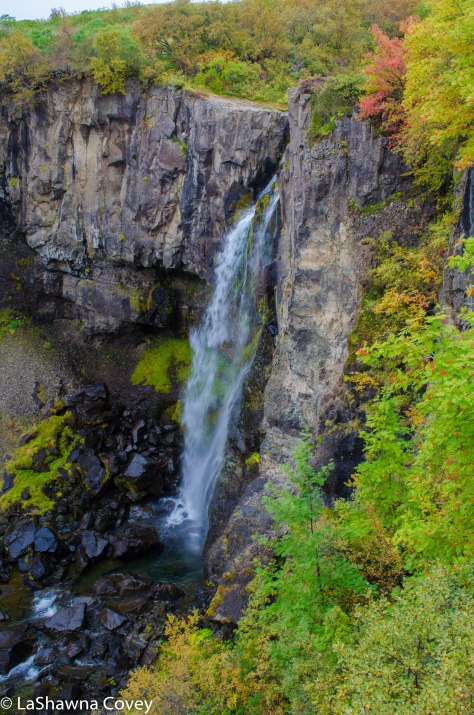
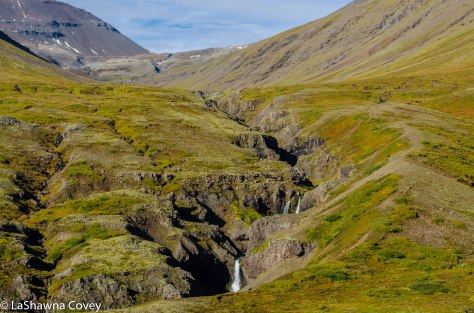
The trail is along the top of the canyon, and there are numerous viewpoints along the way that provide beautiful looks down into the canyon. The canyon walls were covered in moss, with a nice river flowing through it. My favorite views were the couple waterfalls, that were nice shapes and provided a different view of the canyon.
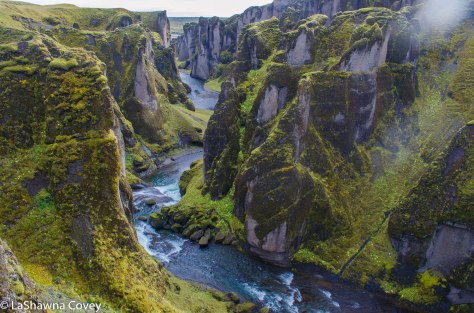
Again, I highly recommend a stop at Fjardargljufur if you have the time. The walk is short and pretty easy, and a good excuse to get out of the car and stretch your legs. The canyon is a bit different than other places we visited in Iceland, and is almost like a glimpse into Middle Earth.

The last two waterfalls I will mention are two rather popular waterfalls, and extremely accessible, as in they are both viewable from the Ring Road. And since both of these waterfalls are found in Southwest Iceland, well within the Reykjavik tourist radius, you can count on seeing hordes of tour buses and rental cars. Which is fine. Just know before you go.
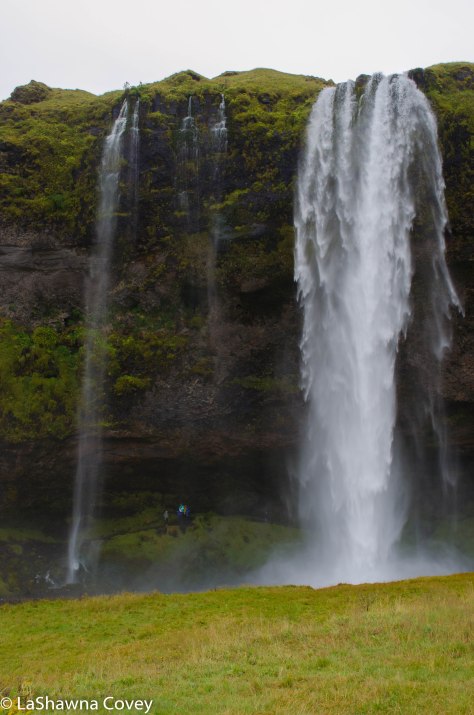
Both of these waterfalls are a short drive between each other, so you can easily see them in one day. And to make it even nicer, both of these waterfalls look different and provide different views, so stopping at both waterfalls provides different viewing pleasures and don’t feel redundant.
Seljalandsfoss is a long, thin waterfall located not far from Porsmork, so it is often a quick stop for Porsmork day tours. In fact, that is where we picked up our tour group, since we were coming from South Iceland. This waterfall must be popular enough to justify paid parking. It is only the second place I have seen paid parking (Skaftafell National Park being the other).
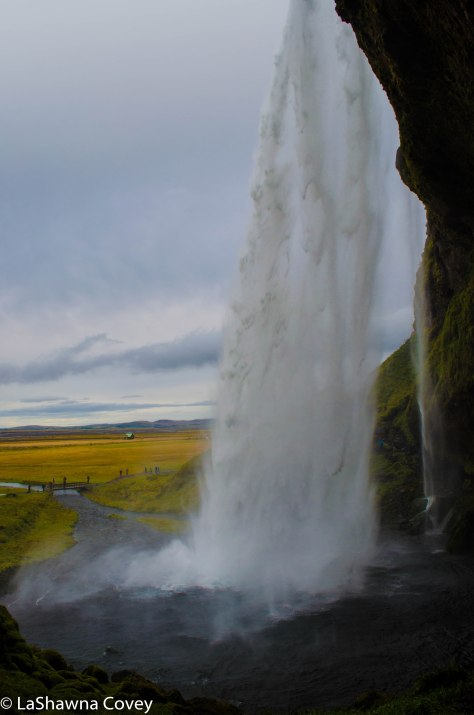
The view of the waterfall from a short distance is nice, but you also have the opportunity of walking around the waterfall and seeing the view from the back. Most people approach the back side of the waterfall from the right side, and from here, the waterfall mist will likely blow into your face if it is windy. Once you get behind the waterfall, the view of the falls is beautiful and the curtain of water adds the scenery. I made the mistake of following the path around the waterfall, instead of turning back from whence I came. The path from the right side is wet, but it is all rock. However, if you follow the trail behind the waterfall to emerge at the left side, you will find that the path is very muddy, slippery. I managed to scramble up the rocks, but I ended up with wet muddy boots and muddy clothes (thankfully you can wash yourself off in the river).
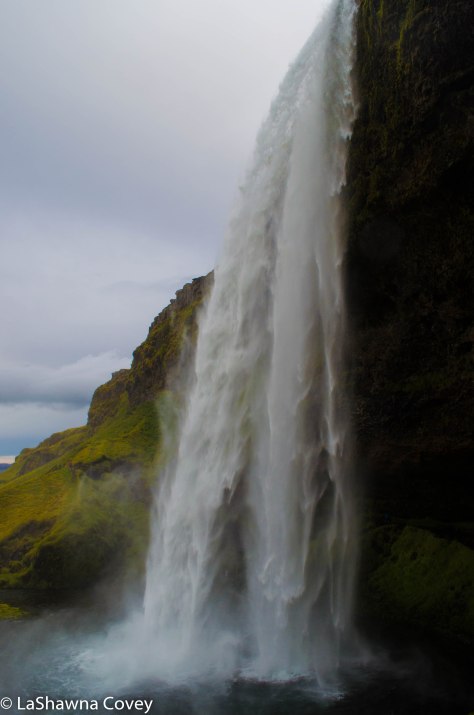
The last waterfall, Skogafoss is just down the road from Seljalandsfoss. This waterfall is a different look, because it is a wider, more traditional looking waterfall. There is a big parking lot and an easy path to the bottom of the waterfall. You can walk right to the edge of the pool, though expect to be showered in waterfall spray. The day we visited the waterfall, the weather forecast was supposed to be a nice, sunny day (and it ended up being that way in the end), but for the brief time we were at the waterfall, the sky just opened up and dumped down on us.
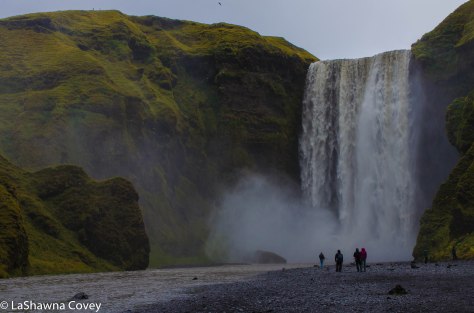
The nice thing about the rain is that it cleared out most of the tourists, including my mother who high tailed it back to the car. But since I was there and outfitted in a good rain jacket, I was determined to get some pictures from the top viewpoint. You can get a nice view of the top of the waterfall and the surrounding countryside by ascending the very steep set of staircases. Skogafoss is 62 meters tall, so it is not an insignificant distance, and you really feel it ascending to the top. The stairs are really nice and easy to ascend, but the sheer steepness required me to stop a few times and catch my breath. But keep at it, and you will get to the top eventually.
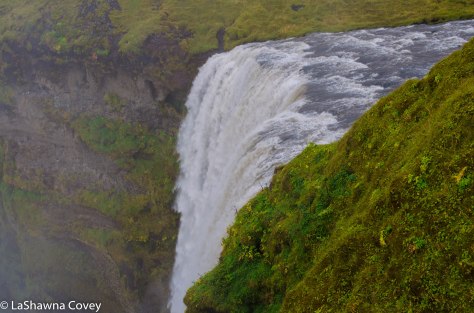
The view was good, even with the cloudy weather, since the rain had stopped by this point and the sky was brightening up. If you wanted, you could continue hiking from the top of Skogafoss to Porsmork, which is about a 23.5 kilometer trail. I elected not to do that, but the option is there if you so desire.
Like I said before, Iceland is an amazing wonderland of all sorts of nature, and if you love waterfalls in general, you will be in ecstasy while visiting this country. I wish I had been able to see a couple more waterfalls, but what I did was more than enough to keep me satisfied for a while.







 There are many, many options for the smaller group tours, though it will require some research. After careful selection, I chose the
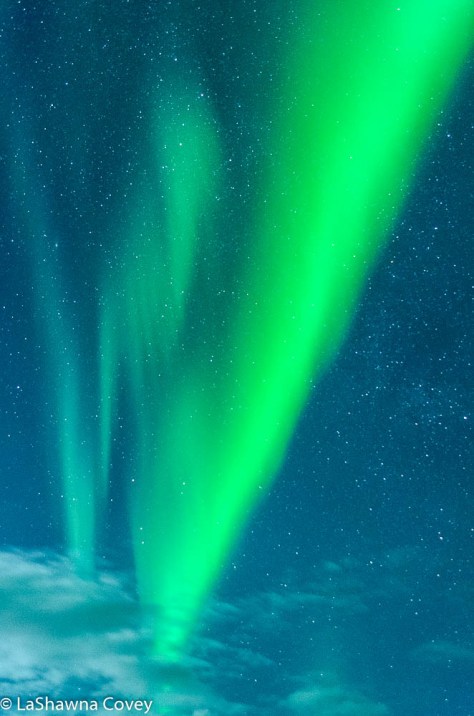

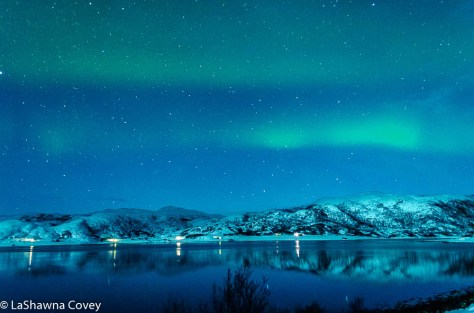
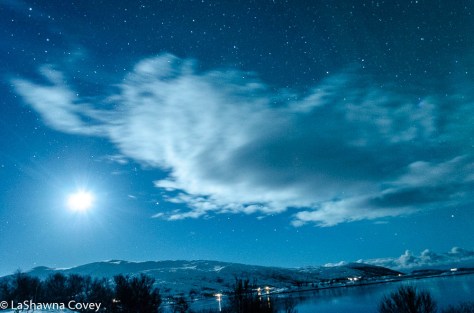
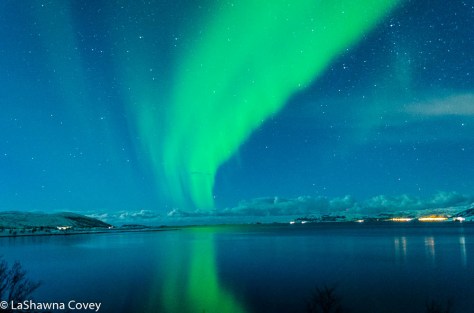


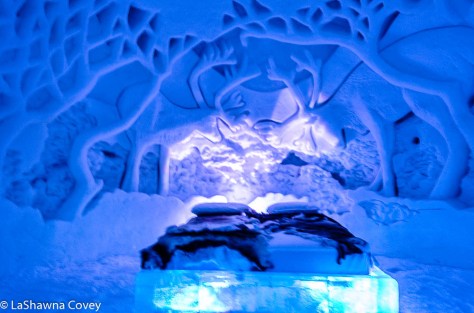
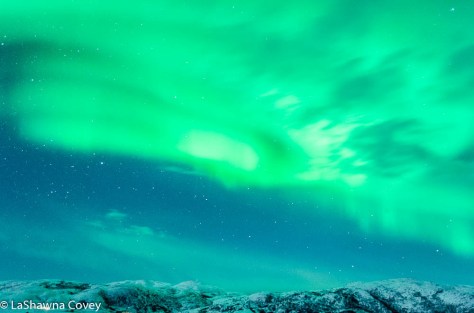
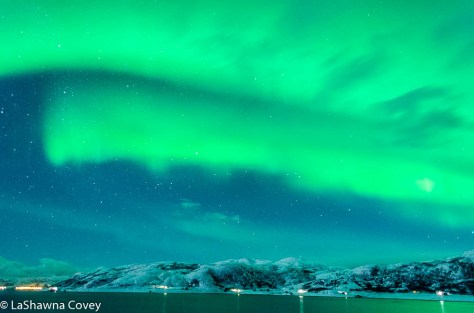
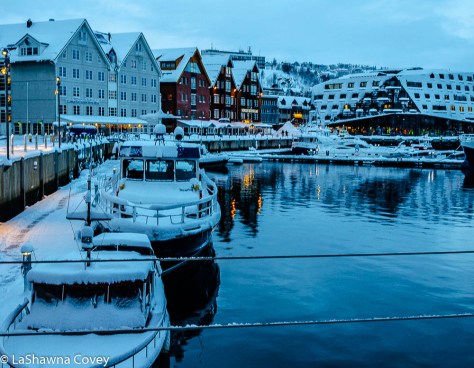
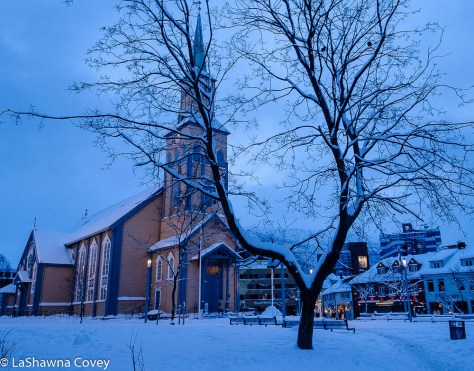 So of course I wanted to experience its opposite in Polar Night. I personally love darkness, and embrace the cold and long, dark nights of winter. I honestly can’t get enough of it, and it disappoints me greatly being in a place where there are mild winters. Of course even if the temperature was warmer than I liked, I still had hours and hours of darkness to cuddle in and enjoy. But it wasn’t enough for me. I wanted to know what it was really like to visit a place where the sun never rose.


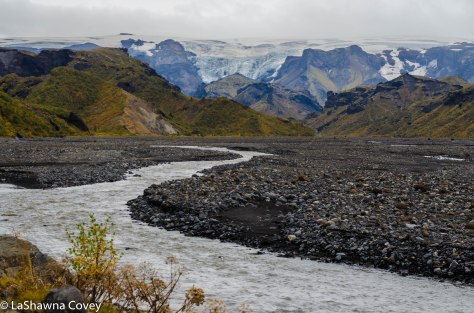
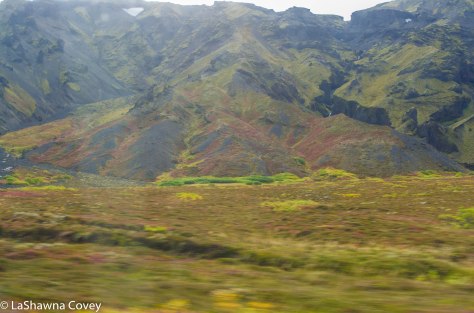


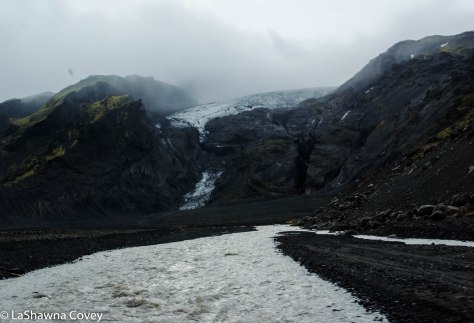
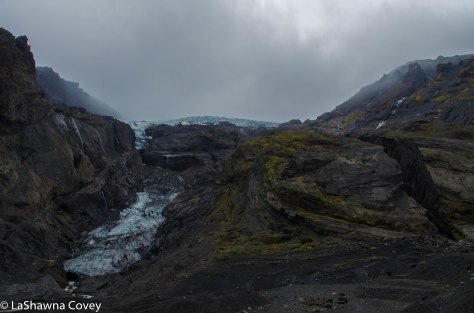

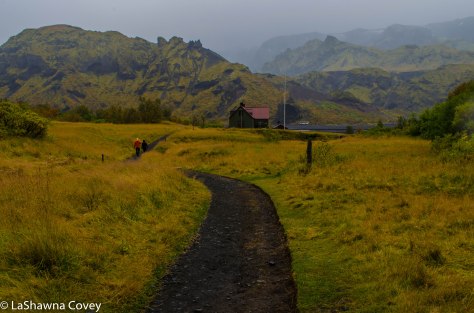
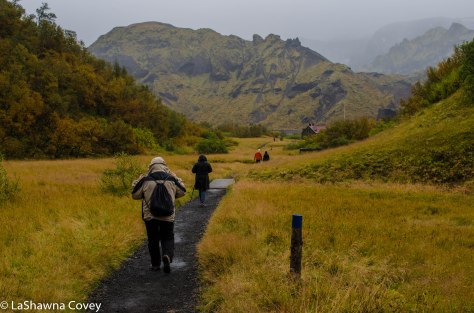
 So instead, we drove out to Husadalur (Volcano Huts Porsmork), which is a terminus to the multi-day Laugavegurinn hike. It has a nice hut tucked into the forest, but is also near one of the many rivers in Porsmork and affords a beautiful view of the surrounding mountains.





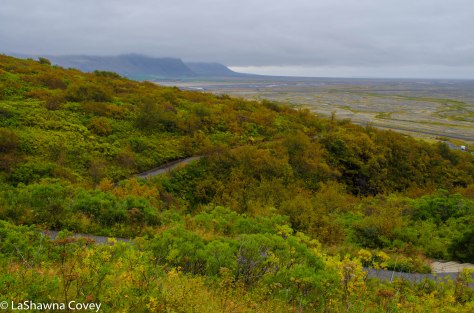


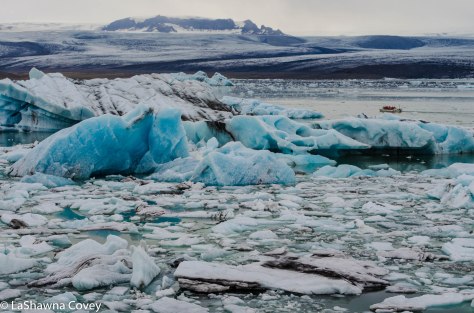
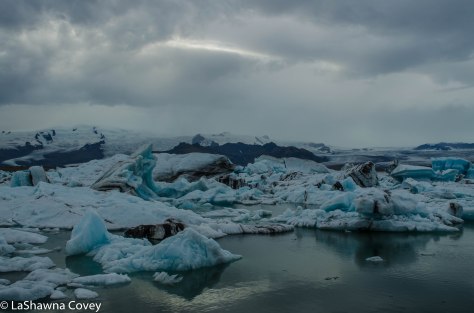

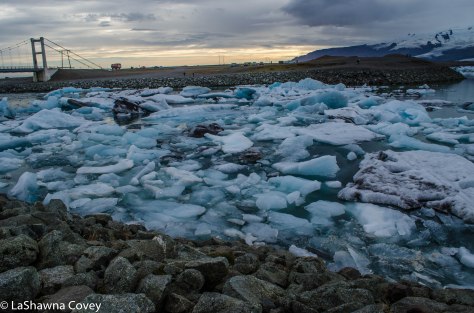
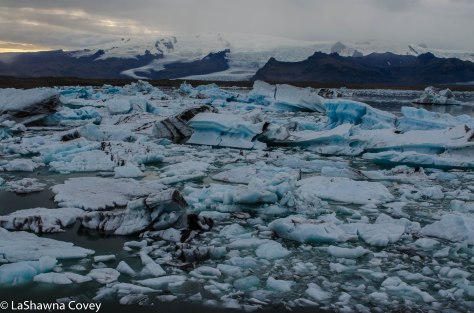

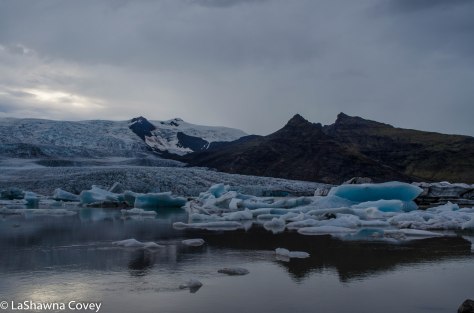
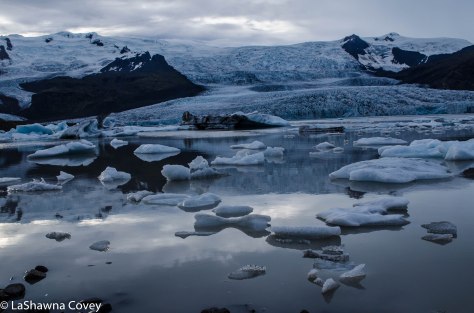
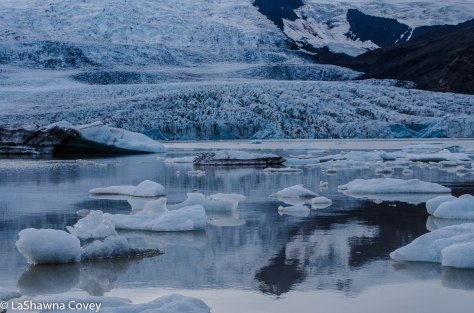
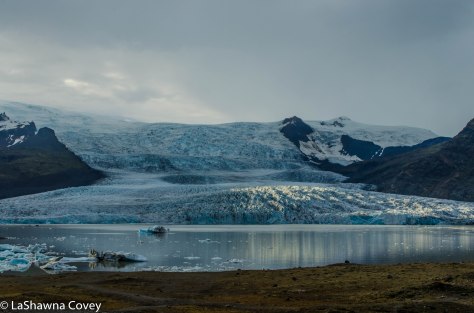
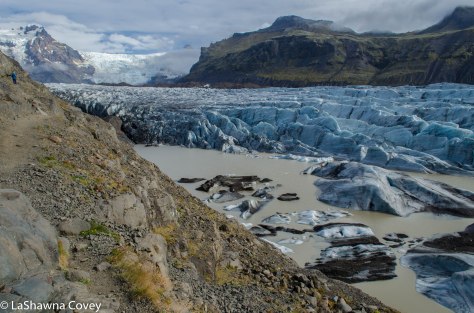
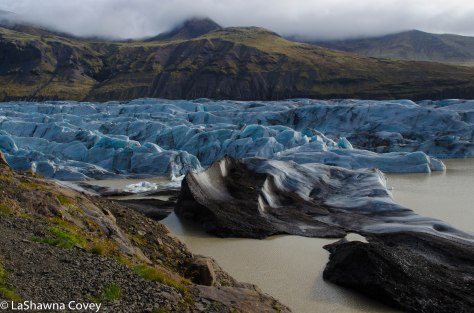
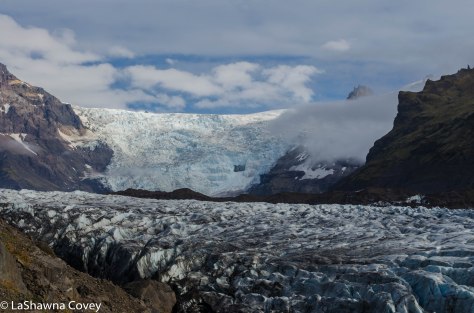 It is remarkable that in so many other parts of the world, glaciers are considered these exotic things, farflung from civilizations and hard to access, but in Iceland, they are literally just down the road and easily accessible for all to see.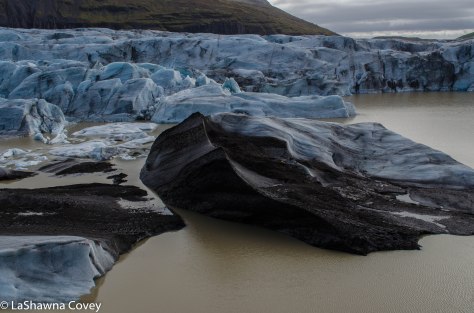
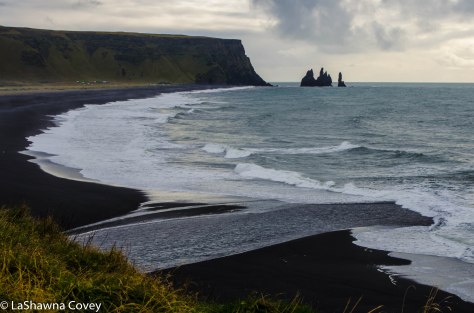




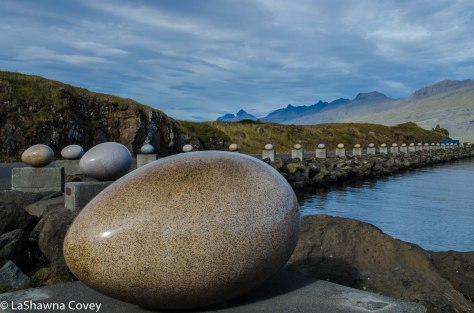
 The farthest south you will see most daytrippers from Reykjavik is the town of Vik, which is on the western side of south Iceland. Among the numerous natural pleasures in the area or within short driving distance (which I will cover in future blog posts), one of the nicest (and therefore most popular) are the sites of Dyrholaey and Reynisfjara. They are two distinct areas, but you can see one from the other.
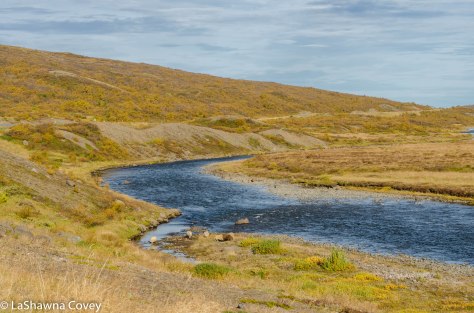
 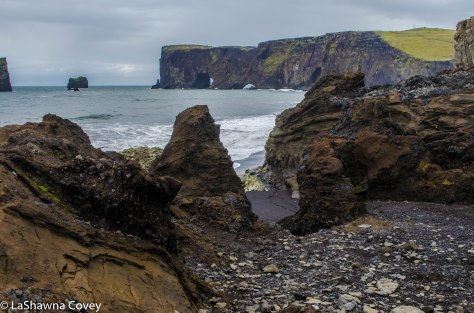 The first place we stopped was Dyrholaey, which is a beautiful rock formation, sea arch, and black sand beach. During nesting season, it is also home to a variety of birds (we visited out of bird nesting season). One of the viewpoints at Dyrholaey overlooks the western side of Reynisfjara black sand beach. From this viewpoint, you can see the sea stacks of Reynisdrangur. However, what captured my eye was the freshwater river that originated somewhere farther inland, most likely from one of the many, many glaciers in the area that flowed into the sea. I wanted to get close to it and see it for myself, but there is no easy way to walk down to the beach from the viewpoint.
  At another vantage point, you can also see the sea arch off in the distance and a beautiful black sand beach down below. I remember this beach from my winter trip, because at the time I visited, it was covered in pure, virgin snow (except for a step of footprints), and I was entranced with the contrast between the pure white of the snow and the pure black of the sand. This time however, we weren’t supposed to go down to the beach, because it was closed.
 After that, we drove a short ways down the road to Reynisfjara. While Dyrholaey is popular with tourists, Reynisfjara is another thing altogether. Hordes of tourist buses regularly show up and discharge their passengers for a short walk around the beach with a chance to look at a basalt sea cave, and a closer look at the sea stacks.
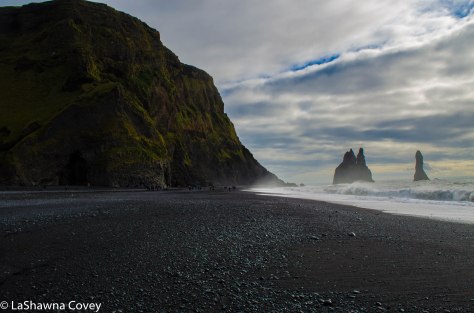 It is a very beautiful site, but as you see from the warning signs before you walk onto the beach, and what is apparent from just observing the beach for a few minutes, it can also be a very dangerous beach. This beach is notorious for sneaker waves, which are very powerful waves that can easily knock someone down or pull them out to sea. The occasional tourist death happens at this beach when people don’t respect the power of the ocean. The ocean is not placid at this beach, but rather filled with reasonably large, powerful swells, along with some powerful ocean currents.
  This beach is also a good reminder that while Iceland has many, many beautiful beaches, this country is not what you would consider a “beach destination.” I mean beach destination in the sense that you would want to hang out on the beach all day and frolic in the water, even on beaches where the sea doesn’t rage as much. The ocean is simply too cold to swim or play in at all, even in the summertime (it doesn’t get that hot in Iceland in the summer). So beaches here are great to visit and enjoy the seascapes and beautiful nature, but not to play in the water.
 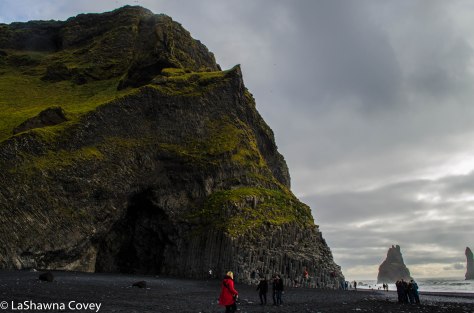 From the entrance point to Reynisfjara from the parking lot, we could see the cliffs of Dyrholaey off in the distance, and it didn’t look TOO far away (though it proved to be around a couple miles). So we just started ambling down the beach, first to get away from the hordes of tourists mucking up the background of our photos, and then later just to see how far we could get. I was hoping to get close to the glacier river I saw at the Dyrholaey viewpoint, and eventually we found ourselves at the banks of that river. After taking in the view, we turned around and made our long way back to the parking lot.
 There are so many beautiful things to see and do in South Iceland, that I can’t do it proper justice in one blog post, but I have a few others coming up that highlight all there is to see and do in the area. Even though you do see daytrippers coming down on a tourist bus, that way is simply too superficial to really see everything. I would highly recommend you rent a car and see this area at your own pace. Just know that you will be one of many, many tourists taking it all in.